

O-Glycosyl Donors
3.4
599
2.9.3 In Situ Double Differential Glycosylations of Two Donors with One Acceptor
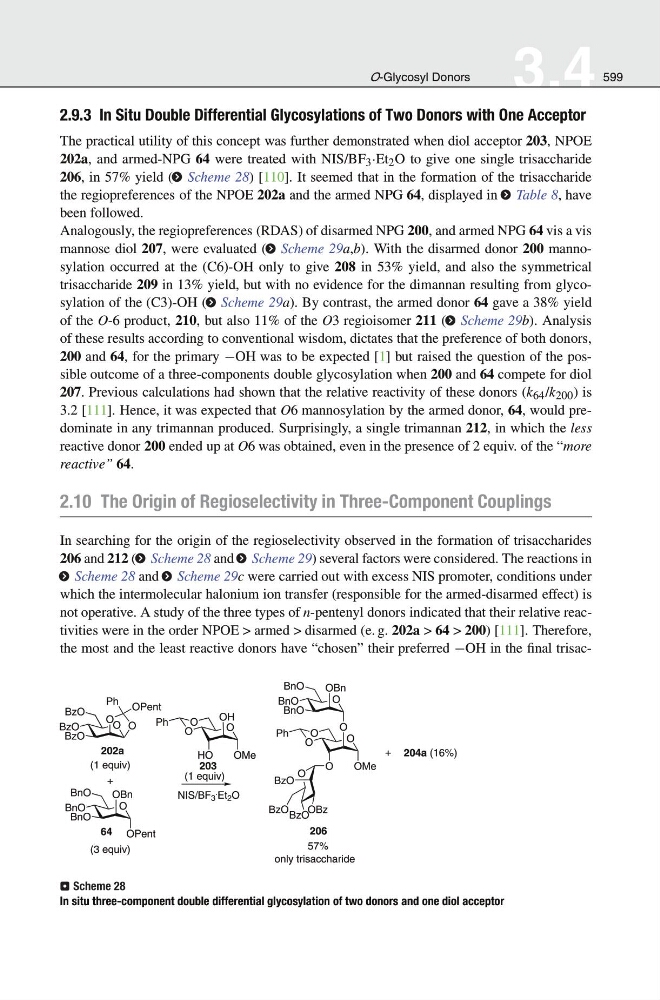
The practical utility of this concept was further demonstrated when diol acceptor 203, NPOE
202a, and armed-NPG 64 were treated with NIS/BF 3 ·Et 2 O to give one single trisaccharide
206, in 57% yield ( > Scheme 28) [110]. It seemed that in the formation of the trisaccharide
the regiopreferences of the NPOE 202a and the armed NPG 64, displayed in > Table 8, have
been followed.
Analogously, the regiopreferences (RDAS) of disarmed NPG 200, and armed NPG 64 vis a vis
mannose diol 207, were evaluated ( > Scheme 29a,b). With the disarmed donor 200 mannosylation occurred at the (C6)-OH only to give 208 in 53% yield, and also the symmetrical
trisaccharide 209 in 13% yield, but with no evidence for the dimannan resulting from glycosylation of the (C3)-OH ( > Scheme 29a). By contrast, the armed donor 64 gave a 38% yield
of the O-6 product, 210, but also 11% of the O3 regioisomer 211 ( > Scheme 29b). Analysis
of these results according to conventional wisdom, dictates that the preference of both donors,
200 and 64, for the primary −OH was to be expected [1] but raised the question of the possible outcome of a three-components double glycosylation when 200 and 64 compete for diol
207. Previous calculations had shown that the relative reactivity of these donors (k 64 /k 200 ) is
3.2 [111]. Hence, it was expected that O6 mannosylation by the armed donor, 64, would predominate in any trimannan produced. Surprisingly, a single trimannan 212, in which the less
reactive donor 200 ended up at O6 was obtained, even in the presence of 2 equiv. of the “more
reactive” 64.
2.10 The Origin of Regioselectivity in Three-Component Couplings
In searching for the origin of the regioselectivity observed in the formation of trisaccharides
206 and 212 ( > Scheme 28 and > Scheme 29) several factors were considered. The reactions in
> Scheme 28 and > Scheme 29c were carried out with excess NIS promoter, conditions under
which the intermolecular halonium ion transfer (responsible for the armed-disarmed effect) is
not operative. A study of the three types of n-pentenyl donors indicated that their relative reactivities were in the order NPOE > armed > disarmed (e. g. 202a > 64 > 200) [111]. Therefore,
the most and the least reactive donors have “chosen” their preferred −OH in the final trisac⊡ Scheme 28
In situ three-component double differential glycosylation of two donors and one diol acceptor