

600
3
Chemical Glycosylation Reactions
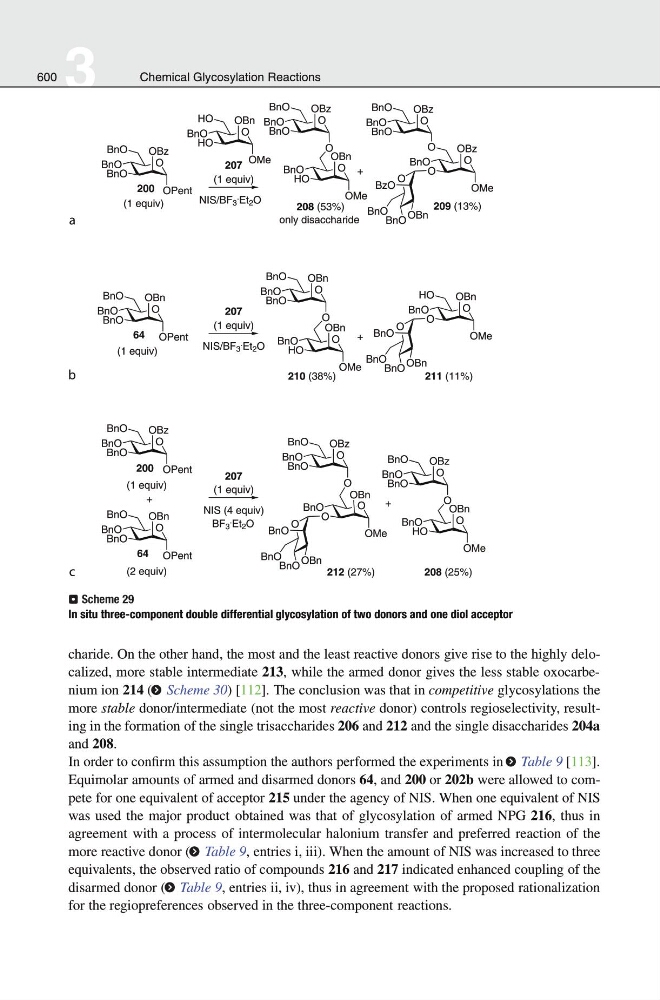
⊡ Scheme 29
In situ three-component double differential glycosylation of two donors and one diol acceptor
charide. On the other hand, the most and the least reactive donors give rise to the highly delocalized, more stable intermediate 213, while the armed donor gives the less stable oxocarbenium ion 214 ( > Scheme 30) [112]. The conclusion was that in competitive glycosylations the
more stable donor/intermediate (not the most reactive donor) controls regioselectivity, resulting in the formation of the single trisaccharides 206 and 212 and the single disaccharides 204a
and 208.
In order to confirm this assumption the authors performed the experiments in > Table 9 [113].
Equimolar amounts of armed and disarmed donors 64, and 200 or 202b were allowed to compete for one equivalent of acceptor 215 under the agency of NIS. When one equivalent of NIS
was used the major product obtained was that of glycosylation of armed NPG 216, thus in
agreement with a process of intermolecular halonium transfer and preferred reaction of the
more reactive donor ( > Table 9, entries i, iii). When the amount of NIS was increased to three
equivalents, the observed ratio of compounds 216 and 217 indicated enhanced coupling of the
disarmed donor ( > Table 9, entries ii, iv), thus in agreement with the proposed rationalization
for the regiopreferences observed in the three-component reactions.