

598
3
Chemical Glycosylation Reactions
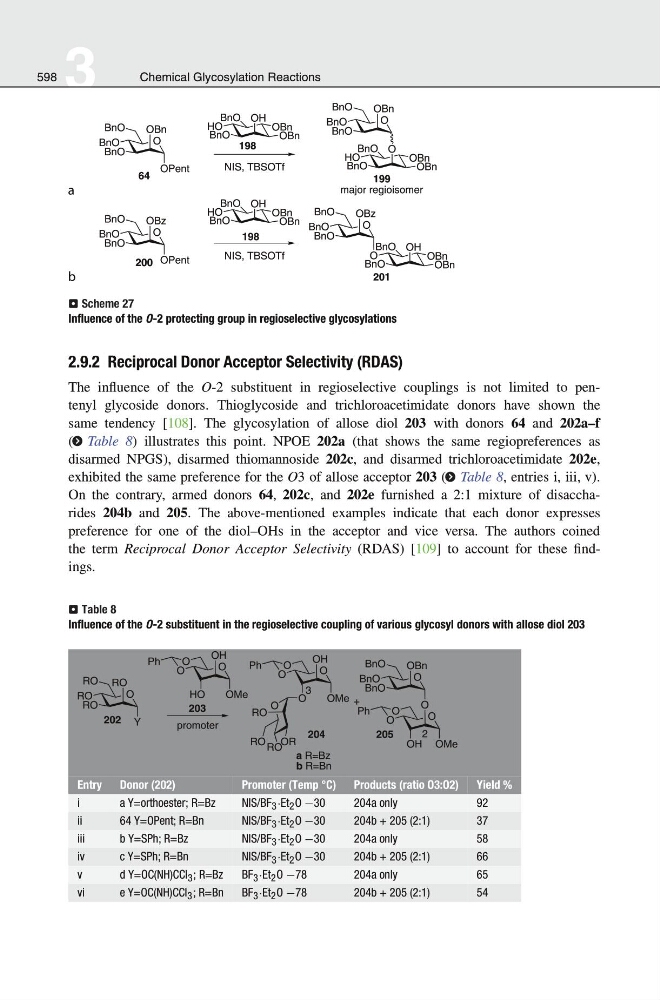
⊡ Scheme 27
Influence of the O-2 protecting group in regioselective glycosylations
2.9.2 Reciprocal Donor Acceptor Selectivity (RDAS)
The influence of the O-2 substituent in regioselective couplings is not limited to pentenyl glycoside donors. Thioglycoside and trichloroacetimidate donors have shown the
same tendency [108]. The glycosylation of allose diol 203 with donors 64 and 202a–f
( > Table 8) illustrates this point. NPOE 202a (that shows the same regiopreferences as
disarmed NPGS), disarmed thiomannoside 202c, and disarmed trichloroacetimidate 202e,
exhibited the same preference for the O3 of allose acceptor 203 ( > Table 8, entries i, iii, v).
On the contrary, armed donors 64, 202c, and 202e furnished a 2:1 mixture of disaccharides 204b and 205. The above-mentioned examples indicate that each donor expresses
preference for one of the diol–OHs in the acceptor and vice versa. The authors coined
the term Reciprocal Donor Acceptor Selectivity (RDAS) [109] to account for these findings.
⊡ Table 8
Influence of the O-2 substituent in the regioselective coupling of various glycosyl donors with allose diol 203
Entry Donor (202)
Promoter (Temp °C) Products (ratio O3:O2) Yield %
i
a Y=orthoester; R=Bz
NIS/BF 3 ·Et 2 O −30
204a only
92
ii
64 Y=OPent; R=Bn
NIS/BF 3 ·Et 2 O −30
204b + 205 (2:1)
37
iii
b Y=SPh; R=Bz
NIS/BF 3 ·Et 2 O −30
204a only
58
iv
c Y=SPh; R=Bn
NIS/BF 3 ·Et 2 O −30
204b + 205 (2:1)
66
v
d Y=OC(NH)CCl 3 ; R=Bz
BF 3 ·Et 2 O −78
204a only
65
vi
e Y=OC(NH)CCl 3 ; R=Bn
BF 3 ·Et 2 O −78
204b + 205 (2:1)
54