

O-Glycosyl Donors
3.4
597
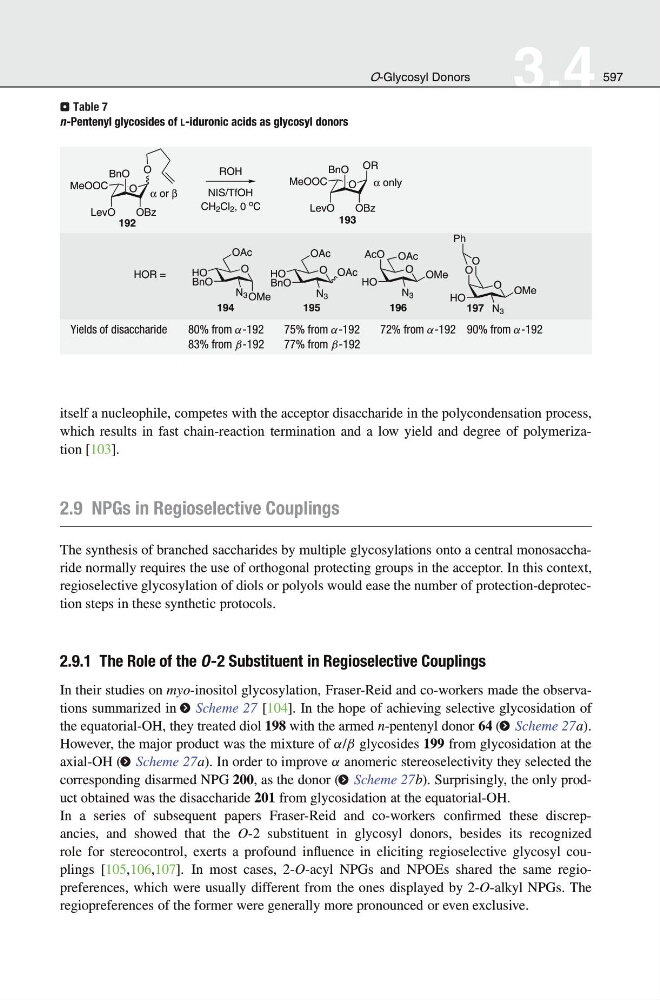
⊡ Table 7
n-Pentenyl glycosides of L-iduronic acids as glycosyl donors
Yields of disaccharide
80% from α-192
83% from β-192
75% from α-192
77% from β-192
72% from α-192 90% from α-192
itself a nucleophile, competes with the acceptor disaccharide in the polycondensation process,
which results in fast chain-reaction termination and a low yield and degree of polymerization [103].
2.9 NPGs in Regioselective Couplings
The synthesis of branched saccharides by multiple glycosylations onto a central monosaccharide normally requires the use of orthogonal protecting groups in the acceptor. In this context,
regioselective glycosylation of diols or polyols would ease the number of protection-deprotection steps in these synthetic protocols.
2.9.1 The Role of the O-2 Substituent in Regioselective Couplings
In their studies on myo-inositol glycosylation, Fraser-Reid and co-workers made the observations summarized in > Scheme 27 [104]. In the hope of achieving selective glycosidation of
the equatorial-OH, they treated diol 198 with the armed n-pentenyl donor 64 ( > Scheme 27a).
However, the major product was the mixture of α/β glycosides 199 from glycosidation at the
axial-OH ( > Scheme 27a). In order to improve α anomeric stereoselectivity they selected the
corresponding disarmed NPG 200, as the donor ( > Scheme 27b). Surprisingly, the only product obtained was the disaccharide 201 from glycosidation at the equatorial-OH.
In a series of subsequent papers Fraser-Reid and co-workers confirmed these discrepancies, and showed that the O-2 substituent in glycosyl donors, besides its recognized
role for stereocontrol, exerts a profound influence in eliciting regioselective glycosyl couplings [105,106,107]. In most cases, 2-O-acyl NPGs and NPOEs shared the same regiopreferences, which were usually different from the ones displayed by 2-O-alkyl NPGs. The
regiopreferences of the former were generally more pronounced or even exclusive.