

596
3
Chemical Glycosylation Reactions
tion of α-D-mannopyranoside 186 led to a mixture of trans- and cis-fused compounds 187,
and 188 (5:1), where the major trans-fused (α-linked) product 187, was this time the kinetic
product ( > Scheme 26b). Treatment of the latter with BF 3 ·OEt 2 promoted the epimerization
to the, more stable, 1,2-cis epimer 188, in 81% yield.
2.8.7 NPGs of N-Acetylneuraminic Acids (Neu5Ac)
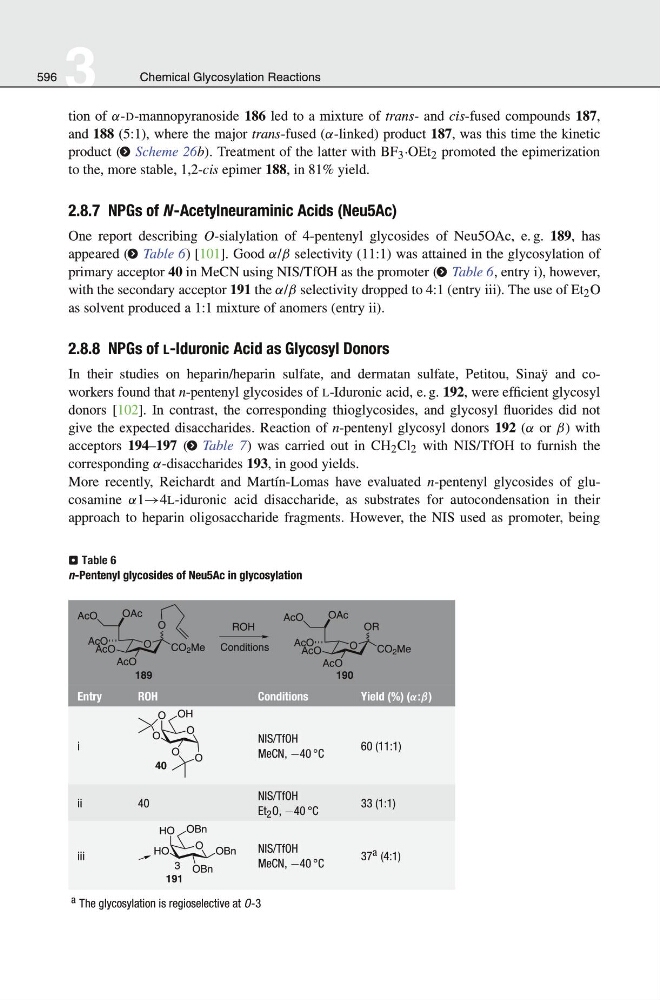
One report describing O-sialylation of 4-pentenyl glycosides of Neu5OAc, e. g. 189, has
appeared ( > Table 6) [101]. Good α/β selectivity (11:1) was attained in the glycosylation of
primary acceptor 40 in MeCN using NIS/TfOH as the promoter ( > Table 6, entry i), however,
with the secondary acceptor 191 the α/β selectivity dropped to 4:1 (entry iii). The use of Et 2 O
as solvent produced a 1:1 mixture of anomers (entry ii).
2.8.8 NPGs of L-Iduronic Acid as Glycosyl Donors
In their studies on heparin/heparin sulfate, and dermatan sulfate, Petitou, Sinaÿ and coworkers found that n-pentenyl glycosides of L-Iduronic acid, e. g. 192, were efficient glycosyl
donors [102]. In contrast, the corresponding thioglycosides, and glycosyl fluorides did not
give the expected disaccharides. Reaction of n-pentenyl glycosyl donors 192 (α or β) with
acceptors 194–197 ( > Table 7) was carried out in CH 2 Cl 2 with NIS/TfOH to furnish the
corresponding α-disaccharides 193, in good yields.
More recently, Reichardt and Martín-Lomas have evaluated n-pentenyl glycosides of glucosamine α1→4L-iduronic acid disaccharide, as substrates for autocondensation in their
approach to heparin oligosaccharide fragments. However, the NIS used as promoter, being
⊡ Table 6
n-Pentenyl glycosides of Neu5Ac in glycosylation
Entry
ROH
Conditions
Yield (%) (α:β)
i
NIS/TfOH
MeCN, −40 °C
60 (11:1)
ii
40
NIS/TfOH
Et 2 O, −40 °C
33 (1:1)
iii
NIS/TfOH
MeCN, −40 °C
37 a (4:1)
a The glycosylation is regioselective at O-3