

O-Glycosyl Donors
3.4
591
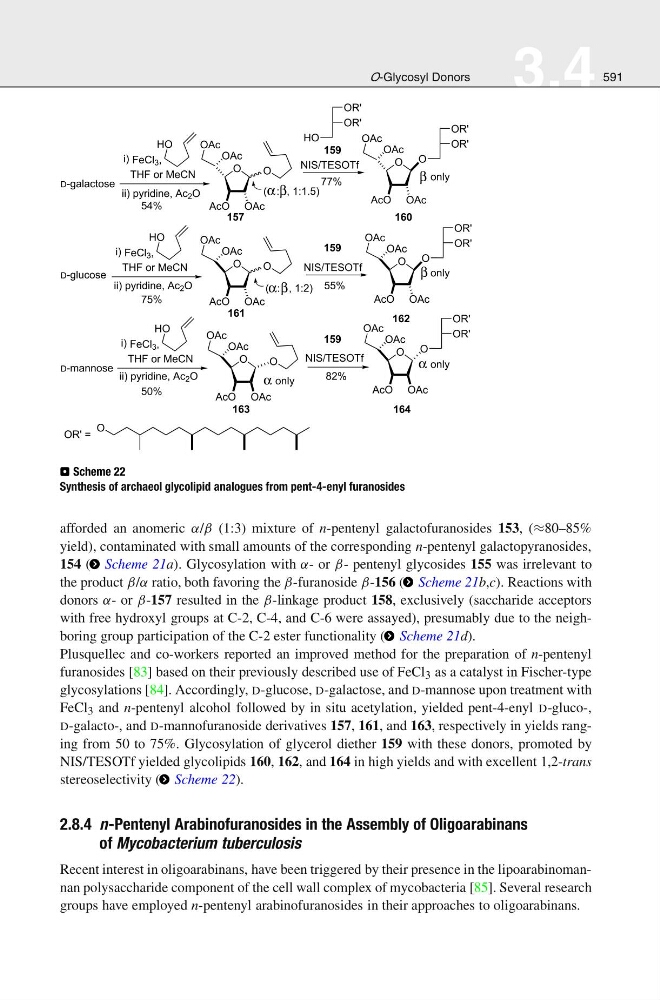
⊡ Scheme 22
Synthesis of archaeol glycolipid analogues from pent-4-enyl furanosides
afforded an anomeric α/β (1:3) mixture of n-pentenyl galactofuranosides 153, (≈80–85%
yield), contaminated with small amounts of the corresponding n-pentenyl galactopyranosides,
154 ( > Scheme 21a). Glycosylation with α- or β- pentenyl glycosides 155 was irrelevant to
the product β/α ratio, both favoring the β-furanoside β-156 ( > Scheme 21b,c). Reactions with
donors α- or β-157 resulted in the β-linkage product 158, exclusively (saccharide acceptors
with free hydroxyl groups at C-2, C-4, and C-6 were assayed), presumably due to the neighboring group participation of the C-2 ester functionality ( > Scheme 21d).
Plusquellec and co-workers reported an improved method for the preparation of n-pentenyl
furanosides [83] based on their previously described use of FeCl 3 as a catalyst in Fischer-type
glycosylations [84]. Accordingly, D-glucose, D-galactose, and D-mannose upon treatment with
FeCl 3 and n-pentenyl alcohol followed by in situ acetylation, yielded pent-4-enyl D-gluco-,
D-galacto-, and D-mannofuranoside derivatives 157, 161, and 163, respectively in yields ranging from 50 to 75%. Glycosylation of glycerol diether 159 with these donors, promoted by
NIS/TESOTf yielded glycolipids 160, 162, and 164 in high yields and with excellent 1,2-trans
stereoselectivity ( > Scheme 22).
2.8.4 n-Pentenyl Arabinofuranosides in the Assembly of Oligoarabinans
of Mycobacterium tuberculosis
Recent interest in oligoarabinans, have been triggered by their presence in the lipoarabinomannan polysaccharide component of the cell wall complex of mycobacteria [85]. Several research
groups have employed n-pentenyl arabinofuranosides in their approaches to oligoarabinans.