

590
3
Chemical Glycosylation Reactions
2.8.2 Application to the Synthesis of Nucleosides
Chapeau and Marnett developed a synthetic route to purine nucleosides from n-pentenyl ribosides ( > Scheme 20) [80]. The authors used a Fischer glycosylation of D-ribose with 4-pentenol to produce pent-4-enyl β-D-erythro-pentofuranoside 148a, in 86% yield. Reaction of
the latter with benzoyl chloride produced their glycosyl donor 148b, in 69% yield. Addition
of TfOH to acetonitrile solutions containing 148b, the selected purine, and NIS, resulted in
a rapid coupling to form the desired nucleosides 149, in a stereocontrolled manner with yields
ranging from 50 to 70% ( > Scheme 20a). The absence of an acyl group at O2 in 2-deoxy
NPG 150, enhanced its reactivity to iodonium sources so IDCP could be used as the promoter.
Thus, reaction of 150 with 6-chloropurine in acetonitrile was neither regio- nor stereo-selective, yielding four coupling products 151α,β and 152α,β, in similar amounts ( > Scheme 20b).
2.8.3 n-Pentenyl Furanosides as Glycosyl Donors
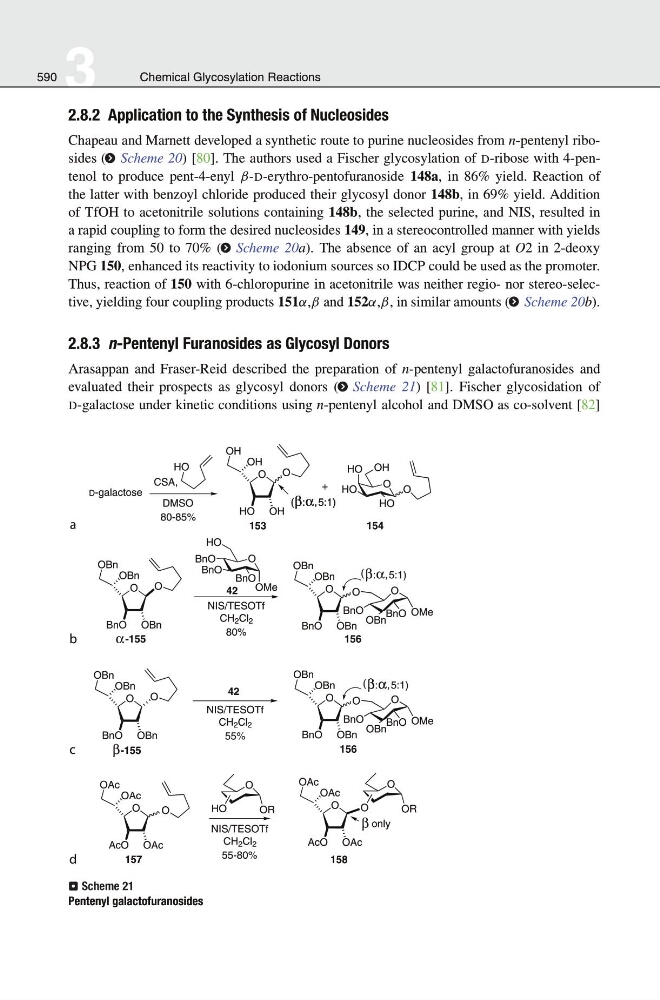
Arasappan and Fraser-Reid described the preparation of n-pentenyl galactofuranosides and
evaluated their prospects as glycosyl donors ( > Scheme 21) [81]. Fischer glycosidation of
D-galactose under kinetic conditions using n-pentenyl alcohol and DMSO as co-solvent [82]
⊡ Scheme 21
Pentenyl galactofuranosides