

592
3
Chemical Glycosylation Reactions
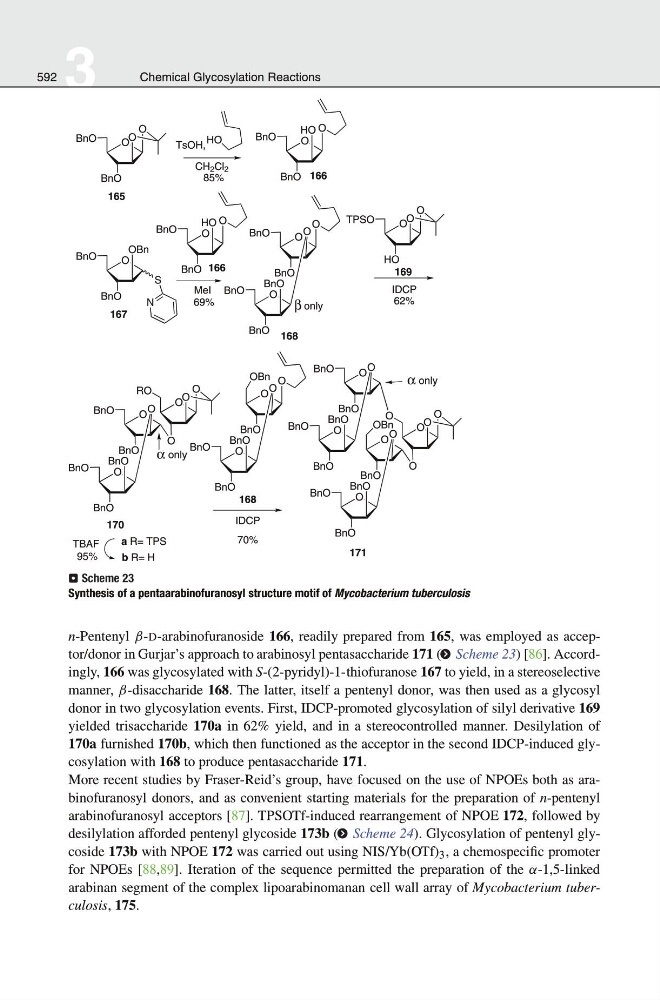
⊡ Scheme 23
Synthesis of a pentaarabinofuranosyl structure motif of Mycobacterium tuberculosis
n-Pentenyl β-D-arabinofuranoside 166, readily prepared from 165, was employed as acceptor/donor in Gurjar’s approach to arabinosyl pentasaccharide 171 ( > Scheme 23) [86]. Accordingly, 166 was glycosylated with S-(2-pyridyl)-1-thiofuranose 167 to yield, in a stereoselective
manner, β-disaccharide 168. The latter, itself a pentenyl donor, was then used as a glycosyl
donor in two glycosylation events. First, IDCP-promoted glycosylation of silyl derivative 169
yielded trisaccharide 170a in 62% yield, and in a stereocontrolled manner. Desilylation of
170a furnished 170b, which then functioned as the acceptor in the second IDCP-induced glycosylation with 168 to produce pentasaccharide 171.
More recent studies by Fraser-Reid’s group, have focused on the use of NPOEs both as arabinofuranosyl donors, and as convenient starting materials for the preparation of n-pentenyl
arabinofuranosyl acceptors [87]. TPSOTf-induced rearrangement of NPOE 172, followed by
desilylation afforded pentenyl glycoside 173b ( > Scheme 24). Glycosylation of pentenyl glycoside 173b with NPOE 172 was carried out using NIS/Yb(OTf) 3 , a chemospecific promoter
for NPOEs [88,89]. Iteration of the sequence permitted the preparation of the α-1,5-linked
arabinan segment of the complex lipoarabinomanan cell wall array of Mycobacterium tuberculosis, 175.