

34
1
General Principles
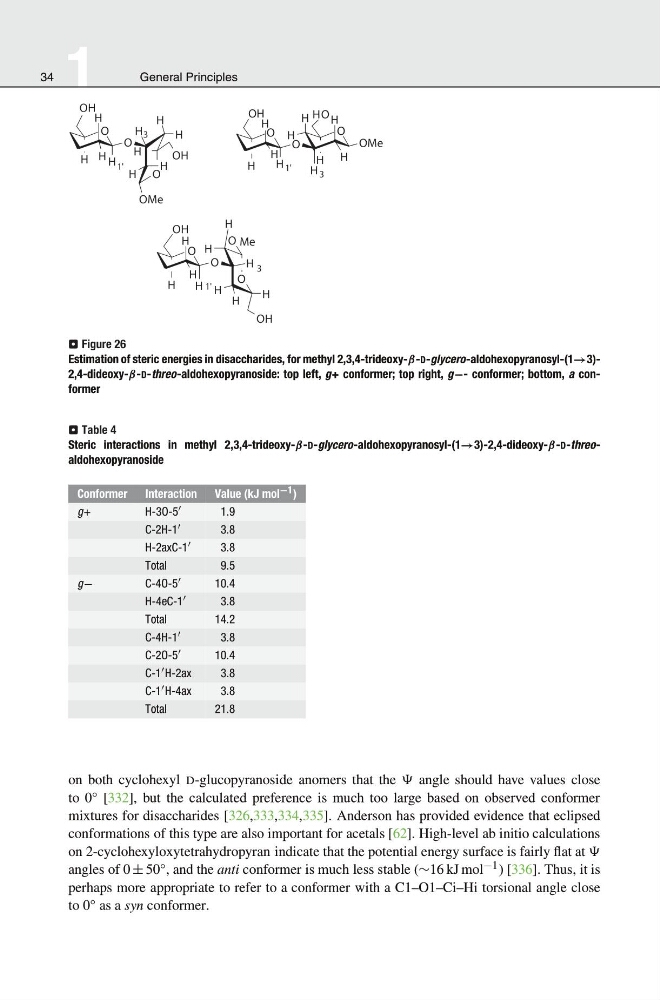
⊡ Figure 26
Estimation of steric energies in disaccharides, for methyl 2,3,4-trideoxy-β-D-glycero-aldohexopyranosyl-(1→3)2,4-dideoxy-β-D-threo-aldohexopyranoside: top left, g+ conformer; top right, g−- conformer; bottom, a conformer
⊡ Table 4
Steric interactions in methyl 2,3,4-trideoxy-β-D-glycero-aldohexopyranosyl-(1→3)-2,4-dideoxy-β-D-threoaldohexopyranoside
Conformer Interaction Value (kJ mol −1 )
g+
H-3O-5
1.9
C-2H-1
3.8
H-2axC-1
3.8
Total
9.5
g−
C-4O-5
10.4
H-4eC-1
3.8
Total
14.2
C-4H-1
3.8
C-2O-5
10.4
C-1 H-2ax
3.8
C-1 H-4ax
3.8
Total
21.8
on both cyclohexyl D-glucopyranoside anomers that the angle should have values close
to 0° [332], but the calculated preference is much too large based on observed conformer
mixtures for disaccharides [326,333,334,335]. Anderson has provided evidence that eclipsed
conformations of this type are also important for acetals [62]. High-level ab initio calculations
on 2-cyclohexyloxytetrahydropyran indicate that the potential energy surface is fairly flat at
angles of 0 ± 50°, and the anti conformer is much less stable (∼16 kJ mol −1 ) [336]. Thus, it is
perhaps more appropriate to refer to a conformer with a C1–O1–Ci–Hi torsional angle close
to 0° as a syn conformer.
1
General Principles
⊡ Figure 26
Estimation of steric energies in disaccharides, for methyl 2,3,4-trideoxy-β-D-glycero-aldohexopyranosyl-(1→3)2,4-dideoxy-β-D-threo-aldohexopyranoside: top left, g+ conformer; top right, g−- conformer; bottom, a conformer
⊡ Table 4
Steric interactions in methyl 2,3,4-trideoxy-β-D-glycero-aldohexopyranosyl-(1→3)-2,4-dideoxy-β-D-threoaldohexopyranoside
Conformer Interaction Value (kJ mol −1 )
g+
H-3O-5
1.9
C-2H-1
3.8
H-2axC-1
3.8
Total
9.5
g−
C-4O-5
10.4
H-4eC-1
3.8
Total
14.2
C-4H-1
3.8
C-2O-5
10.4
C-1 H-2ax
3.8
C-1 H-4ax
3.8
Total
21.8
on both cyclohexyl D-glucopyranoside anomers that the angle should have values close
to 0° [332], but the calculated preference is much too large based on observed conformer
mixtures for disaccharides [326,333,334,335]. Anderson has provided evidence that eclipsed
conformations of this type are also important for acetals [62]. High-level ab initio calculations
on 2-cyclohexyloxytetrahydropyran indicate that the potential energy surface is fairly flat at
angles of 0 ± 50°, and the anti conformer is much less stable (∼16 kJ mol −1 ) [336]. Thus, it is
perhaps more appropriate to refer to a conformer with a C1–O1–Ci–Hi torsional angle close
to 0° as a syn conformer.