

Structure and Conformation of Carbohydrates
1.1
35
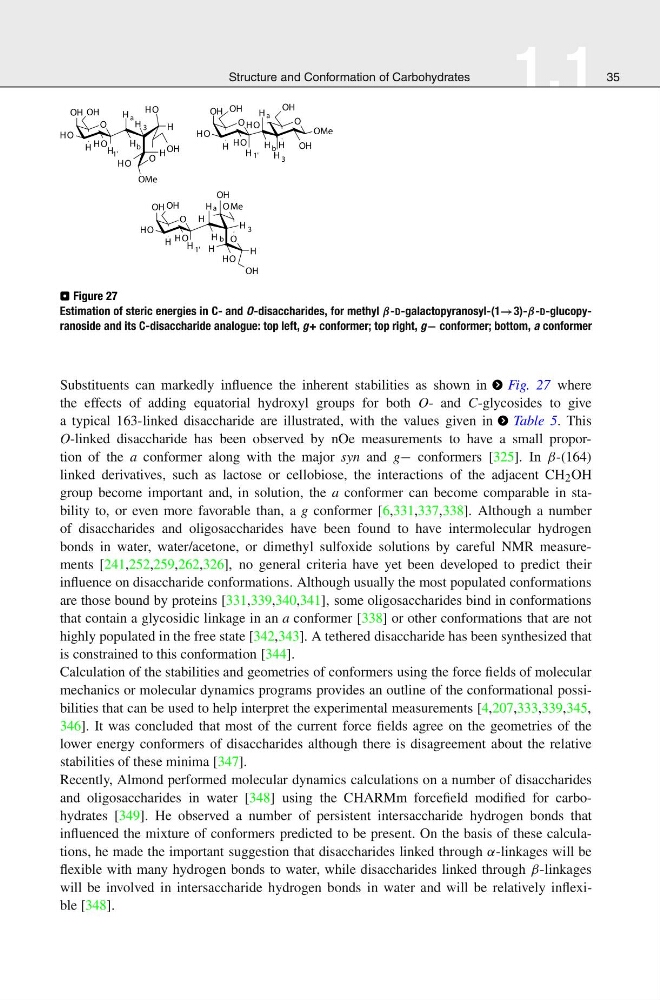
⊡ Figure 27
Estimation of steric energies in C- and O-disaccharides, for methyl β-D-galactopyranosyl-(1→3)-β-D-glucopyranoside and its C-disaccharide analogue: top left, g+ conformer; top right, g− conformer; bottom, a conformer
Substituents can markedly influence the inherent stabilities as shown in > Fig. 27 where
the effects of adding equatorial hydroxyl groups for both O- and C-glycosides to give
a typical 163-linked disaccharide are illustrated, with the values given in > Table 5. This
O-linked disaccharide has been observed by nOe measurements to have a small proportion of the a conformer along with the major syn and g− conformers [325]. In β-(164)
linked derivatives, such as lactose or cellobiose, the interactions of the adjacent CH 2 OH
group become important and, in solution, the a conformer can become comparable in stability to, or even more favorable than, a g conformer [6,331,337,338]. Although a number
of disaccharides and oligosaccharides have been found to have intermolecular hydrogen
bonds in water, water/acetone, or dimethyl sulfoxide solutions by careful NMR measurements [241,252,259,262,326], no general criteria have yet been developed to predict their
influence on disaccharide conformations. Although usually the most populated conformations
are those bound by proteins [331,339,340,341], some oligosaccharides bind in conformations
that contain a glycosidic linkage in an a conformer [338] or other conformations that are not
highly populated in the free state [342,343]. A tethered disaccharide has been synthesized that
is constrained to this conformation [344].
Calculation of the stabilities and geometries of conformers using the force fields of molecular
mechanics or molecular dynamics programs provides an outline of the conformational possibilities that can be used to help interpret the experimental measurements [4,207,333,339,345,
346]. It was concluded that most of the current force fields agree on the geometries of the
lower energy conformers of disaccharides although there is disagreement about the relative
stabilities of these minima [347].
Recently, Almond performed molecular dynamics calculations on a number of disaccharides
and oligosaccharides in water [348] using the CHARMm forcefield modified for carbohydrates [349]. He observed a number of persistent intersaccharide hydrogen bonds that
influenced the mixture of conformers predicted to be present. On the basis of these calculations, he made the important suggestion that disaccharides linked through α-linkages will be
flexible with many hydrogen bonds to water, while disaccharides linked through β-linkages
will be involved in intersaccharide hydrogen bonds in water and will be relatively inflexible [348].
1.1
35
⊡ Figure 27
Estimation of steric energies in C- and O-disaccharides, for methyl β-D-galactopyranosyl-(1→3)-β-D-glucopyranoside and its C-disaccharide analogue: top left, g+ conformer; top right, g− conformer; bottom, a conformer
Substituents can markedly influence the inherent stabilities as shown in > Fig. 27 where
the effects of adding equatorial hydroxyl groups for both O- and C-glycosides to give
a typical 163-linked disaccharide are illustrated, with the values given in > Table 5. This
O-linked disaccharide has been observed by nOe measurements to have a small proportion of the a conformer along with the major syn and g− conformers [325]. In β-(164)
linked derivatives, such as lactose or cellobiose, the interactions of the adjacent CH 2 OH
group become important and, in solution, the a conformer can become comparable in stability to, or even more favorable than, a g conformer [6,331,337,338]. Although a number
of disaccharides and oligosaccharides have been found to have intermolecular hydrogen
bonds in water, water/acetone, or dimethyl sulfoxide solutions by careful NMR measurements [241,252,259,262,326], no general criteria have yet been developed to predict their
influence on disaccharide conformations. Although usually the most populated conformations
are those bound by proteins [331,339,340,341], some oligosaccharides bind in conformations
that contain a glycosidic linkage in an a conformer [338] or other conformations that are not
highly populated in the free state [342,343]. A tethered disaccharide has been synthesized that
is constrained to this conformation [344].
Calculation of the stabilities and geometries of conformers using the force fields of molecular
mechanics or molecular dynamics programs provides an outline of the conformational possibilities that can be used to help interpret the experimental measurements [4,207,333,339,345,
346]. It was concluded that most of the current force fields agree on the geometries of the
lower energy conformers of disaccharides although there is disagreement about the relative
stabilities of these minima [347].
Recently, Almond performed molecular dynamics calculations on a number of disaccharides
and oligosaccharides in water [348] using the CHARMm forcefield modified for carbohydrates [349]. He observed a number of persistent intersaccharide hydrogen bonds that
influenced the mixture of conformers predicted to be present. On the basis of these calculations, he made the important suggestion that disaccharides linked through α-linkages will be
flexible with many hydrogen bonds to water, while disaccharides linked through β-linkages
will be involved in intersaccharide hydrogen bonds in water and will be relatively inflexible [348].