

Structure and Conformation of Carbohydrates
1.1
33
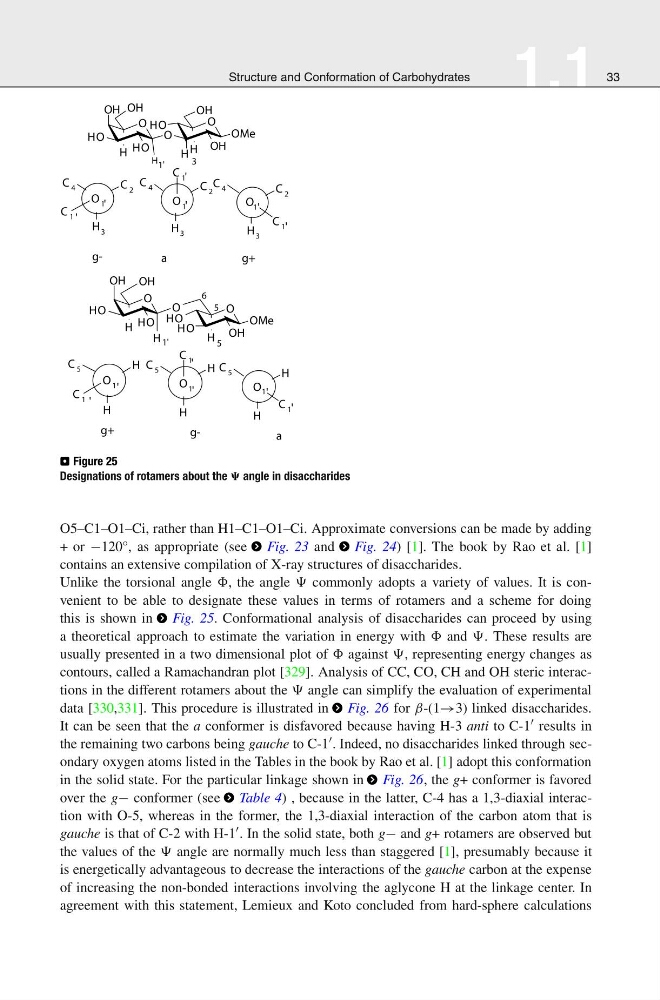
⊡ Figure 25
Designations of rotamers about the angle in disaccharides
O5–C1–O1–Ci, rather than H1–C1–O1–Ci. Approximate conversions can be made by adding
+ or −120°, as appropriate (see > Fig. 23 and > Fig. 24) [1]. The book by Rao et al. [1]
contains an extensive compilation of X-ray structures of disaccharides.
Unlike the torsional angle , the angle commonly adopts a variety of values. It is convenient to be able to designate these values in terms of rotamers and a scheme for doing
this is shown in > Fig. 25. Conformational analysis of disaccharides can proceed by using
a theoretical approach to estimate the variation in energy with and . These results are
usually presented in a two dimensional plot of against , representing energy changes as
contours, called a Ramachandran plot [329]. Analysis of CC, CO, CH and OH steric interactions in the different rotamers about the angle can simplify the evaluation of experimental
data [330,331]. This procedure is illustrated in > Fig. 26 for β-(1→3) linked disaccharides.
It can be seen that the a conformer is disfavored because having H-3 anti to C-1 results in
the remaining two carbons being gauche to C-1 . Indeed, no disaccharides linked through secondary oxygen atoms listed in the Tables in the book by Rao et al. [1] adopt this conformation
in the solid state. For the particular linkage shown in > Fig. 26, the g+ conformer is favored
over the g− conformer (see > Table 4) , because in the latter, C-4 has a 1,3-diaxial interaction with O-5, whereas in the former, the 1,3-diaxial interaction of the carbon atom that is
gauche is that of C-2 with H-1 . In the solid state, both g− and g+ rotamers are observed but
the values of the angle are normally much less than staggered [1], presumably because it
is energetically advantageous to decrease the interactions of the gauche carbon at the expense
of increasing the non-bonded interactions involving the aglycone H at the linkage center. In
agreement with this statement, Lemieux and Koto concluded from hard-sphere calculations
1.1
33
⊡ Figure 25
Designations of rotamers about the angle in disaccharides
O5–C1–O1–Ci, rather than H1–C1–O1–Ci. Approximate conversions can be made by adding
+ or −120°, as appropriate (see > Fig. 23 and > Fig. 24) [1]. The book by Rao et al. [1]
contains an extensive compilation of X-ray structures of disaccharides.
Unlike the torsional angle , the angle commonly adopts a variety of values. It is convenient to be able to designate these values in terms of rotamers and a scheme for doing
this is shown in > Fig. 25. Conformational analysis of disaccharides can proceed by using
a theoretical approach to estimate the variation in energy with and . These results are
usually presented in a two dimensional plot of against , representing energy changes as
contours, called a Ramachandran plot [329]. Analysis of CC, CO, CH and OH steric interactions in the different rotamers about the angle can simplify the evaluation of experimental
data [330,331]. This procedure is illustrated in > Fig. 26 for β-(1→3) linked disaccharides.
It can be seen that the a conformer is disfavored because having H-3 anti to C-1 results in
the remaining two carbons being gauche to C-1 . Indeed, no disaccharides linked through secondary oxygen atoms listed in the Tables in the book by Rao et al. [1] adopt this conformation
in the solid state. For the particular linkage shown in > Fig. 26, the g+ conformer is favored
over the g− conformer (see > Table 4) , because in the latter, C-4 has a 1,3-diaxial interaction with O-5, whereas in the former, the 1,3-diaxial interaction of the carbon atom that is
gauche is that of C-2 with H-1 . In the solid state, both g− and g+ rotamers are observed but
the values of the angle are normally much less than staggered [1], presumably because it
is energetically advantageous to decrease the interactions of the gauche carbon at the expense
of increasing the non-bonded interactions involving the aglycone H at the linkage center. In
agreement with this statement, Lemieux and Koto concluded from hard-sphere calculations