

32
1
General Principles
1.4 Conformations of Disaccharides, Trisaccharides,
and Oligosaccharides
1.4.1 Conformations of Disaccharides
The conformations adopted by disaccharides are defined in terms of the torsional angles across
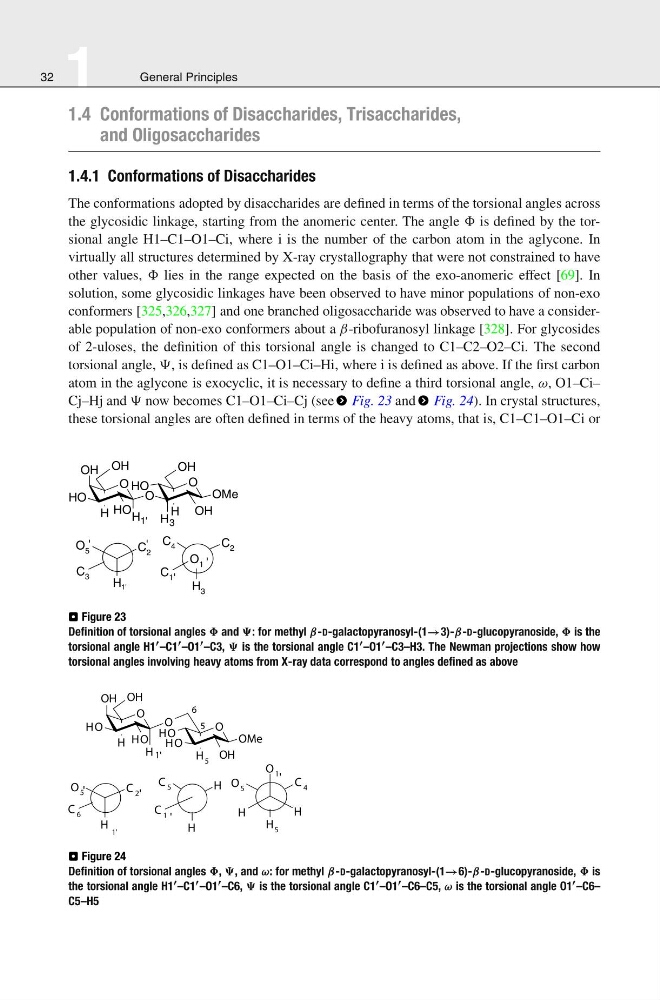
the glycosidic linkage, starting from the anomeric center. The angle is defined by the torsional angle H1–C1–O1–Ci, where i is the number of the carbon atom in the aglycone. In
virtually all structures determined by X-ray crystallography that were not constrained to have
other values, lies in the range expected on the basis of the exo-anomeric effect [69]. In
solution, some glycosidic linkages have been observed to have minor populations of non-exo
conformers [325,326,327] and one branched oligosaccharide was observed to have a considerable population of non-exo conformers about a β-ribofuranosyl linkage [328]. For glycosides
of 2-uloses, the definition of this torsional angle is changed to C1–C2–O2–Ci. The second
torsional angle, , is defined as C1–O1–Ci–Hi, where i is defined as above. If the first carbon
atom in the aglycone is exocyclic, it is necessary to define a third torsional angle, ω, O1–Ci–
Cj–Hj and now becomes C1–O1–Ci–Cj (see > Fig. 23 and > Fig. 24). In crystal structures,
these torsional angles are often defined in terms of the heavy atoms, that is, C1–C1–O1–Ci or
⊡ Figure 23
Definition of torsional angles and : for methyl β-D-galactopyranosyl-(1→3)-β-D-glucopyranoside, is the
torsional angle H1 –C1 –O1 –C3, is the torsional angle C1 –O1 –C3–H3. The Newman projections show how
torsional angles involving heavy atoms from X-ray data correspond to angles defined as above
⊡ Figure 24
Definition of torsional angles , , and ω: for methyl β-D-galactopyranosyl-(1→6)-β-D-glucopyranoside, is
the torsional angle H1 –C1 –O1 –C6, is the torsional angle C1 –O1 –C6–C5, ω is the torsional angle O1 –C6–
C5–H5
1
General Principles
1.4 Conformations of Disaccharides, Trisaccharides,
and Oligosaccharides
1.4.1 Conformations of Disaccharides
The conformations adopted by disaccharides are defined in terms of the torsional angles across
the glycosidic linkage, starting from the anomeric center. The angle is defined by the torsional angle H1–C1–O1–Ci, where i is the number of the carbon atom in the aglycone. In
virtually all structures determined by X-ray crystallography that were not constrained to have
other values, lies in the range expected on the basis of the exo-anomeric effect [69]. In
solution, some glycosidic linkages have been observed to have minor populations of non-exo
conformers [325,326,327] and one branched oligosaccharide was observed to have a considerable population of non-exo conformers about a β-ribofuranosyl linkage [328]. For glycosides
of 2-uloses, the definition of this torsional angle is changed to C1–C2–O2–Ci. The second
torsional angle, , is defined as C1–O1–Ci–Hi, where i is defined as above. If the first carbon
atom in the aglycone is exocyclic, it is necessary to define a third torsional angle, ω, O1–Ci–
Cj–Hj and now becomes C1–O1–Ci–Cj (see > Fig. 23 and > Fig. 24). In crystal structures,
these torsional angles are often defined in terms of the heavy atoms, that is, C1–C1–O1–Ci or
⊡ Figure 23
Definition of torsional angles and : for methyl β-D-galactopyranosyl-(1→3)-β-D-glucopyranoside, is the
torsional angle H1 –C1 –O1 –C3, is the torsional angle C1 –O1 –C3–H3. The Newman projections show how
torsional angles involving heavy atoms from X-ray data correspond to angles defined as above
⊡ Figure 24
Definition of torsional angles , , and ω: for methyl β-D-galactopyranosyl-(1→6)-β-D-glucopyranoside, is
the torsional angle H1 –C1 –O1 –C6, is the torsional angle C1 –O1 –C6–C5, ω is the torsional angle O1 –C6–
C5–H5