

Structure and Conformation of Carbohydrates
1.1
31
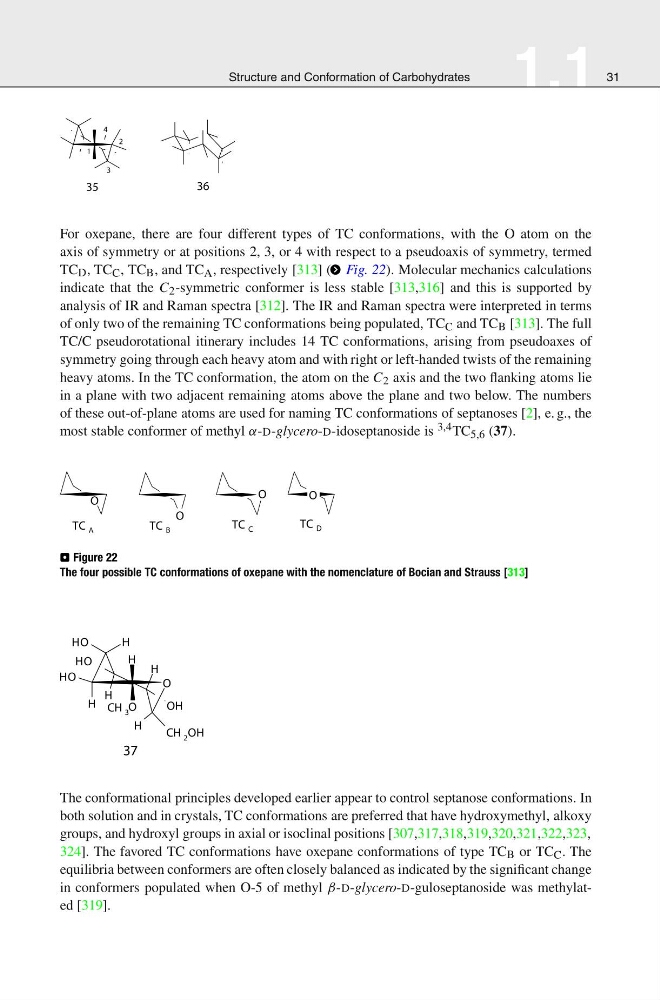
For oxepane, there are four different types of TC conformations, with the O atom on the
axis of symmetry or at positions 2, 3, or 4 with respect to a pseudoaxis of symmetry, termed
TC D , TC C , TC B , and TC A , respectively [313] ( > Fig. 22). Molecular mechanics calculations
indicate that the C 2 -symmetric conformer is less stable [313,316] and this is supported by
analysis of IR and Raman spectra [312]. The IR and Raman spectra were interpreted in terms
of only two of the remaining TC conformations being populated, TC C and TC B [313]. The full
TC/C pseudorotational itinerary includes 14 TC conformations, arising from pseudoaxes of
symmetry going through each heavy atom and with right or left-handed twists of the remaining
heavy atoms. In the TC conformation, the atom on the C 2 axis and the two flanking atoms lie
in a plane with two adjacent remaining atoms above the plane and two below. The numbers
of these out-of-plane atoms are used for naming TC conformations of septanoses [2], e. g., the
most stable conformer of methyl α-D-glycero-D-idoseptanoside is 3,4 TC 5,6 (37).
⊡ Figure 22
The four possible TC conformations of oxepane with the nomenclature of Bocian and Strauss [313]
The conformational principles developed earlier appear to control septanose conformations. In
both solution and in crystals, TC conformations are preferred that have hydroxymethyl, alkoxy
groups, and hydroxyl groups in axial or isoclinal positions [307,317,318,319,320,321,322,323,
324]. The favored TC conformations have oxepane conformations of type TC B or TC C . The
equilibria between conformers are often closely balanced as indicated by the significant change
in conformers populated when O-5 of methyl β-D-glycero-D-guloseptanoside was methylated [319].
1.1
31
For oxepane, there are four different types of TC conformations, with the O atom on the
axis of symmetry or at positions 2, 3, or 4 with respect to a pseudoaxis of symmetry, termed
TC D , TC C , TC B , and TC A , respectively [313] ( > Fig. 22). Molecular mechanics calculations
indicate that the C 2 -symmetric conformer is less stable [313,316] and this is supported by
analysis of IR and Raman spectra [312]. The IR and Raman spectra were interpreted in terms
of only two of the remaining TC conformations being populated, TC C and TC B [313]. The full
TC/C pseudorotational itinerary includes 14 TC conformations, arising from pseudoaxes of
symmetry going through each heavy atom and with right or left-handed twists of the remaining
heavy atoms. In the TC conformation, the atom on the C 2 axis and the two flanking atoms lie
in a plane with two adjacent remaining atoms above the plane and two below. The numbers
of these out-of-plane atoms are used for naming TC conformations of septanoses [2], e. g., the
most stable conformer of methyl α-D-glycero-D-idoseptanoside is 3,4 TC 5,6 (37).
⊡ Figure 22
The four possible TC conformations of oxepane with the nomenclature of Bocian and Strauss [313]
The conformational principles developed earlier appear to control septanose conformations. In
both solution and in crystals, TC conformations are preferred that have hydroxymethyl, alkoxy
groups, and hydroxyl groups in axial or isoclinal positions [307,317,318,319,320,321,322,323,
324]. The favored TC conformations have oxepane conformations of type TC B or TC C . The
equilibria between conformers are often closely balanced as indicated by the significant change
in conformers populated when O-5 of methyl β-D-glycero-D-guloseptanoside was methylated [319].