

O-Glycosyl Donors
3.4
575
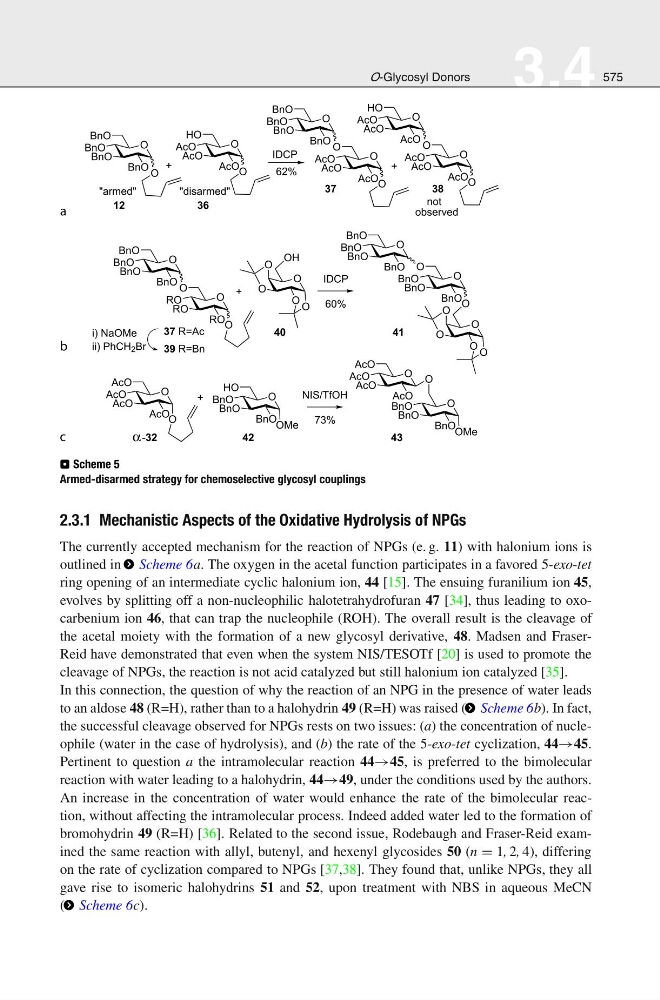
⊡ Scheme 5
Armed-disarmed strategy for chemoselective glycosyl couplings
2.3.1 Mechanistic Aspects of the Oxidative Hydrolysis of NPGs
The currently accepted mechanism for the reaction of NPGs (e. g. 11) with halonium ions is
outlined in > Scheme 6a. The oxygen in the acetal function participates in a favored 5-exo-tet
ring opening of an intermediate cyclic halonium ion, 44 [15]. The ensuing furanilium ion 45,
evolves by splitting off a non-nucleophilic halotetrahydrofuran 47 [34], thus leading to oxocarbenium ion 46, that can trap the nucleophile (ROH). The overall result is the cleavage of
the acetal moiety with the formation of a new glycosyl derivative, 48. Madsen and FraserReid have demonstrated that even when the system NIS/TESOTf [20] is used to promote the
cleavage of NPGs, the reaction is not acid catalyzed but still halonium ion catalyzed [35].
In this connection, the question of why the reaction of an NPG in the presence of water leads
to an aldose 48 (R=H), rather than to a halohydrin 49 (R=H) was raised ( > Scheme 6b). In fact,
the successful cleavage observed for NPGs rests on two issues: (a) the concentration of nucleophile (water in the case of hydrolysis), and (b) the rate of the 5-exo-tet cyclization, 44→45.
Pertinent to question a the intramolecular reaction 44→45, is preferred to the bimolecular
reaction with water leading to a halohydrin, 44→49, under the conditions used by the authors.
An increase in the concentration of water would enhance the rate of the bimolecular reaction, without affecting the intramolecular process. Indeed added water led to the formation of
bromohydrin 49 (R=H) [36]. Related to the second issue, Rodebaugh and Fraser-Reid examined the same reaction with allyl, butenyl, and hexenyl glycosides 50 (n = 1, 2, 4), differing
on the rate of cyclization compared to NPGs [37,38]. They found that, unlike NPGs, they all
gave rise to isomeric halohydrins 51 and 52, upon treatment with NBS in aqueous MeCN
( > Scheme 6c).