

574
3
Chemical Glycosylation Reactions
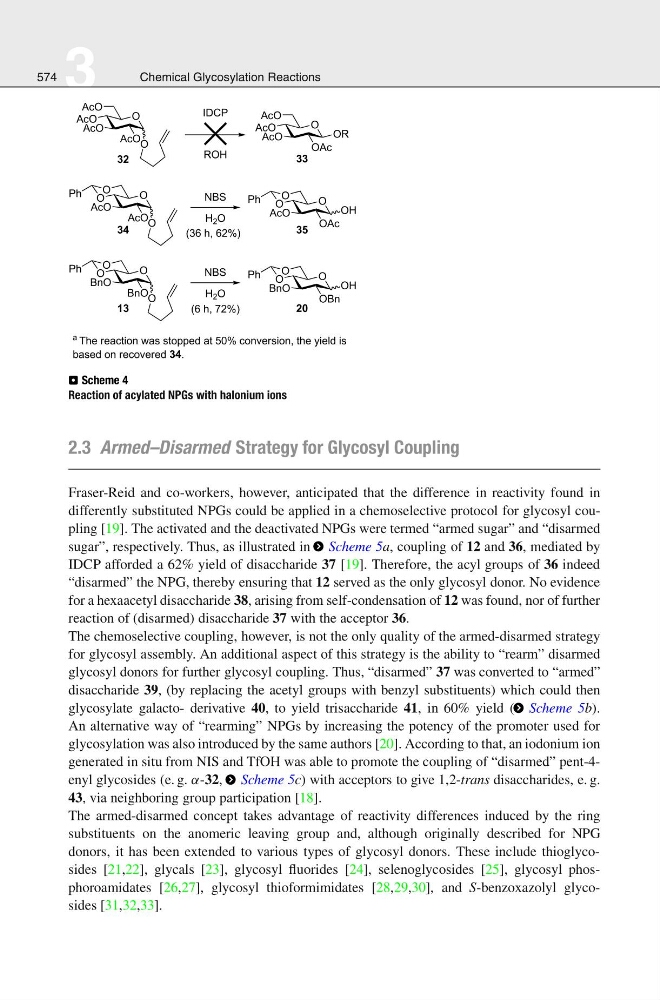
⊡ Scheme 4
Reaction of acylated NPGs with halonium ions
2.3 Armed–Disarmed Strategy for Glycosyl Coupling
Fraser-Reid and co-workers, however, anticipated that the difference in reactivity found in
differently substituted NPGs could be applied in a chemoselective protocol for glycosyl coupling [19]. The activated and the deactivated NPGs were termed “armed sugar” and “disarmed
sugar”, respectively. Thus, as illustrated in > Scheme 5a, coupling of 12 and 36, mediated by
IDCP afforded a 62% yield of disaccharide 37 [19]. Therefore, the acyl groups of 36 indeed
“disarmed” the NPG, thereby ensuring that 12 served as the only glycosyl donor. No evidence
for a hexaacetyl disaccharide 38, arising from self-condensation of 12 was found, nor of further
reaction of (disarmed) disaccharide 37 with the acceptor 36.
The chemoselective coupling, however, is not the only quality of the armed-disarmed strategy
for glycosyl assembly. An additional aspect of this strategy is the ability to “rearm” disarmed
glycosyl donors for further glycosyl coupling. Thus, “disarmed” 37 was converted to “armed”
disaccharide 39, (by replacing the acetyl groups with benzyl substituents) which could then
glycosylate galacto- derivative 40, to yield trisaccharide 41, in 60% yield ( > Scheme 5b).
An alternative way of “rearming” NPGs by increasing the potency of the promoter used for
glycosylation was also introduced by the same authors [20]. According to that, an iodonium ion
generated in situ from NIS and TfOH was able to promote the coupling of “disarmed” pent-4enyl glycosides (e. g. α-32, > Scheme 5c) with acceptors to give 1,2-trans disaccharides, e. g.
43, via neighboring group participation [18].
The armed-disarmed concept takes advantage of reactivity differences induced by the ring
substituents on the anomeric leaving group and, although originally described for NPG
donors, it has been extended to various types of glycosyl donors. These include thioglycosides [21,22], glycals [23], glycosyl fluorides [24], selenoglycosides [25], glycosyl phosphoroamidates [26,27], glycosyl thioformimidates [28,29,30], and S-benzoxazolyl glycosides [31,32,33].