

O-Glycosyl Donors
3.4
573
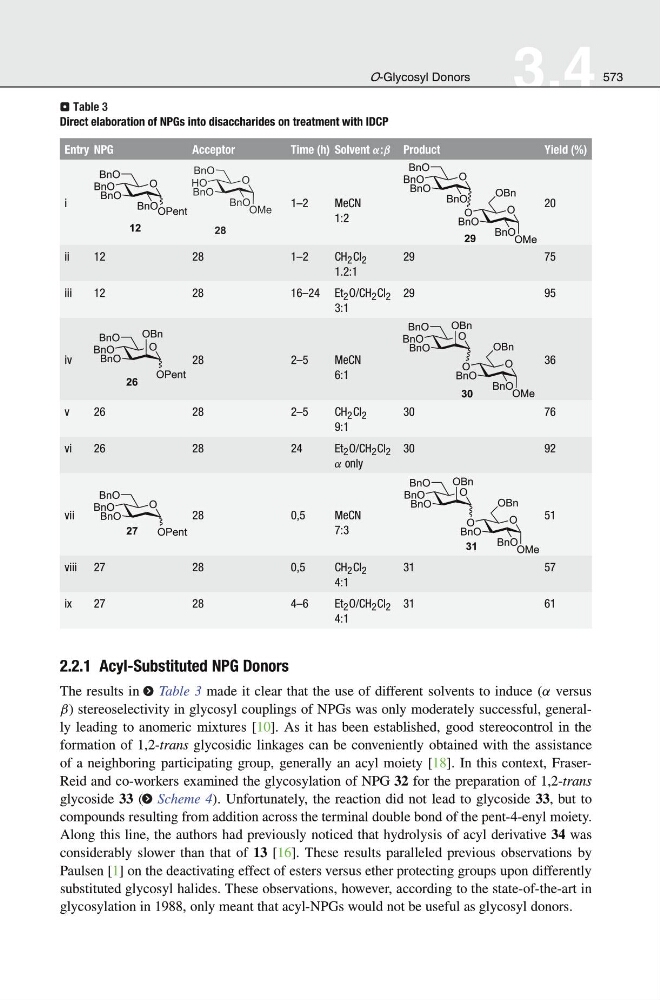
⊡ Table 3
Direct elaboration of NPGs into disaccharides on treatment with IDCP
Entry NPG
Acceptor
Time (h) Solvent α:β Product
Yield (%)
i
1–2
MeCN
1:2
20
ii
12
28
1–2
CH 2 Cl 2
1.2:1
29
75
iii
12
28
16–24 Et 2 O/CH 2 Cl 2
3:1
29
95
iv
28
2–5
MeCN
6:1
36
v
26
28
2–5
CH 2 Cl 2
9:1
30
76
vi
26
28
24
Et 2 O/CH 2 Cl 2
α only
30
92
vii
28
0,5
MeCN
7:3
51
viii 27
28
0,5
CH 2 Cl 2
4:1
31
57
ix
27
28
4–6
Et 2 O/CH 2 Cl 2
4:1
31
61
2.2.1 Acyl-Substituted NPG Donors
The results in > Table 3 made it clear that the use of different solvents to induce (α versus
β) stereoselectivity in glycosyl couplings of NPGs was only moderately successful, generally leading to anomeric mixtures [10]. As it has been established, good stereocontrol in the
formation of 1,2-trans glycosidic linkages can be conveniently obtained with the assistance
of a neighboring participating group, generally an acyl moiety [18]. In this context, FraserReid and co-workers examined the glycosylation of NPG 32 for the preparation of 1,2-trans
glycoside 33 ( > Scheme 4). Unfortunately, the reaction did not lead to glycoside 33, but to
compounds resulting from addition across the terminal double bond of the pent-4-enyl moiety.
Along this line, the authors had previously noticed that hydrolysis of acyl derivative 34 was
considerably slower than that of 13 [16]. These results paralleled previous observations by
Paulsen [1] on the deactivating effect of esters versus ether protecting groups upon differently
substituted glycosyl halides. These observations, however, according to the state-of-the-art in
glycosylation in 1988, only meant that acyl-NPGs would not be useful as glycosyl donors.