

576
3
Chemical Glycosylation Reactions
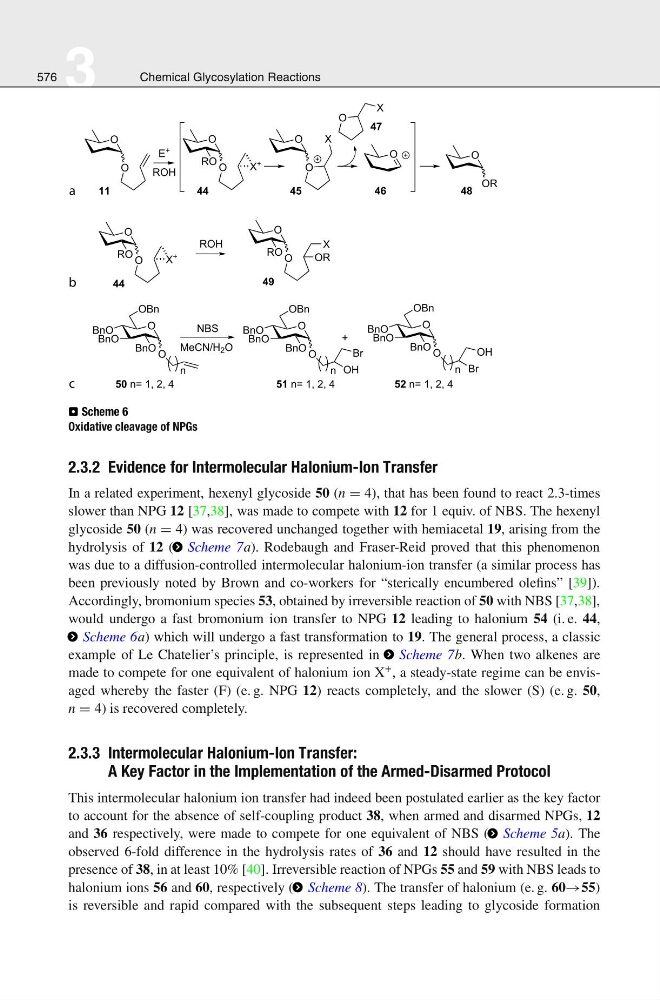
⊡ Scheme 6
Oxidative cleavage of NPGs
2.3.2 Evidence for Intermolecular Halonium-Ion Transfer
In a related experiment, hexenyl glycoside 50 (n = 4), that has been found to react 2.3-times
slower than NPG 12 [37,38], was made to compete with 12 for 1 equiv. of NBS. The hexenyl
glycoside 50 (n = 4) was recovered unchanged together with hemiacetal 19, arising from the
hydrolysis of 12 ( > Scheme 7a). Rodebaugh and Fraser-Reid proved that this phenomenon
was due to a diffusion-controlled intermolecular halonium-ion transfer (a similar process has
been previously noted by Brown and co-workers for “sterically encumbered olefins” [39]).
Accordingly, bromonium species 53, obtained by irreversible reaction of 50 with NBS [37,38],
would undergo a fast bromonium ion transfer to NPG 12 leading to halonium 54 (i. e. 44,
> Scheme 6a) which will undergo a fast transformation to 19. The general process, a classic
example of Le Chatelier’s principle, is represented in > Scheme 7b. When two alkenes are
made to compete for one equivalent of halonium ion X + , a steady-state regime can be envisaged whereby the faster (F) (e. g. NPG 12) reacts completely, and the slower (S) (e. g. 50,
n = 4) is recovered completely.
2.3.3 Intermolecular Halonium-Ion Transfer:
A Key Factor in the Implementation of the Armed-Disarmed Protocol
This intermolecular halonium ion transfer had indeed been postulated earlier as the key factor
to account for the absence of self-coupling product 38, when armed and disarmed NPGs, 12
and 36 respectively, were made to compete for one equivalent of NBS ( > Scheme 5a). The
observed 6-fold difference in the hydrolysis rates of 36 and 12 should have resulted in the
presence of 38, in at least 10% [40]. Irreversible reaction of NPGs 55 and 59 with NBS leads to
halonium ions 56 and 60, respectively ( > Scheme 8). The transfer of halonium (e. g. 60→55)
is reversible and rapid compared with the subsequent steps leading to glycoside formation