

570
3
Chemical Glycosylation Reactions
2 n-Pentenyl Glycosides
2.1 Introduction
2.1.1 The Origin of n-Pentenyl Glycosides (NPGs)
The discovery of n-pentenyl glycosides (NPGs) [12], was derived from an observation made
by Mootoo and Fraser-Reid in a completely unrelated project [13]. Attempted formation of
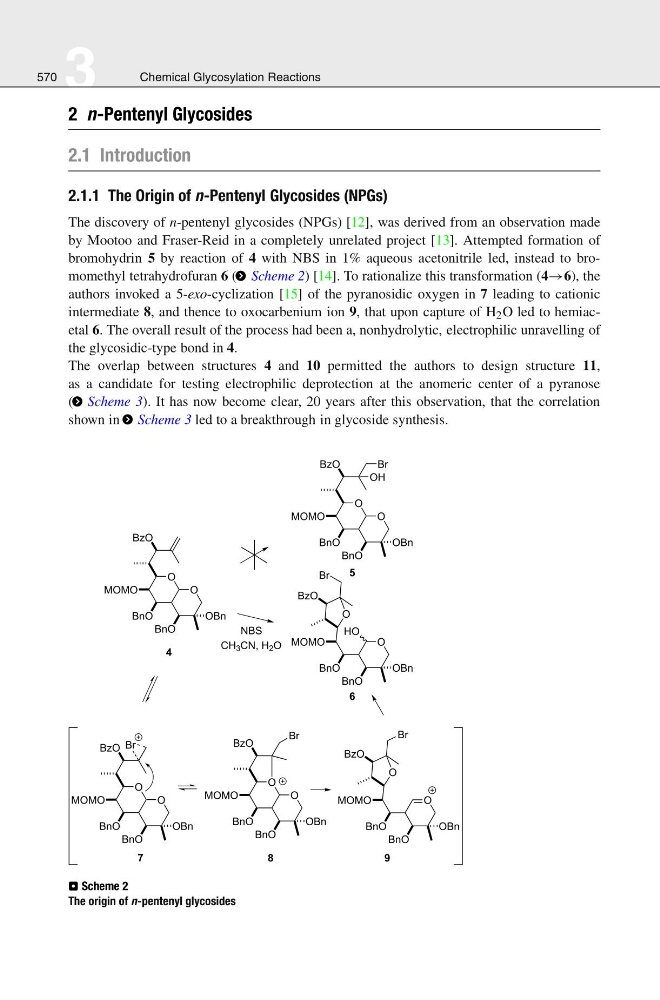
bromohydrin 5 by reaction of 4 with NBS in 1% aqueous acetonitrile led, instead to bromomethyl tetrahydrofuran 6 ( > Scheme 2) [14]. To rationalize this transformation (4→6), the
authors invoked a 5-exo-cyclization [15] of the pyranosidic oxygen in 7 leading to cationic
intermediate 8, and thence to oxocarbenium ion 9, that upon capture of H 2 O led to hemiacetal 6. The overall result of the process had been a, nonhydrolytic, electrophilic unravelling of
the glycosidic-type bond in 4.
The overlap between structures 4 and 10 permitted the authors to design structure 11,
as a candidate for testing electrophilic deprotection at the anomeric center of a pyranose
( > Scheme 3). It has now become clear, 20 years after this observation, that the correlation
shown in > Scheme 3 led to a breakthrough in glycoside synthesis.
⊡ Scheme 2
The origin of n-pentenyl glycosides