

O-Glycosyl Donors
3.4
571
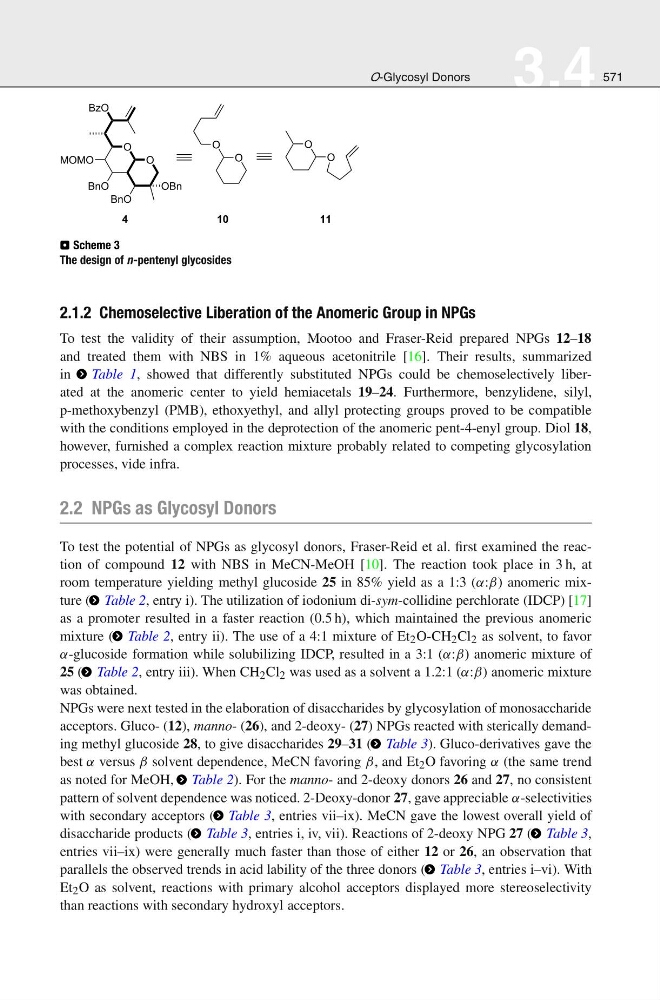
⊡ Scheme 3
The design of n-pentenyl glycosides
2.1.2 Chemoselective Liberation of the Anomeric Group in NPGs
To test the validity of their assumption, Mootoo and Fraser-Reid prepared NPGs 12–18
and treated them with NBS in 1% aqueous acetonitrile [16]. Their results, summarized
in > Table 1, showed that differently substituted NPGs could be chemoselectively liberated at the anomeric center to yield hemiacetals 19–24. Furthermore, benzylidene, silyl,
p-methoxybenzyl (PMB), ethoxyethyl, and allyl protecting groups proved to be compatible
with the conditions employed in the deprotection of the anomeric pent-4-enyl group. Diol 18,
however, furnished a complex reaction mixture probably related to competing glycosylation
processes, vide infra.
2.2 NPGs as Glycosyl Donors
To test the potential of NPGs as glycosyl donors, Fraser-Reid et al. first examined the reaction of compound 12 with NBS in MeCN-MeOH [10]. The reaction took place in 3 h, at
room temperature yielding methyl glucoside 25 in 85% yield as a 1:3 (α:β) anomeric mixture ( > Table 2, entry i). The utilization of iodonium di-sym-collidine perchlorate (IDCP) [17]
as a promoter resulted in a faster reaction (0.5 h), which maintained the previous anomeric
mixture ( > Table 2, entry ii). The use of a 4:1 mixture of Et 2 O-CH 2 Cl 2 as solvent, to favor
α-glucoside formation while solubilizing IDCP, resulted in a 3:1 (α:β) anomeric mixture of
25 ( > Table 2, entry iii). When CH 2 Cl 2 was used as a solvent a 1.2:1 (α:β) anomeric mixture
was obtained.
NPGs were next tested in the elaboration of disaccharides by glycosylation of monosaccharide
acceptors. Gluco- (12), manno- (26), and 2-deoxy- (27) NPGs reacted with sterically demanding methyl glucoside 28, to give disaccharides 29–31 ( > Table 3). Gluco-derivatives gave the
best α versus β solvent dependence, MeCN favoring β, and Et 2 O favoring α (the same trend
as noted for MeOH, > Table 2). For the manno- and 2-deoxy donors 26 and 27, no consistent
pattern of solvent dependence was noticed. 2-Deoxy-donor 27, gave appreciable α-selectivities
with secondary acceptors ( > Table 3, entries vii–ix). MeCN gave the lowest overall yield of
disaccharide products ( > Table 3, entries i, iv, vii). Reactions of 2-deoxy NPG 27 ( > Table 3,
entries vii–ix) were generally much faster than those of either 12 or 26, an observation that
parallels the observed trends in acid lability of the three donors ( > Table 3, entries i–vi). With
Et 2 O as solvent, reactions with primary alcohol acceptors displayed more stereoselectivity
than reactions with secondary hydroxyl acceptors.