

O-Glycosyl Donors
3.4
569
include: (a) preparation under mild reaction conditions, (b) selective activation by reagents that
would not interfere with the protecting and functional groups present in the donor and the glycosyl acceptor, and (c) good reactivity [1,2,3,4]. More recently, the advent of convergent block
synthesis to tackle complex oligosaccharide preparations have also demanded that glycosyl
donor building blocks (d) are sufficiently stable to be purified and stored for considerable
periods of time, and (e) are resistant towards a wide range of reaction conditions [5,6,7,8,9].
According to this, O-glycosyl donors (the topic of this chapter), because of their remarkable
“shelf-life“ and stability (conditions d, e) will be attractive candidates for oligosaccharide
block synthesis, provided that conditions a, b, and c are also met.
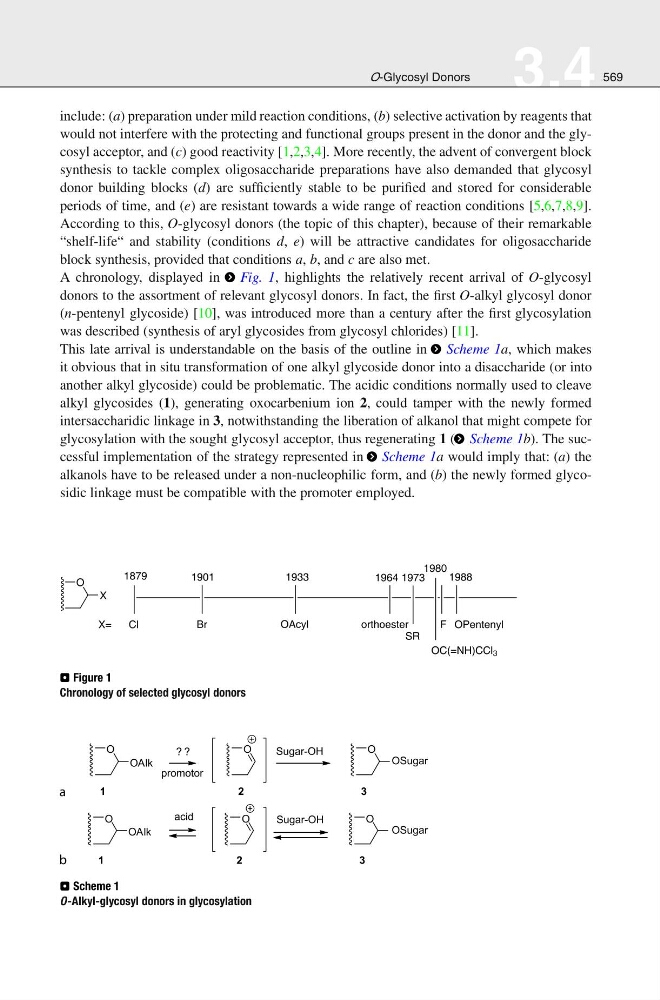
A chronology, displayed in > Fig. 1, highlights the relatively recent arrival of O-glycosyl
donors to the assortment of relevant glycosyl donors. In fact, the first O-alkyl glycosyl donor
(n-pentenyl glycoside) [10], was introduced more than a century after the first glycosylation
was described (synthesis of aryl glycosides from glycosyl chlorides) [11].
This late arrival is understandable on the basis of the outline in > Scheme 1a, which makes
it obvious that in situ transformation of one alkyl glycoside donor into a disaccharide (or into
another alkyl glycoside) could be problematic. The acidic conditions normally used to cleave
alkyl glycosides (1), generating oxocarbenium ion 2, could tamper with the newly formed
intersaccharidic linkage in 3, notwithstanding the liberation of alkanol that might compete for
glycosylation with the sought glycosyl acceptor, thus regenerating 1 ( > Scheme 1b). The successful implementation of the strategy represented in > Scheme 1a would imply that: (a) the
alkanols have to be released under a non-nucleophilic form, and (b) the newly formed glycosidic linkage must be compatible with the promoter employed.
⊡ Figure 1
Chronology of selected glycosyl donors
⊡ Scheme 1
O-Alkyl-glycosyl donors in glycosylation