

Structure and Conformation of Carbohydrates
1.1
27
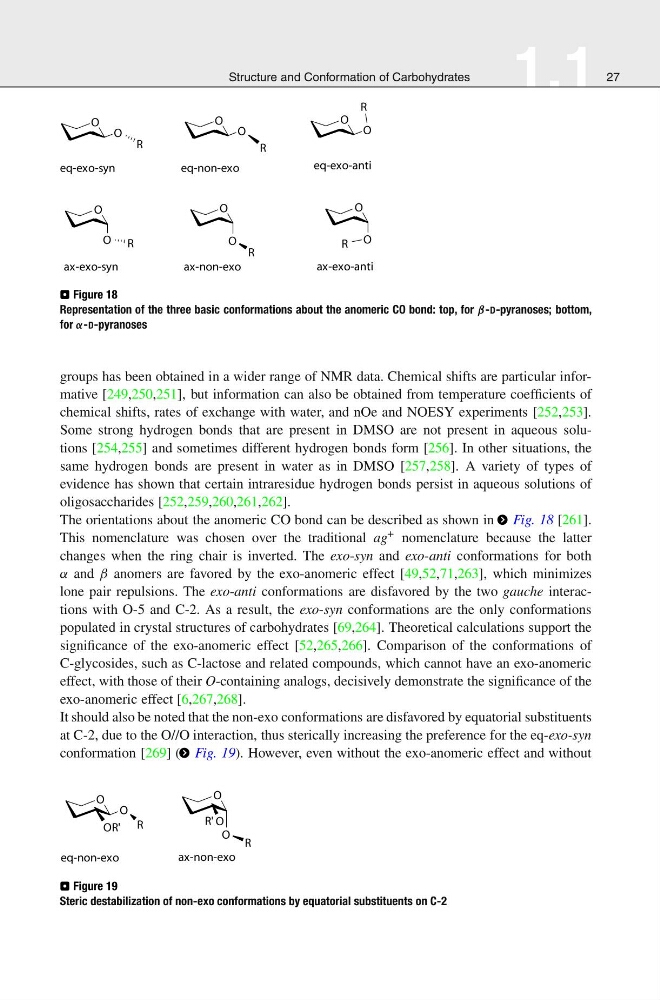
⊡ Figure 18
Representation of the three basic conformations about the anomeric CO bond: top, for β-D-pyranoses; bottom,
for α-D-pyranoses
groups has been obtained in a wider range of NMR data. Chemical shifts are particular informative [249,250,251], but information can also be obtained from temperature coefficients of
chemical shifts, rates of exchange with water, and nOe and NOESY experiments [252,253].
Some strong hydrogen bonds that are present in DMSO are not present in aqueous solutions [254,255] and sometimes different hydrogen bonds form [256]. In other situations, the
same hydrogen bonds are present in water as in DMSO [257,258]. A variety of types of
evidence has shown that certain intraresidue hydrogen bonds persist in aqueous solutions of
oligosaccharides [252,259,260,261,262].
The orientations about the anomeric CO bond can be described as shown in > Fig. 18 [261].
This nomenclature was chosen over the traditional ag + nomenclature because the latter
changes when the ring chair is inverted. The exo-syn and exo-anti conformations for both
α and β anomers are favored by the exo-anomeric effect [49,52,71,263], which minimizes
lone pair repulsions. The exo-anti conformations are disfavored by the two gauche interactions with O-5 and C-2. As a result, the exo-syn conformations are the only conformations
populated in crystal structures of carbohydrates [69,264]. Theoretical calculations support the
significance of the exo-anomeric effect [52,265,266]. Comparison of the conformations of
C-glycosides, such as C-lactose and related compounds, which cannot have an exo-anomeric
effect, with those of their O-containing analogs, decisively demonstrate the significance of the
exo-anomeric effect [6,267,268].
It should also be noted that the non-exo conformations are disfavored by equatorial substituents
at C-2, due to the O//O interaction, thus sterically increasing the preference for the eq-exo-syn
conformation [269] ( > Fig. 19). However, even without the exo-anomeric effect and without
⊡ Figure 19
Steric destabilization of non-exo conformations by equatorial substituents on C-2
1.1
27
⊡ Figure 18
Representation of the three basic conformations about the anomeric CO bond: top, for β-D-pyranoses; bottom,
for α-D-pyranoses
groups has been obtained in a wider range of NMR data. Chemical shifts are particular informative [249,250,251], but information can also be obtained from temperature coefficients of
chemical shifts, rates of exchange with water, and nOe and NOESY experiments [252,253].
Some strong hydrogen bonds that are present in DMSO are not present in aqueous solutions [254,255] and sometimes different hydrogen bonds form [256]. In other situations, the
same hydrogen bonds are present in water as in DMSO [257,258]. A variety of types of
evidence has shown that certain intraresidue hydrogen bonds persist in aqueous solutions of
oligosaccharides [252,259,260,261,262].
The orientations about the anomeric CO bond can be described as shown in > Fig. 18 [261].
This nomenclature was chosen over the traditional ag + nomenclature because the latter
changes when the ring chair is inverted. The exo-syn and exo-anti conformations for both
α and β anomers are favored by the exo-anomeric effect [49,52,71,263], which minimizes
lone pair repulsions. The exo-anti conformations are disfavored by the two gauche interactions with O-5 and C-2. As a result, the exo-syn conformations are the only conformations
populated in crystal structures of carbohydrates [69,264]. Theoretical calculations support the
significance of the exo-anomeric effect [52,265,266]. Comparison of the conformations of
C-glycosides, such as C-lactose and related compounds, which cannot have an exo-anomeric
effect, with those of their O-containing analogs, decisively demonstrate the significance of the
exo-anomeric effect [6,267,268].
It should also be noted that the non-exo conformations are disfavored by equatorial substituents
at C-2, due to the O//O interaction, thus sterically increasing the preference for the eq-exo-syn
conformation [269] ( > Fig. 19). However, even without the exo-anomeric effect and without
⊡ Figure 19
Steric destabilization of non-exo conformations by equatorial substituents on C-2