

28
1
General Principles
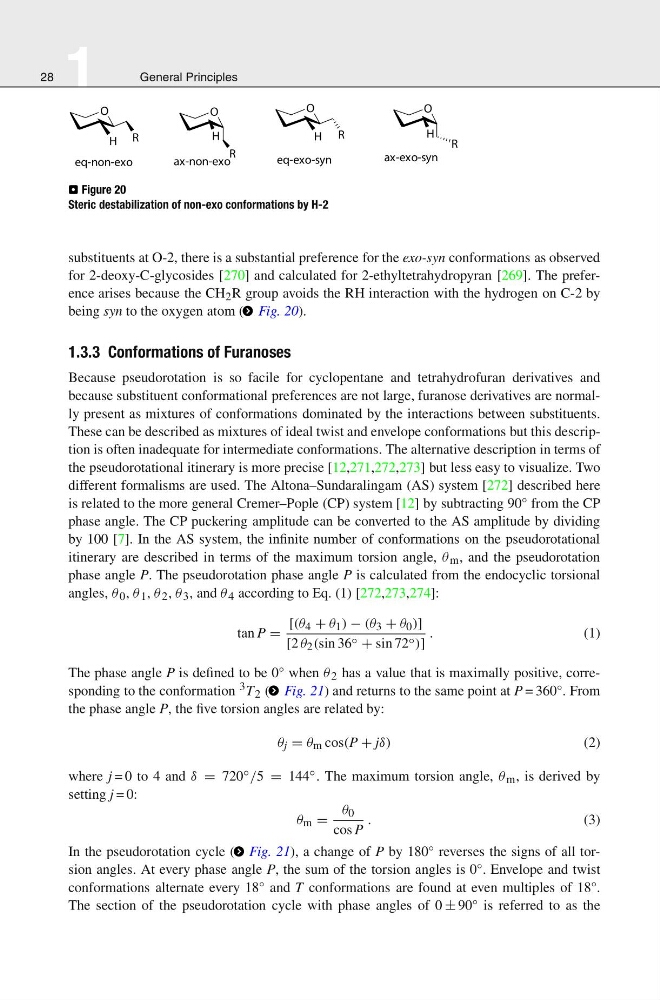
⊡ Figure 20
Steric destabilization of non-exo conformations by H-2
substituents at O-2, there is a substantial preference for the exo-syn conformations as observed
for 2-deoxy-C-glycosides [270] and calculated for 2-ethyltetrahydropyran [269]. The preference arises because the CH 2 R group avoids the RH interaction with the hydrogen on C-2 by
being syn to the oxygen atom ( > Fig. 20).
1.3.3 Conformations of Furanoses
Because pseudorotation is so facile for cyclopentane and tetrahydrofuran derivatives and
because substituent conformational preferences are not large, furanose derivatives are normally present as mixtures of conformations dominated by the interactions between substituents.
These can be described as mixtures of ideal twist and envelope conformations but this description is often inadequate for intermediate conformations. The alternative description in terms of
the pseudorotational itinerary is more precise [12,271,272,273] but less easy to visualize. Two
different formalisms are used. The Altona–Sundaralingam (AS) system [272] described here
is related to the more general Cremer–Pople (CP) system [12] by subtracting 90° from the CP
phase angle. The CP puckering amplitude can be converted to the AS amplitude by dividing
by 100 [7]. In the AS system, the infinite number of conformations on the pseudorotational
itinerary are described in terms of the maximum torsion angle, θ m , and the pseudorotation
phase angle P. The pseudorotation phase angle P is calculated from the endocyclic torsional
angles, θ 0 , θ 1 , θ 2 , θ 3 , and θ 4 according to Eq. (1) [272,273,274]:
tan P =
[(θ 4 + θ 1 ) − (θ 3 + θ 0 )]
[2 θ 2 (sin 36 ◦ + sin 72 ◦ )]
.
(1)
The phase angle P is defined to be 0° when θ 2 has a value that is maximally positive, corresponding to the conformation 3 T 2 ( > Fig. 21) and returns to the same point at P = 360°. From
the phase angle P, the five torsion angles are related by:
θ j = θ m cos(P + jδ)
(2)
where j = 0 to 4 and δ = 720 ◦ /5 = 144 ◦ . The maximum torsion angle, θ m , is derived by
setting j = 0:
θ m =
θ 0
cos P
.
(3)
In the pseudorotation cycle ( > Fig. 21), a change of P by 180° reverses the signs of all torsion angles. At every phase angle P, the sum of the torsion angles is 0°. Envelope and twist
conformations alternate every 18° and T conformations are found at even multiples of 18°.
The section of the pseudorotation cycle with phase angles of 0 ± 90° is referred to as the
1
General Principles
⊡ Figure 20
Steric destabilization of non-exo conformations by H-2
substituents at O-2, there is a substantial preference for the exo-syn conformations as observed
for 2-deoxy-C-glycosides [270] and calculated for 2-ethyltetrahydropyran [269]. The preference arises because the CH 2 R group avoids the RH interaction with the hydrogen on C-2 by
being syn to the oxygen atom ( > Fig. 20).
1.3.3 Conformations of Furanoses
Because pseudorotation is so facile for cyclopentane and tetrahydrofuran derivatives and
because substituent conformational preferences are not large, furanose derivatives are normally present as mixtures of conformations dominated by the interactions between substituents.
These can be described as mixtures of ideal twist and envelope conformations but this description is often inadequate for intermediate conformations. The alternative description in terms of
the pseudorotational itinerary is more precise [12,271,272,273] but less easy to visualize. Two
different formalisms are used. The Altona–Sundaralingam (AS) system [272] described here
is related to the more general Cremer–Pople (CP) system [12] by subtracting 90° from the CP
phase angle. The CP puckering amplitude can be converted to the AS amplitude by dividing
by 100 [7]. In the AS system, the infinite number of conformations on the pseudorotational
itinerary are described in terms of the maximum torsion angle, θ m , and the pseudorotation
phase angle P. The pseudorotation phase angle P is calculated from the endocyclic torsional
angles, θ 0 , θ 1 , θ 2 , θ 3 , and θ 4 according to Eq. (1) [272,273,274]:
tan P =
[(θ 4 + θ 1 ) − (θ 3 + θ 0 )]
[2 θ 2 (sin 36 ◦ + sin 72 ◦ )]
.
(1)
The phase angle P is defined to be 0° when θ 2 has a value that is maximally positive, corresponding to the conformation 3 T 2 ( > Fig. 21) and returns to the same point at P = 360°. From
the phase angle P, the five torsion angles are related by:
θ j = θ m cos(P + jδ)
(2)
where j = 0 to 4 and δ = 720 ◦ /5 = 144 ◦ . The maximum torsion angle, θ m , is derived by
setting j = 0:
θ m =
θ 0
cos P
.
(3)
In the pseudorotation cycle ( > Fig. 21), a change of P by 180° reverses the signs of all torsion angles. At every phase angle P, the sum of the torsion angles is 0°. Envelope and twist
conformations alternate every 18° and T conformations are found at even multiples of 18°.
The section of the pseudorotation cycle with phase angles of 0 ± 90° is referred to as the