

26
1
General Principles
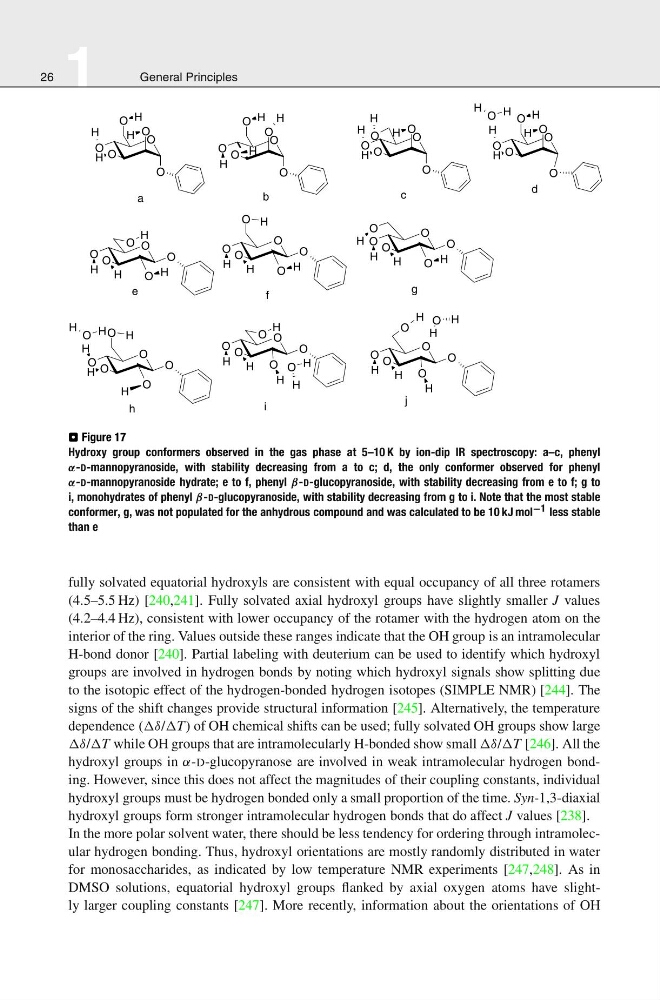
⊡ Figure 17
Hydroxy group conformers observed in the gas phase at 5–10 K by ion-dip IR spectroscopy: a–c, phenyl
α-D-mannopyranoside, with stability decreasing from a to c; d, the only conformer observed for phenyl
α-D-mannopyranoside hydrate; e to f, phenyl β-D-glucopyranoside, with stability decreasing from e to f; g to
i, monohydrates of phenyl β-D-glucopyranoside, with stability decreasing from g to i. Note that the most stable
conformer, g, was not populated for the anhydrous compound and was calculated to be 10 kJ mol −1 less stable
than e
fully solvated equatorial hydroxyls are consistent with equal occupancy of all three rotamers
(4.5–5.5 Hz) [240,241]. Fully solvated axial hydroxyl groups have slightly smaller J values
(4.2–4.4 Hz), consistent with lower occupancy of the rotamer with the hydrogen atom on the
interior of the ring. Values outside these ranges indicate that the OH group is an intramolecular
H-bond donor [240]. Partial labeling with deuterium can be used to identify which hydroxyl
groups are involved in hydrogen bonds by noting which hydroxyl signals show splitting due
to the isotopic effect of the hydrogen-bonded hydrogen isotopes (SIMPLE NMR) [244]. The
signs of the shift changes provide structural information [245]. Alternatively, the temperature
dependence ( of OH chemical shifts can be used; fully solvated OH groups show large
while OH groups that are intramolecularly H-bonded show small [246]. All the
hydroxyl groups in α-D-glucopyranose are involved in weak intramolecular hydrogen bonding. However, since this does not affect the magnitudes of their coupling constants, individual
hydroxyl groups must be hydrogen bonded only a small proportion of the time. Syn-1,3-diaxial
hydroxyl groups form stronger intramolecular hydrogen bonds that do affect J values [238].
In the more polar solvent water, there should be less tendency for ordering through intramolecular hydrogen bonding. Thus, hydroxyl orientations are mostly randomly distributed in water
for monosaccharides, as indicated by low temperature NMR experiments [247,248]. As in
DMSO solutions, equatorial hydroxyl groups flanked by axial oxygen atoms have slightly larger coupling constants [247]. More recently, information about the orientations of OH
1
General Principles
⊡ Figure 17
Hydroxy group conformers observed in the gas phase at 5–10 K by ion-dip IR spectroscopy: a–c, phenyl
α-D-mannopyranoside, with stability decreasing from a to c; d, the only conformer observed for phenyl
α-D-mannopyranoside hydrate; e to f, phenyl β-D-glucopyranoside, with stability decreasing from e to f; g to
i, monohydrates of phenyl β-D-glucopyranoside, with stability decreasing from g to i. Note that the most stable
conformer, g, was not populated for the anhydrous compound and was calculated to be 10 kJ mol −1 less stable
than e
fully solvated equatorial hydroxyls are consistent with equal occupancy of all three rotamers
(4.5–5.5 Hz) [240,241]. Fully solvated axial hydroxyl groups have slightly smaller J values
(4.2–4.4 Hz), consistent with lower occupancy of the rotamer with the hydrogen atom on the
interior of the ring. Values outside these ranges indicate that the OH group is an intramolecular
H-bond donor [240]. Partial labeling with deuterium can be used to identify which hydroxyl
groups are involved in hydrogen bonds by noting which hydroxyl signals show splitting due
to the isotopic effect of the hydrogen-bonded hydrogen isotopes (SIMPLE NMR) [244]. The
signs of the shift changes provide structural information [245]. Alternatively, the temperature
dependence ( of OH chemical shifts can be used; fully solvated OH groups show large
while OH groups that are intramolecularly H-bonded show small [246]. All the
hydroxyl groups in α-D-glucopyranose are involved in weak intramolecular hydrogen bonding. However, since this does not affect the magnitudes of their coupling constants, individual
hydroxyl groups must be hydrogen bonded only a small proportion of the time. Syn-1,3-diaxial
hydroxyl groups form stronger intramolecular hydrogen bonds that do affect J values [238].
In the more polar solvent water, there should be less tendency for ordering through intramolecular hydrogen bonding. Thus, hydroxyl orientations are mostly randomly distributed in water
for monosaccharides, as indicated by low temperature NMR experiments [247,248]. As in
DMSO solutions, equatorial hydroxyl groups flanked by axial oxygen atoms have slightly larger coupling constants [247]. More recently, information about the orientations of OH