

Structure and Conformation of Carbohydrates
1.1
25
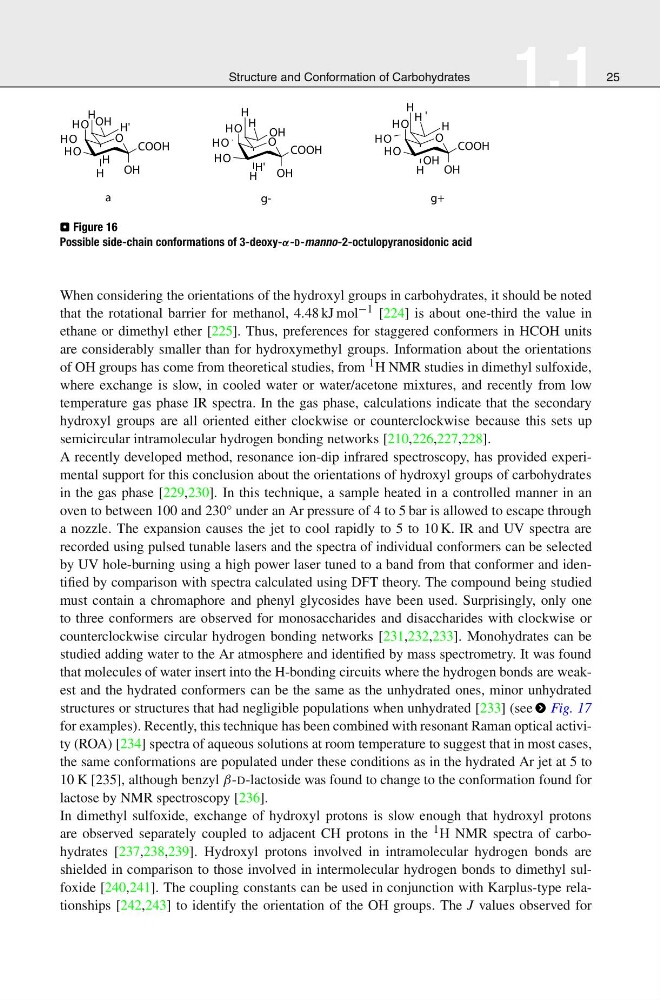
⊡ Figure 16
Possible side-chain conformations of 3-deoxy-α-D-manno-2-octulopyranosidonic acid
When considering the orientations of the hydroxyl groups in carbohydrates, it should be noted
that the rotational barrier for methanol, 4.48 kJ mol −1 [224] is about one-third the value in
ethane or dimethyl ether [225]. Thus, preferences for staggered conformers in HCOH units
are considerably smaller than for hydroxymethyl groups. Information about the orientations
of OH groups has come from theoretical studies, from 1 H NMR studies in dimethyl sulfoxide,
where exchange is slow, in cooled water or water/acetone mixtures, and recently from low
temperature gas phase IR spectra. In the gas phase, calculations indicate that the secondary
hydroxyl groups are all oriented either clockwise or counterclockwise because this sets up
semicircular intramolecular hydrogen bonding networks [210,226,227,228].
A recently developed method, resonance ion-dip infrared spectroscopy, has provided experimental support for this conclusion about the orientations of hydroxyl groups of carbohydrates
in the gas phase [229,230]. In this technique, a sample heated in a controlled manner in an
oven to between 100 and 230° under an Ar pressure of 4 to 5 bar is allowed to escape through
a nozzle. The expansion causes the jet to cool rapidly to 5 to 10 K. IR and UV spectra are
recorded using pulsed tunable lasers and the spectra of individual conformers can be selected
by UV hole-burning using a high power laser tuned to a band from that conformer and identified by comparison with spectra calculated using DFT theory. The compound being studied
must contain a chromaphore and phenyl glycosides have been used. Surprisingly, only one
to three conformers are observed for monosaccharides and disaccharides with clockwise or
counterclockwise circular hydrogen bonding networks [231,232,233]. Monohydrates can be
studied adding water to the Ar atmosphere and identified by mass spectrometry. It was found
that molecules of water insert into the H-bonding circuits where the hydrogen bonds are weakest and the hydrated conformers can be the same as the unhydrated ones, minor unhydrated
structures or structures that had negligible populations when unhydrated [233] (see > Fig. 17
for examples). Recently, this technique has been combined with resonant Raman optical activity (ROA) [234] spectra of aqueous solutions at room temperature to suggest that in most cases,
the same conformations are populated under these conditions as in the hydrated Ar jet at 5 to
10 K [235], although benzyl β-D-lactoside was found to change to the conformation found for
lactose by NMR spectroscopy [236].
In dimethyl sulfoxide, exchange of hydroxyl protons is slow enough that hydroxyl protons
are observed separately coupled to adjacent CH protons in the 1 H NMR spectra of carbohydrates [237,238,239]. Hydroxyl protons involved in intramolecular hydrogen bonds are
shielded in comparison to those involved in intermolecular hydrogen bonds to dimethyl sulfoxide [240,241]. The coupling constants can be used in conjunction with Karplus-type relationships [242,243] to identify the orientation of the OH groups. The J values observed for
1.1
25
⊡ Figure 16
Possible side-chain conformations of 3-deoxy-α-D-manno-2-octulopyranosidonic acid
When considering the orientations of the hydroxyl groups in carbohydrates, it should be noted
that the rotational barrier for methanol, 4.48 kJ mol −1 [224] is about one-third the value in
ethane or dimethyl ether [225]. Thus, preferences for staggered conformers in HCOH units
are considerably smaller than for hydroxymethyl groups. Information about the orientations
of OH groups has come from theoretical studies, from 1 H NMR studies in dimethyl sulfoxide,
where exchange is slow, in cooled water or water/acetone mixtures, and recently from low
temperature gas phase IR spectra. In the gas phase, calculations indicate that the secondary
hydroxyl groups are all oriented either clockwise or counterclockwise because this sets up
semicircular intramolecular hydrogen bonding networks [210,226,227,228].
A recently developed method, resonance ion-dip infrared spectroscopy, has provided experimental support for this conclusion about the orientations of hydroxyl groups of carbohydrates
in the gas phase [229,230]. In this technique, a sample heated in a controlled manner in an
oven to between 100 and 230° under an Ar pressure of 4 to 5 bar is allowed to escape through
a nozzle. The expansion causes the jet to cool rapidly to 5 to 10 K. IR and UV spectra are
recorded using pulsed tunable lasers and the spectra of individual conformers can be selected
by UV hole-burning using a high power laser tuned to a band from that conformer and identified by comparison with spectra calculated using DFT theory. The compound being studied
must contain a chromaphore and phenyl glycosides have been used. Surprisingly, only one
to three conformers are observed for monosaccharides and disaccharides with clockwise or
counterclockwise circular hydrogen bonding networks [231,232,233]. Monohydrates can be
studied adding water to the Ar atmosphere and identified by mass spectrometry. It was found
that molecules of water insert into the H-bonding circuits where the hydrogen bonds are weakest and the hydrated conformers can be the same as the unhydrated ones, minor unhydrated
structures or structures that had negligible populations when unhydrated [233] (see > Fig. 17
for examples). Recently, this technique has been combined with resonant Raman optical activity (ROA) [234] spectra of aqueous solutions at room temperature to suggest that in most cases,
the same conformations are populated under these conditions as in the hydrated Ar jet at 5 to
10 K [235], although benzyl β-D-lactoside was found to change to the conformation found for
lactose by NMR spectroscopy [236].
In dimethyl sulfoxide, exchange of hydroxyl protons is slow enough that hydroxyl protons
are observed separately coupled to adjacent CH protons in the 1 H NMR spectra of carbohydrates [237,238,239]. Hydroxyl protons involved in intramolecular hydrogen bonds are
shielded in comparison to those involved in intermolecular hydrogen bonds to dimethyl sulfoxide [240,241]. The coupling constants can be used in conjunction with Karplus-type relationships [242,243] to identify the orientation of the OH groups. The J values observed for