

24
1
General Principles
The conformations of the side-chains of sialic acid and KDO can be predicted using the principles outlined above. For N-acetyl-D-neuraminic acid ( > Fig. 15), the conformation of the
side chain can be termed gg, gt, or tg, using the orientations of C-8 with respect to O-6 and
C-5 to define the conformers, as for hydroxymethyl conformers. The gt conformer has three
minor O//H interactions, an N//H interaction, two C/O and an O/O interaction, the gg conformer has C//H and the major C//O interaction plus two C/O and a C/C interaction, while
the tg conformer has major C//N and C//O interactions plus C/C and O/O interactions. Not
surprisingly, the gt conformer is preferred as shown by small J 6,7 values both for the parent
compound (0.8Hz [166]) and for α-(268) linked oligomers (0.5 to 1.0Hz [217]). The planar
extended conformation about the C-7 – C-8 bond avoids the O//O and C//O interactions present
in the other rotamers and is strongly preferred (J 7,8 9.2 Hz) for the parent compound [166,218].
The J 8,9 values are 6.2 and 2.5 Hz, consistent with a mixture of the OH extended conformer
( > Fig. 15 bottom center) and the gauche conformer which avoids an O//O interaction (bottom right). The NMR relaxation times for C-7 and C-8 are similar to those of the secondary
ring suggesting that there is only one populated conformer for the C-7 C-8 portion of the side
chain [167,168].
However, in the α-(268) linked sialic acid oligomers, the OH-8 is replaced by OR-8, where
R is the bulky quaternary center C-2’ of the next sialic acid. Not surprisingly, in the α-(268)
linked sialic acid trisaccharide and in the α-(268) linked sialic acid polymer, colominic acid,
mixtures of rotamers about the C-7–C-8 bond are adopted [219,220] that have been interpreted
for the polymer as giving a helix [221] or a short-lived helix [219], consistent with this polymer
being a conformational epitope for serogroup B of Neisseria meningitidis. More recent detailed
NMR relaxation studies have concluded that the polymer is a random coil with no helix present
for any extended period and that the polymer has considerable flexibility about the exocyclic
torsional angles [222].
The axial hydroxyl group at C-5 and the R-configuration at C-7 of 3-deoxy-α-D-manno-2octulopyranosidonic acid result in the gt conformer about the C-6–C-7 bond being strongly
preferred to avoid C//O and O//O interactions [174] ( > Fig. 16). Interestingly, the populations
of the hydroxymethyl group rotamers change when the anomeric configuration of the methyl
glycoside of the ammonium salt is converted from α to β. The a conformer (defined by the
relationship of C-6 and O-8) should be more stable; it has only a O/O interaction, while the
g− conformer has an O//O interaction and the g+ conformer has O/O and O//O interactions.
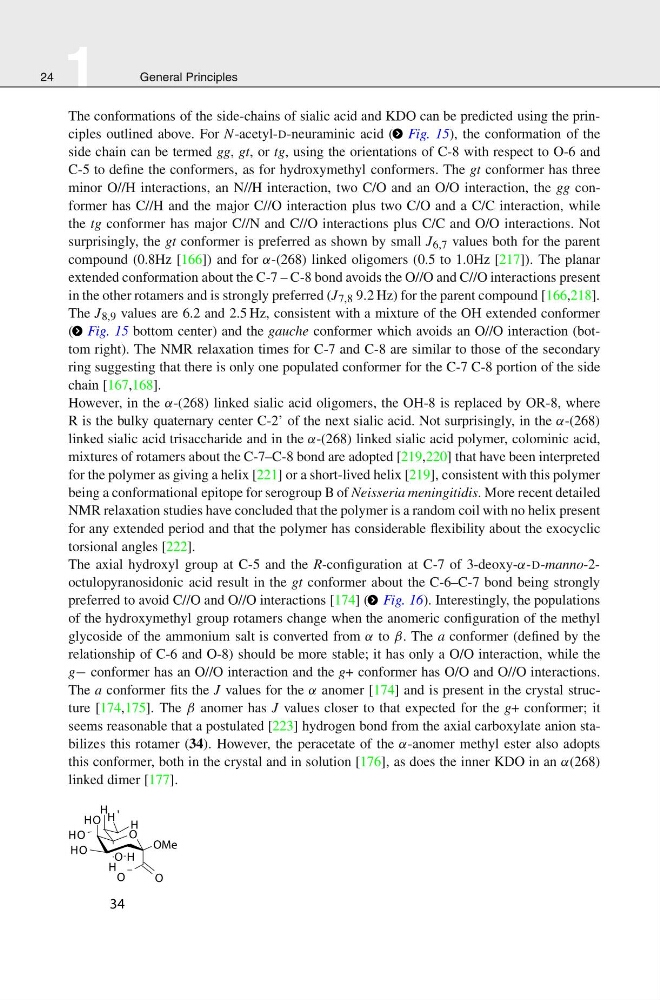
The a conformer fits the J values for the α anomer [174] and is present in the crystal structure [174,175]. The β anomer has J values closer to that expected for the g+ conformer; it
seems reasonable that a postulated [223] hydrogen bond from the axial carboxylate anion stabilizes this rotamer (34). However, the peracetate of the α-anomer methyl ester also adopts
this conformer, both in the crystal and in solution [176], as does the inner KDO in an α(268)
linked dimer [177].
1
General Principles
The conformations of the side-chains of sialic acid and KDO can be predicted using the principles outlined above. For N-acetyl-D-neuraminic acid ( > Fig. 15), the conformation of the
side chain can be termed gg, gt, or tg, using the orientations of C-8 with respect to O-6 and
C-5 to define the conformers, as for hydroxymethyl conformers. The gt conformer has three
minor O//H interactions, an N//H interaction, two C/O and an O/O interaction, the gg conformer has C//H and the major C//O interaction plus two C/O and a C/C interaction, while
the tg conformer has major C//N and C//O interactions plus C/C and O/O interactions. Not
surprisingly, the gt conformer is preferred as shown by small J 6,7 values both for the parent
compound (0.8Hz [166]) and for α-(268) linked oligomers (0.5 to 1.0Hz [217]). The planar
extended conformation about the C-7 – C-8 bond avoids the O//O and C//O interactions present
in the other rotamers and is strongly preferred (J 7,8 9.2 Hz) for the parent compound [166,218].
The J 8,9 values are 6.2 and 2.5 Hz, consistent with a mixture of the OH extended conformer
( > Fig. 15 bottom center) and the gauche conformer which avoids an O//O interaction (bottom right). The NMR relaxation times for C-7 and C-8 are similar to those of the secondary
ring suggesting that there is only one populated conformer for the C-7 C-8 portion of the side
chain [167,168].
However, in the α-(268) linked sialic acid oligomers, the OH-8 is replaced by OR-8, where
R is the bulky quaternary center C-2’ of the next sialic acid. Not surprisingly, in the α-(268)
linked sialic acid trisaccharide and in the α-(268) linked sialic acid polymer, colominic acid,
mixtures of rotamers about the C-7–C-8 bond are adopted [219,220] that have been interpreted
for the polymer as giving a helix [221] or a short-lived helix [219], consistent with this polymer
being a conformational epitope for serogroup B of Neisseria meningitidis. More recent detailed
NMR relaxation studies have concluded that the polymer is a random coil with no helix present
for any extended period and that the polymer has considerable flexibility about the exocyclic
torsional angles [222].
The axial hydroxyl group at C-5 and the R-configuration at C-7 of 3-deoxy-α-D-manno-2octulopyranosidonic acid result in the gt conformer about the C-6–C-7 bond being strongly
preferred to avoid C//O and O//O interactions [174] ( > Fig. 16). Interestingly, the populations
of the hydroxymethyl group rotamers change when the anomeric configuration of the methyl
glycoside of the ammonium salt is converted from α to β. The a conformer (defined by the
relationship of C-6 and O-8) should be more stable; it has only a O/O interaction, while the
g− conformer has an O//O interaction and the g+ conformer has O/O and O//O interactions.
The a conformer fits the J values for the α anomer [174] and is present in the crystal structure [174,175]. The β anomer has J values closer to that expected for the g+ conformer; it
seems reasonable that a postulated [223] hydrogen bond from the axial carboxylate anion stabilizes this rotamer (34). However, the peracetate of the α-anomer methyl ester also adopts
this conformer, both in the crystal and in solution [176], as does the inner KDO in an α(268)
linked dimer [177].