

Degradations and Rearrangement Reactions
2.7
393
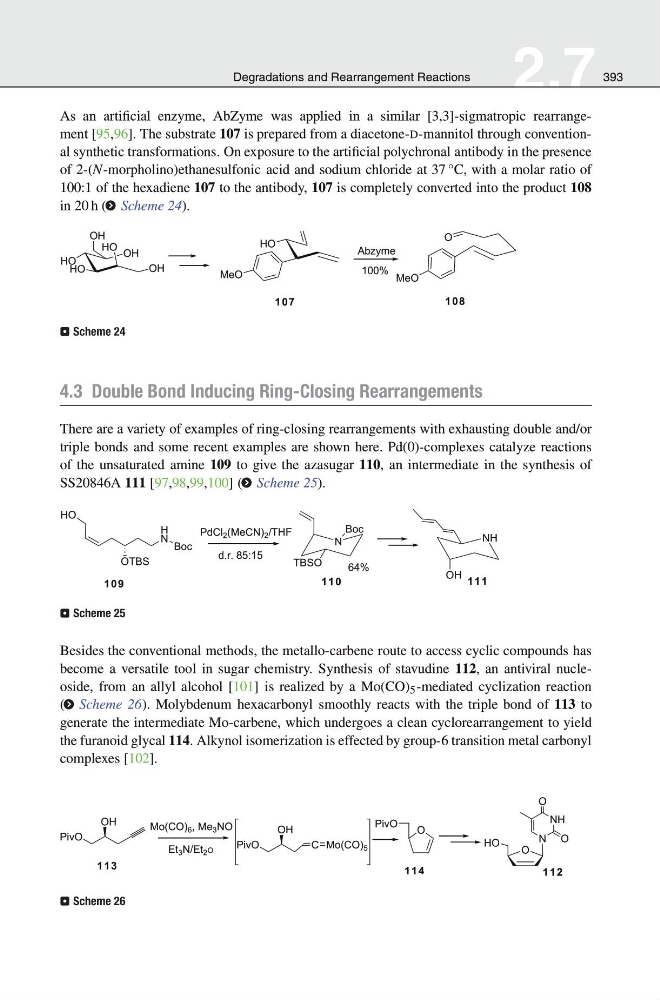
As an artificial enzyme, AbZyme was applied in a similar [3,3]-sigmatropic rearrangement [95,96]. The substrate 107 is prepared from a diacetone-D-mannitol through conventional synthetic transformations. On exposure to the artificial polychronal antibody in the presence
of 2-(N-morpholino)ethanesulfonic acid and sodium chloride at 37 °C, with a molar ratio of
100:1 of the hexadiene 107 to the antibody, 107 is completely converted into the product 108
in 20 h ( > Scheme 24).
⊡ Scheme 24
4.3 Double Bond Inducing Ring-Closing Rearrangements
There are a variety of examples of ring-closing rearrangements with exhausting double and/or
triple bonds and some recent examples are shown here. Pd(0)-complexes catalyze reactions
of the unsaturated amine 109 to give the azasugar 110, an intermediate in the synthesis of
SS20846A 111 [97,98,99,100] ( > Scheme 25).
⊡ Scheme 25
Besides the conventional methods, the metallo-carbene route to access cyclic compounds has
become a versatile tool in sugar chemistry. Synthesis of stavudine 112, an antiviral nucleoside, from an allyl alcohol [101] is realized by a Mo(CO) 5 -mediated cyclization reaction
( > Scheme 26). Molybdenum hexacarbonyl smoothly reacts with the triple bond of 113 to
generate the intermediate Mo-carbene, which undergoes a clean cyclorearrangement to yield
the furanoid glycal 114. Alkynol isomerization is effected by group-6 transition metal carbonyl
complexes [102].
⊡ Scheme 26
2.7
393
As an artificial enzyme, AbZyme was applied in a similar [3,3]-sigmatropic rearrangement [95,96]. The substrate 107 is prepared from a diacetone-D-mannitol through conventional synthetic transformations. On exposure to the artificial polychronal antibody in the presence
of 2-(N-morpholino)ethanesulfonic acid and sodium chloride at 37 °C, with a molar ratio of
100:1 of the hexadiene 107 to the antibody, 107 is completely converted into the product 108
in 20 h ( > Scheme 24).
⊡ Scheme 24
4.3 Double Bond Inducing Ring-Closing Rearrangements
There are a variety of examples of ring-closing rearrangements with exhausting double and/or
triple bonds and some recent examples are shown here. Pd(0)-complexes catalyze reactions
of the unsaturated amine 109 to give the azasugar 110, an intermediate in the synthesis of
SS20846A 111 [97,98,99,100] ( > Scheme 25).
⊡ Scheme 25
Besides the conventional methods, the metallo-carbene route to access cyclic compounds has
become a versatile tool in sugar chemistry. Synthesis of stavudine 112, an antiviral nucleoside, from an allyl alcohol [101] is realized by a Mo(CO) 5 -mediated cyclization reaction
( > Scheme 26). Molybdenum hexacarbonyl smoothly reacts with the triple bond of 113 to
generate the intermediate Mo-carbene, which undergoes a clean cyclorearrangement to yield
the furanoid glycal 114. Alkynol isomerization is effected by group-6 transition metal carbonyl
complexes [102].
⊡ Scheme 26