

394
2
General Synthetic Methods
5 Ring Isomerizations
Ring transformations are useful reactions in synthetic carbohydrate chemistry [103].
5.1 Ring Contractions
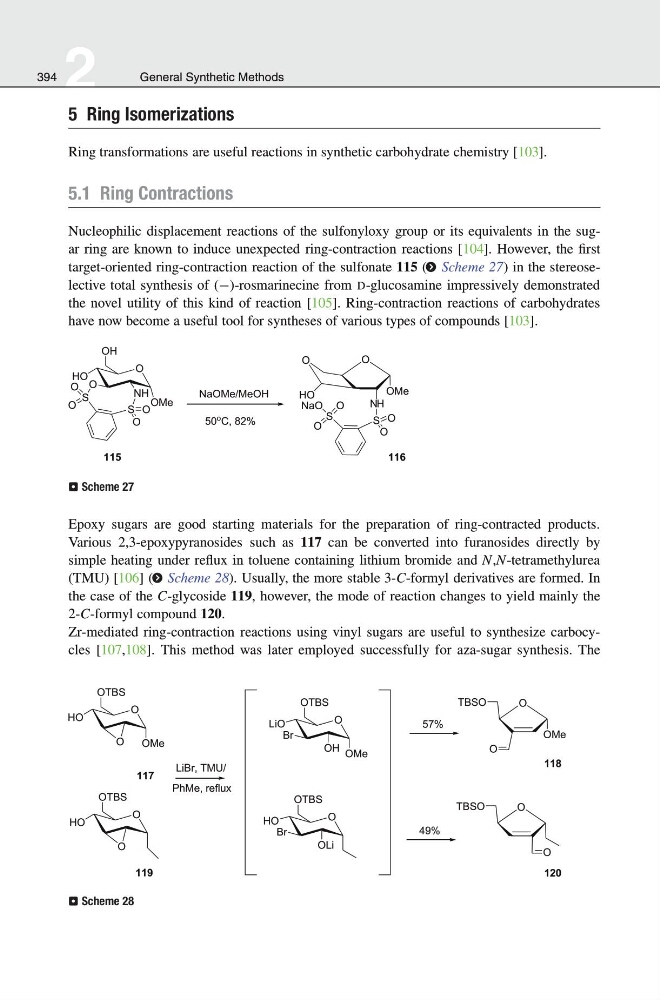
Nucleophilic displacement reactions of the sulfonyloxy group or its equivalents in the sugar ring are known to induce unexpected ring-contraction reactions [104]. However, the first
target-oriented ring-contraction reaction of the sulfonate 115 ( > Scheme 27) in the stereoselective total synthesis of (−)-rosmarinecine from D-glucosamine impressively demonstrated
the novel utility of this kind of reaction [105]. Ring-contraction reactions of carbohydrates
have now become a useful tool for syntheses of various types of compounds [103].
⊡ Scheme 27
Epoxy sugars are good starting materials for the preparation of ring-contracted products.
Various 2,3-epoxypyranosides such as 117 can be converted into furanosides directly by
simple heating under reflux in toluene containing lithium bromide and N,N-tetramethylurea
(TMU) [106] ( > Scheme 28). Usually, the more stable 3-C-formyl derivatives are formed. In
the case of the C-glycoside 119, however, the mode of reaction changes to yield mainly the
2-C-formyl compound 120.
Zr-mediated ring-contraction reactions using vinyl sugars are useful to synthesize carbocycles [107,108]. This method was later employed successfully for aza-sugar synthesis. The
⊡ Scheme 28
2
General Synthetic Methods
5 Ring Isomerizations
Ring transformations are useful reactions in synthetic carbohydrate chemistry [103].
5.1 Ring Contractions
Nucleophilic displacement reactions of the sulfonyloxy group or its equivalents in the sugar ring are known to induce unexpected ring-contraction reactions [104]. However, the first
target-oriented ring-contraction reaction of the sulfonate 115 ( > Scheme 27) in the stereoselective total synthesis of (−)-rosmarinecine from D-glucosamine impressively demonstrated
the novel utility of this kind of reaction [105]. Ring-contraction reactions of carbohydrates
have now become a useful tool for syntheses of various types of compounds [103].
⊡ Scheme 27
Epoxy sugars are good starting materials for the preparation of ring-contracted products.
Various 2,3-epoxypyranosides such as 117 can be converted into furanosides directly by
simple heating under reflux in toluene containing lithium bromide and N,N-tetramethylurea
(TMU) [106] ( > Scheme 28). Usually, the more stable 3-C-formyl derivatives are formed. In
the case of the C-glycoside 119, however, the mode of reaction changes to yield mainly the
2-C-formyl compound 120.
Zr-mediated ring-contraction reactions using vinyl sugars are useful to synthesize carbocycles [107,108]. This method was later employed successfully for aza-sugar synthesis. The
⊡ Scheme 28