

392
2
General Synthetic Methods
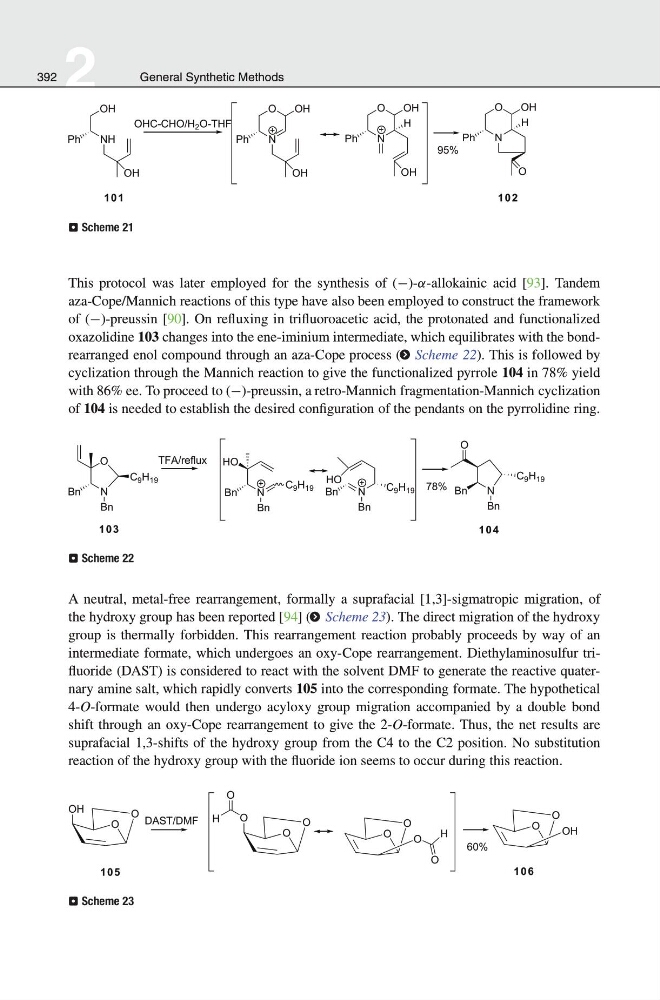
⊡ Scheme 21
This protocol was later employed for the synthesis of (−)-α-allokainic acid [93]. Tandem
aza-Cope/Mannich reactions of this type have also been employed to construct the framework
of (−)-preussin [90]. On refluxing in trifluoroacetic acid, the protonated and functionalized
oxazolidine 103 changes into the ene-iminium intermediate, which equilibrates with the bondrearranged enol compound through an aza-Cope process ( > Scheme 22). This is followed by
cyclization through the Mannich reaction to give the functionalized pyrrole 104 in 78% yield
with 86% ee. To proceed to (−)-preussin, a retro-Mannich fragmentation-Mannich cyclization
of 104 is needed to establish the desired configuration of the pendants on the pyrrolidine ring.
⊡ Scheme 22
A neutral, metal-free rearrangement, formally a suprafacial [1,3]-sigmatropic migration, of
the hydroxy group has been reported [94] ( > Scheme 23). The direct migration of the hydroxy
group is thermally forbidden. This rearrangement reaction probably proceeds by way of an
intermediate formate, which undergoes an oxy-Cope rearrangement. Diethylaminosulfur trifluoride (DAST) is considered to react with the solvent DMF to generate the reactive quaternary amine salt, which rapidly converts 105 into the corresponding formate. The hypothetical
4-O-formate would then undergo acyloxy group migration accompanied by a double bond
shift through an oxy-Cope rearrangement to give the 2-O-formate. Thus, the net results are
suprafacial 1,3-shifts of the hydroxy group from the C4 to the C2 position. No substitution
reaction of the hydroxy group with the fluoride ion seems to occur during this reaction.
⊡ Scheme 23
2
General Synthetic Methods
⊡ Scheme 21
This protocol was later employed for the synthesis of (−)-α-allokainic acid [93]. Tandem
aza-Cope/Mannich reactions of this type have also been employed to construct the framework
of (−)-preussin [90]. On refluxing in trifluoroacetic acid, the protonated and functionalized
oxazolidine 103 changes into the ene-iminium intermediate, which equilibrates with the bondrearranged enol compound through an aza-Cope process ( > Scheme 22). This is followed by
cyclization through the Mannich reaction to give the functionalized pyrrole 104 in 78% yield
with 86% ee. To proceed to (−)-preussin, a retro-Mannich fragmentation-Mannich cyclization
of 104 is needed to establish the desired configuration of the pendants on the pyrrolidine ring.
⊡ Scheme 22
A neutral, metal-free rearrangement, formally a suprafacial [1,3]-sigmatropic migration, of
the hydroxy group has been reported [94] ( > Scheme 23). The direct migration of the hydroxy
group is thermally forbidden. This rearrangement reaction probably proceeds by way of an
intermediate formate, which undergoes an oxy-Cope rearrangement. Diethylaminosulfur trifluoride (DAST) is considered to react with the solvent DMF to generate the reactive quaternary amine salt, which rapidly converts 105 into the corresponding formate. The hypothetical
4-O-formate would then undergo acyloxy group migration accompanied by a double bond
shift through an oxy-Cope rearrangement to give the 2-O-formate. Thus, the net results are
suprafacial 1,3-shifts of the hydroxy group from the C4 to the C2 position. No substitution
reaction of the hydroxy group with the fluoride ion seems to occur during this reaction.
⊡ Scheme 23