

Degradations and Rearrangement Reactions
2.7
391
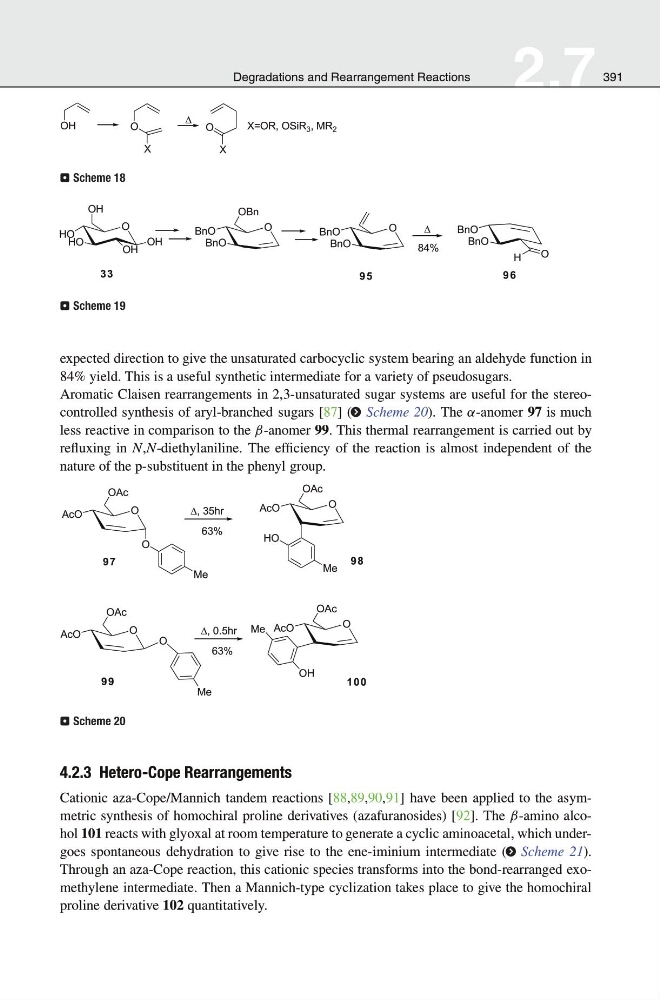
⊡ Scheme 18
⊡ Scheme 19
expected direction to give the unsaturated carbocyclic system bearing an aldehyde function in
84% yield. This is a useful synthetic intermediate for a variety of pseudosugars.
Aromatic Claisen rearrangements in 2,3-unsaturated sugar systems are useful for the stereocontrolled synthesis of aryl-branched sugars [87] ( > Scheme 20). The α-anomer 97 is much
less reactive in comparison to the β-anomer 99. This thermal rearrangement is carried out by
refluxing in N,N-diethylaniline. The efficiency of the reaction is almost independent of the
nature of the p-substituent in the phenyl group.
⊡ Scheme 20
4.2.3 Hetero-Cope Rearrangements
Cationic aza-Cope/Mannich tandem reactions [88,89,90,91] have been applied to the asymmetric synthesis of homochiral proline derivatives (azafuranosides) [92]. The β-amino alcohol 101 reacts with glyoxal at room temperature to generate a cyclic aminoacetal, which undergoes spontaneous dehydration to give rise to the ene-iminium intermediate ( > Scheme 21).
Through an aza-Cope reaction, this cationic species transforms into the bond-rearranged exomethylene intermediate. Then a Mannich-type cyclization takes place to give the homochiral
proline derivative 102 quantitatively.
2.7
391
⊡ Scheme 18
⊡ Scheme 19
expected direction to give the unsaturated carbocyclic system bearing an aldehyde function in
84% yield. This is a useful synthetic intermediate for a variety of pseudosugars.
Aromatic Claisen rearrangements in 2,3-unsaturated sugar systems are useful for the stereocontrolled synthesis of aryl-branched sugars [87] ( > Scheme 20). The α-anomer 97 is much
less reactive in comparison to the β-anomer 99. This thermal rearrangement is carried out by
refluxing in N,N-diethylaniline. The efficiency of the reaction is almost independent of the
nature of the p-substituent in the phenyl group.
⊡ Scheme 20
4.2.3 Hetero-Cope Rearrangements
Cationic aza-Cope/Mannich tandem reactions [88,89,90,91] have been applied to the asymmetric synthesis of homochiral proline derivatives (azafuranosides) [92]. The β-amino alcohol 101 reacts with glyoxal at room temperature to generate a cyclic aminoacetal, which undergoes spontaneous dehydration to give rise to the ene-iminium intermediate ( > Scheme 21).
Through an aza-Cope reaction, this cationic species transforms into the bond-rearranged exomethylene intermediate. Then a Mannich-type cyclization takes place to give the homochiral
proline derivative 102 quantitatively.