

388
2
General Synthetic Methods
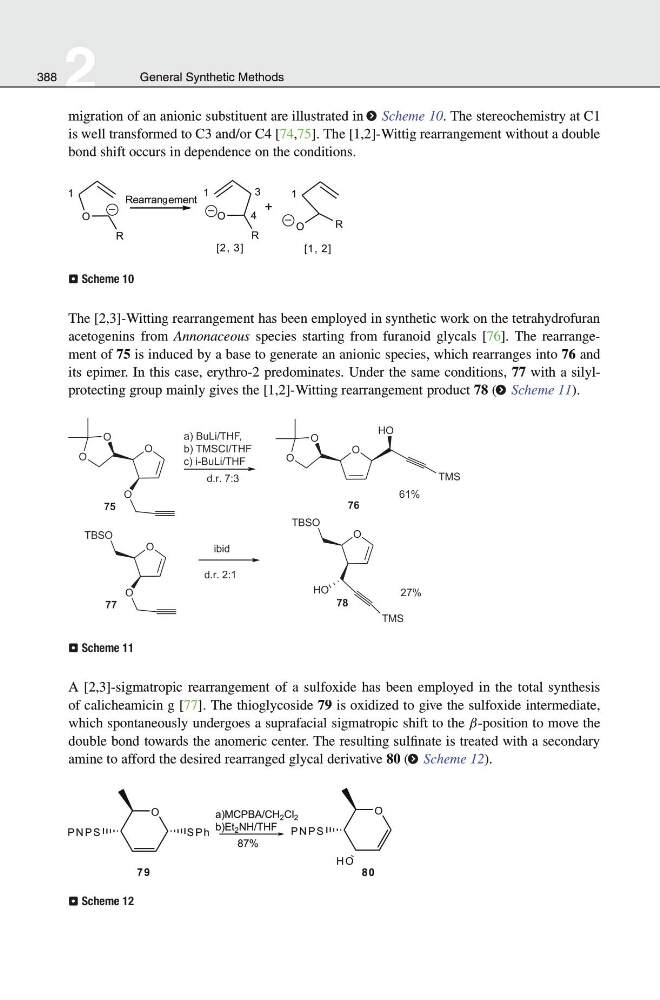
migration of an anionic substituent are illustrated in > Scheme 10. The stereochemistry at C1
is well transformed to C3 and/or C4 [74,75]. The [1,2]-Wittig rearrangement without a double
bond shift occurs in dependence on the conditions.
⊡ Scheme 10
The [2,3]-Witting rearrangement has been employed in synthetic work on the tetrahydrofuran
acetogenins from Annonaceous species starting from furanoid glycals [76]. The rearrangement of 75 is induced by a base to generate an anionic species, which rearranges into 76 and
its epimer. In this case, erythro-2 predominates. Under the same conditions, 77 with a silylprotecting group mainly gives the [1,2]-Witting rearrangement product 78 ( > Scheme 11).
⊡ Scheme 11
A [2,3]-sigmatropic rearrangement of a sulfoxide has been employed in the total synthesis
of calicheamicin g [77]. The thioglycoside 79 is oxidized to give the sulfoxide intermediate,
which spontaneously undergoes a suprafacial sigmatropic shift to the β-position to move the
double bond towards the anomeric center. The resulting sulfinate is treated with a secondary
amine to afford the desired rearranged glycal derivative 80 ( > Scheme 12).
⊡ Scheme 12
2
General Synthetic Methods
migration of an anionic substituent are illustrated in > Scheme 10. The stereochemistry at C1
is well transformed to C3 and/or C4 [74,75]. The [1,2]-Wittig rearrangement without a double
bond shift occurs in dependence on the conditions.
⊡ Scheme 10
The [2,3]-Witting rearrangement has been employed in synthetic work on the tetrahydrofuran
acetogenins from Annonaceous species starting from furanoid glycals [76]. The rearrangement of 75 is induced by a base to generate an anionic species, which rearranges into 76 and
its epimer. In this case, erythro-2 predominates. Under the same conditions, 77 with a silylprotecting group mainly gives the [1,2]-Witting rearrangement product 78 ( > Scheme 11).
⊡ Scheme 11
A [2,3]-sigmatropic rearrangement of a sulfoxide has been employed in the total synthesis
of calicheamicin g [77]. The thioglycoside 79 is oxidized to give the sulfoxide intermediate,
which spontaneously undergoes a suprafacial sigmatropic shift to the β-position to move the
double bond towards the anomeric center. The resulting sulfinate is treated with a secondary
amine to afford the desired rearranged glycal derivative 80 ( > Scheme 12).
⊡ Scheme 12