

Degradations and Rearrangement Reactions
2.7
387
component of liquefiable petroleum gas via the intermediacy of maleic anhydride. The new
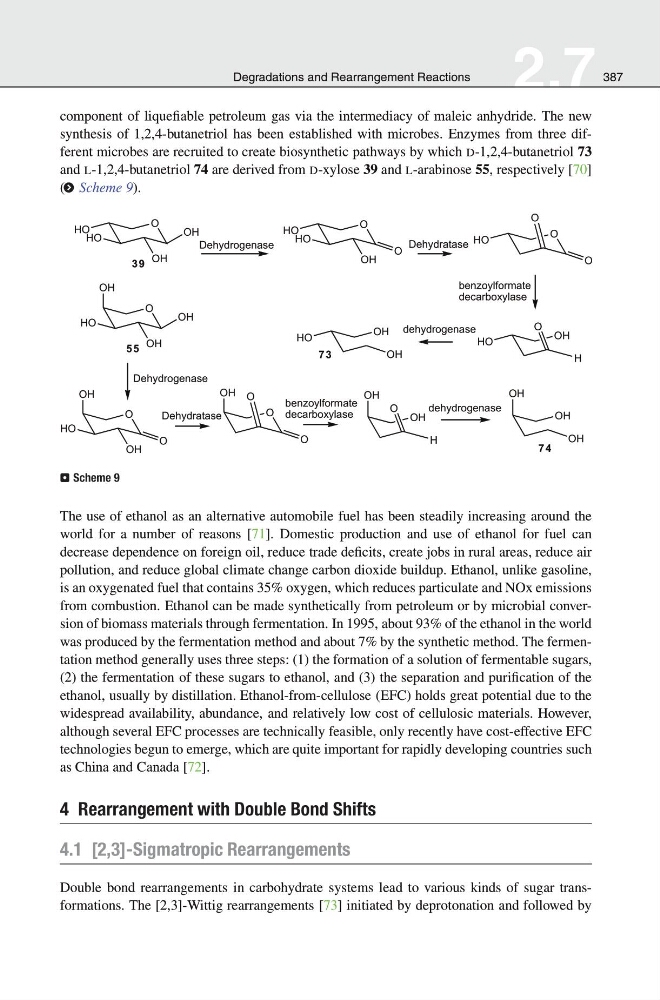
synthesis of 1,2,4-butanetriol has been established with microbes. Enzymes from three different microbes are recruited to create biosynthetic pathways by which D-1,2,4-butanetriol 73
and L-1,2,4-butanetriol 74 are derived from D-xylose 39 and L-arabinose 55, respectively [70]
( > Scheme 9).
⊡ Scheme 9
The use of ethanol as an alternative automobile fuel has been steadily increasing around the
world for a number of reasons [71]. Domestic production and use of ethanol for fuel can
decrease dependence on foreign oil, reduce trade deficits, create jobs in rural areas, reduce air
pollution, and reduce global climate change carbon dioxide buildup. Ethanol, unlike gasoline,
is an oxygenated fuel that contains 35% oxygen, which reduces particulate and NOx emissions
from combustion. Ethanol can be made synthetically from petroleum or by microbial conversion of biomass materials through fermentation. In 1995, about 93% of the ethanol in the world
was produced by the fermentation method and about 7% by the synthetic method. The fermentation method generally uses three steps: (1) the formation of a solution of fermentable sugars,
(2) the fermentation of these sugars to ethanol, and (3) the separation and purification of the
ethanol, usually by distillation. Ethanol-from-cellulose (EFC) holds great potential due to the
widespread availability, abundance, and relatively low cost of cellulosic materials. However,
although several EFC processes are technically feasible, only recently have cost-effective EFC
technologies begun to emerge, which are quite important for rapidly developing countries such
as China and Canada [72].
4 Rearrangement with Double Bond Shifts
4.1 [2,3]-Sigmatropic Rearrangements
Double bond rearrangements in carbohydrate systems lead to various kinds of sugar transformations. The [2,3]-Wittig rearrangements [73] initiated by deprotonation and followed by
2.7
387
component of liquefiable petroleum gas via the intermediacy of maleic anhydride. The new
synthesis of 1,2,4-butanetriol has been established with microbes. Enzymes from three different microbes are recruited to create biosynthetic pathways by which D-1,2,4-butanetriol 73
and L-1,2,4-butanetriol 74 are derived from D-xylose 39 and L-arabinose 55, respectively [70]
( > Scheme 9).
⊡ Scheme 9
The use of ethanol as an alternative automobile fuel has been steadily increasing around the
world for a number of reasons [71]. Domestic production and use of ethanol for fuel can
decrease dependence on foreign oil, reduce trade deficits, create jobs in rural areas, reduce air
pollution, and reduce global climate change carbon dioxide buildup. Ethanol, unlike gasoline,
is an oxygenated fuel that contains 35% oxygen, which reduces particulate and NOx emissions
from combustion. Ethanol can be made synthetically from petroleum or by microbial conversion of biomass materials through fermentation. In 1995, about 93% of the ethanol in the world
was produced by the fermentation method and about 7% by the synthetic method. The fermentation method generally uses three steps: (1) the formation of a solution of fermentable sugars,
(2) the fermentation of these sugars to ethanol, and (3) the separation and purification of the
ethanol, usually by distillation. Ethanol-from-cellulose (EFC) holds great potential due to the
widespread availability, abundance, and relatively low cost of cellulosic materials. However,
although several EFC processes are technically feasible, only recently have cost-effective EFC
technologies begun to emerge, which are quite important for rapidly developing countries such
as China and Canada [72].
4 Rearrangement with Double Bond Shifts
4.1 [2,3]-Sigmatropic Rearrangements
Double bond rearrangements in carbohydrate systems lead to various kinds of sugar transformations. The [2,3]-Wittig rearrangements [73] initiated by deprotonation and followed by