

386
2
General Synthetic Methods
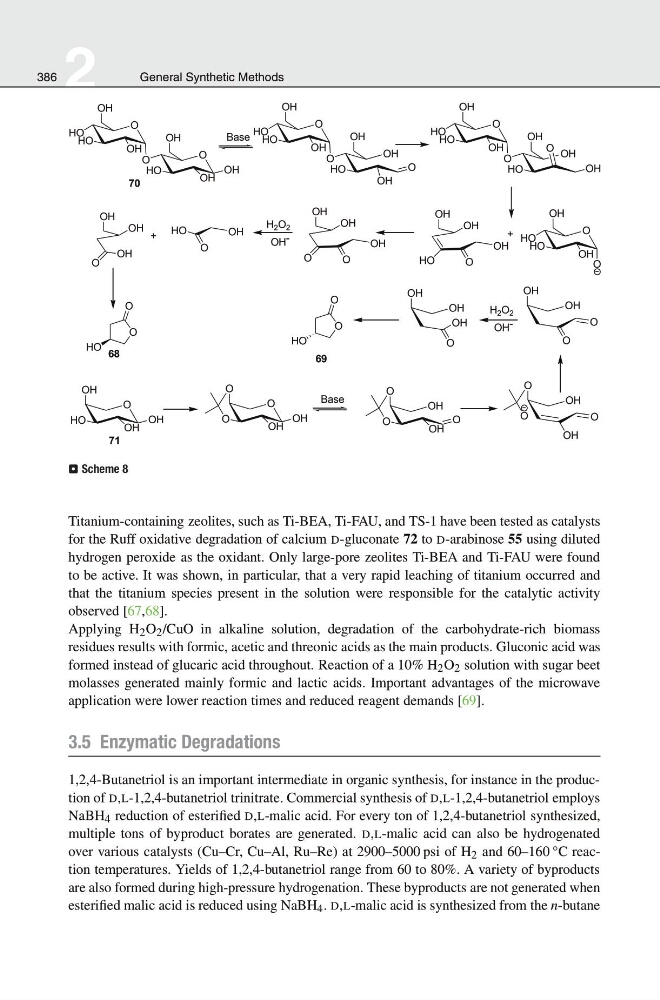
⊡ Scheme 8
Titanium-containing zeolites, such as Ti-BEA, Ti-FAU, and TS-1 have been tested as catalysts
for the Ruff oxidative degradation of calcium D-gluconate 72 to D-arabinose 55 using diluted
hydrogen peroxide as the oxidant. Only large-pore zeolites Ti-BEA and Ti-FAU were found
to be active. It was shown, in particular, that a very rapid leaching of titanium occurred and
that the titanium species present in the solution were responsible for the catalytic activity
observed [67,68].
Applying H 2 O 2 /CuO in alkaline solution, degradation of the carbohydrate-rich biomass
residues results with formic, acetic and threonic acids as the main products. Gluconic acid was
formed instead of glucaric acid throughout. Reaction of a 10% H 2 O 2 solution with sugar beet
molasses generated mainly formic and lactic acids. Important advantages of the microwave
application were lower reaction times and reduced reagent demands [69].
3.5 Enzymatic Degradations
1,2,4-Butanetriol is an important intermediate in organic synthesis, for instance in the production of D,L-1,2,4-butanetriol trinitrate. Commercial synthesis of D,L-1,2,4-butanetriol employs
NaBH 4 reduction of esterified D,L-malic acid. For every ton of 1,2,4-butanetriol synthesized,
multiple tons of byproduct borates are generated. D,L-malic acid can also be hydrogenated
over various catalysts (Cu–Cr, Cu–Al, Ru–Re) at 2900–5000 psi of H 2 and 60–160 °C reaction temperatures. Yields of 1,2,4-butanetriol range from 60 to 80%. A variety of byproducts
are also formed during high-pressure hydrogenation. These byproducts are not generated when
esterified malic acid is reduced using NaBH 4 . D,L-malic acid is synthesized from the n-butane
2
General Synthetic Methods
⊡ Scheme 8
Titanium-containing zeolites, such as Ti-BEA, Ti-FAU, and TS-1 have been tested as catalysts
for the Ruff oxidative degradation of calcium D-gluconate 72 to D-arabinose 55 using diluted
hydrogen peroxide as the oxidant. Only large-pore zeolites Ti-BEA and Ti-FAU were found
to be active. It was shown, in particular, that a very rapid leaching of titanium occurred and
that the titanium species present in the solution were responsible for the catalytic activity
observed [67,68].
Applying H 2 O 2 /CuO in alkaline solution, degradation of the carbohydrate-rich biomass
residues results with formic, acetic and threonic acids as the main products. Gluconic acid was
formed instead of glucaric acid throughout. Reaction of a 10% H 2 O 2 solution with sugar beet
molasses generated mainly formic and lactic acids. Important advantages of the microwave
application were lower reaction times and reduced reagent demands [69].
3.5 Enzymatic Degradations
1,2,4-Butanetriol is an important intermediate in organic synthesis, for instance in the production of D,L-1,2,4-butanetriol trinitrate. Commercial synthesis of D,L-1,2,4-butanetriol employs
NaBH 4 reduction of esterified D,L-malic acid. For every ton of 1,2,4-butanetriol synthesized,
multiple tons of byproduct borates are generated. D,L-malic acid can also be hydrogenated
over various catalysts (Cu–Cr, Cu–Al, Ru–Re) at 2900–5000 psi of H 2 and 60–160 °C reaction temperatures. Yields of 1,2,4-butanetriol range from 60 to 80%. A variety of byproducts
are also formed during high-pressure hydrogenation. These byproducts are not generated when
esterified malic acid is reduced using NaBH 4 . D,L-malic acid is synthesized from the n-butane