

Degradations and Rearrangement Reactions
2.7
385
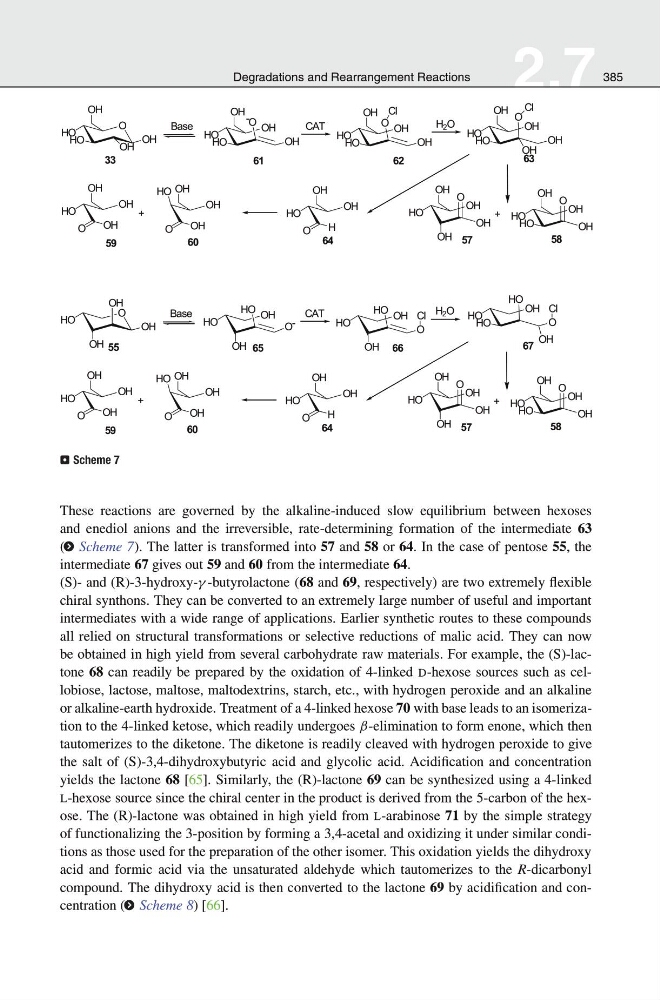
⊡ Scheme 7
These reactions are governed by the alkaline-induced slow equilibrium between hexoses
and enediol anions and the irreversible, rate-determining formation of the intermediate 63
( > Scheme 7). The latter is transformed into 57 and 58 or 64. In the case of pentose 55, the
intermediate 67 gives out 59 and 60 from the intermediate 64.
(S)- and (R)-3-hydroxy-γ -butyrolactone (68 and 69, respectively) are two extremely flexible
chiral synthons. They can be converted to an extremely large number of useful and important
intermediates with a wide range of applications. Earlier synthetic routes to these compounds
all relied on structural transformations or selective reductions of malic acid. They can now
be obtained in high yield from several carbohydrate raw materials. For example, the (S)-lactone 68 can readily be prepared by the oxidation of 4-linked D-hexose sources such as cellobiose, lactose, maltose, maltodextrins, starch, etc., with hydrogen peroxide and an alkaline
or alkaline-earth hydroxide. Treatment of a 4-linked hexose 70 with base leads to an isomerization to the 4-linked ketose, which readily undergoes β-elimination to form enone, which then
tautomerizes to the diketone. The diketone is readily cleaved with hydrogen peroxide to give
the salt of (S)-3,4-dihydroxybutyric acid and glycolic acid. Acidification and concentration
yields the lactone 68 [65]. Similarly, the (R)-lactone 69 can be synthesized using a 4-linked
L-hexose source since the chiral center in the product is derived from the 5-carbon of the hexose. The (R)-lactone was obtained in high yield from L-arabinose 71 by the simple strategy
of functionalizing the 3-position by forming a 3,4-acetal and oxidizing it under similar conditions as those used for the preparation of the other isomer. This oxidation yields the dihydroxy
acid and formic acid via the unsaturated aldehyde which tautomerizes to the R-dicarbonyl
compound. The dihydroxy acid is then converted to the lactone 69 by acidification and concentration ( > Scheme 8) [66].
2.7
385
⊡ Scheme 7
These reactions are governed by the alkaline-induced slow equilibrium between hexoses
and enediol anions and the irreversible, rate-determining formation of the intermediate 63
( > Scheme 7). The latter is transformed into 57 and 58 or 64. In the case of pentose 55, the
intermediate 67 gives out 59 and 60 from the intermediate 64.
(S)- and (R)-3-hydroxy-γ -butyrolactone (68 and 69, respectively) are two extremely flexible
chiral synthons. They can be converted to an extremely large number of useful and important
intermediates with a wide range of applications. Earlier synthetic routes to these compounds
all relied on structural transformations or selective reductions of malic acid. They can now
be obtained in high yield from several carbohydrate raw materials. For example, the (S)-lactone 68 can readily be prepared by the oxidation of 4-linked D-hexose sources such as cellobiose, lactose, maltose, maltodextrins, starch, etc., with hydrogen peroxide and an alkaline
or alkaline-earth hydroxide. Treatment of a 4-linked hexose 70 with base leads to an isomerization to the 4-linked ketose, which readily undergoes β-elimination to form enone, which then
tautomerizes to the diketone. The diketone is readily cleaved with hydrogen peroxide to give
the salt of (S)-3,4-dihydroxybutyric acid and glycolic acid. Acidification and concentration
yields the lactone 68 [65]. Similarly, the (R)-lactone 69 can be synthesized using a 4-linked
L-hexose source since the chiral center in the product is derived from the 5-carbon of the hexose. The (R)-lactone was obtained in high yield from L-arabinose 71 by the simple strategy
of functionalizing the 3-position by forming a 3,4-acetal and oxidizing it under similar conditions as those used for the preparation of the other isomer. This oxidation yields the dihydroxy
acid and formic acid via the unsaturated aldehyde which tautomerizes to the R-dicarbonyl
compound. The dihydroxy acid is then converted to the lactone 69 by acidification and concentration ( > Scheme 8) [66].