

384
2
General Synthetic Methods
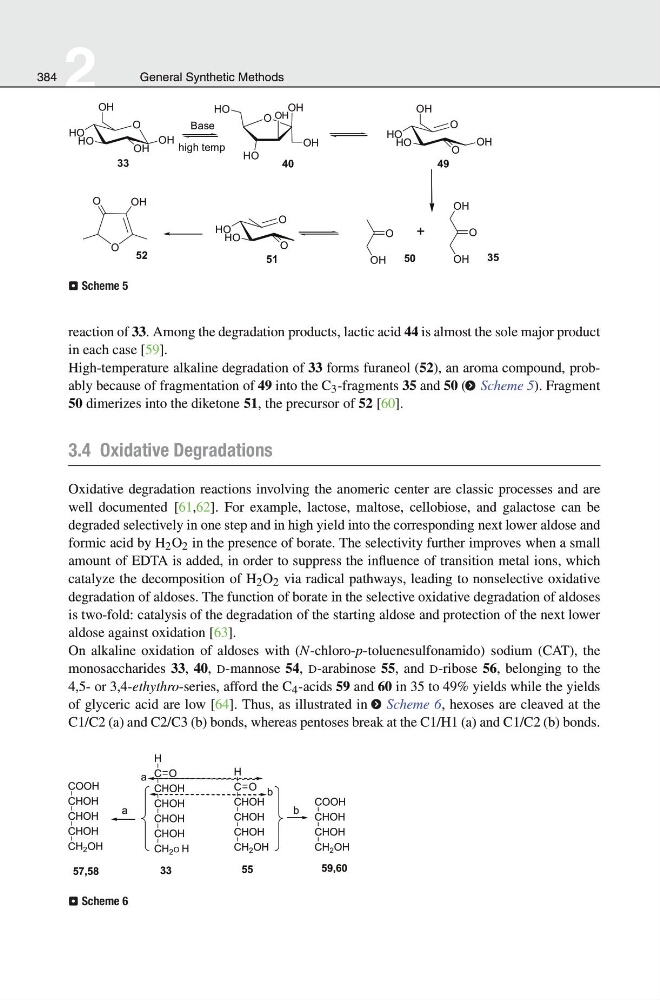
⊡ Scheme 5
reaction of 33. Among the degradation products, lactic acid 44 is almost the sole major product
in each case [59].
High-temperature alkaline degradation of 33 forms furaneol (52), an aroma compound, probably because of fragmentation of 49 into the C 3 -fragments 35 and 50 ( > Scheme 5). Fragment
50 dimerizes into the diketone 51, the precursor of 52 [60].
3.4 Oxidative Degradations
Oxidative degradation reactions involving the anomeric center are classic processes and are
well documented [61,62]. For example, lactose, maltose, cellobiose, and galactose can be
degraded selectively in one step and in high yield into the corresponding next lower aldose and
formic acid by H 2 O 2 in the presence of borate. The selectivity further improves when a small
amount of EDTA is added, in order to suppress the influence of transition metal ions, which
catalyze the decomposition of H 2 O 2 via radical pathways, leading to nonselective oxidative
degradation of aldoses. The function of borate in the selective oxidative degradation of aldoses
is two-fold: catalysis of the degradation of the starting aldose and protection of the next lower
aldose against oxidation [63].
On alkaline oxidation of aldoses with (N-chloro-p-toluenesulfonamido) sodium (CAT), the
monosaccharides 33, 40, D-mannose 54, D-arabinose 55, and D-ribose 56, belonging to the
4,5- or 3,4-ethythro-series, afford the C 4 -acids 59 and 60 in 35 to 49% yields while the yields
of glyceric acid are low [64]. Thus, as illustrated in > Scheme 6, hexoses are cleaved at the
C1/C2 (a) and C2/C3 (b) bonds, whereas pentoses break at the C1/H1 (a) and C1/C2 (b) bonds.
⊡ Scheme 6
2
General Synthetic Methods
⊡ Scheme 5
reaction of 33. Among the degradation products, lactic acid 44 is almost the sole major product
in each case [59].
High-temperature alkaline degradation of 33 forms furaneol (52), an aroma compound, probably because of fragmentation of 49 into the C 3 -fragments 35 and 50 ( > Scheme 5). Fragment
50 dimerizes into the diketone 51, the precursor of 52 [60].
3.4 Oxidative Degradations
Oxidative degradation reactions involving the anomeric center are classic processes and are
well documented [61,62]. For example, lactose, maltose, cellobiose, and galactose can be
degraded selectively in one step and in high yield into the corresponding next lower aldose and
formic acid by H 2 O 2 in the presence of borate. The selectivity further improves when a small
amount of EDTA is added, in order to suppress the influence of transition metal ions, which
catalyze the decomposition of H 2 O 2 via radical pathways, leading to nonselective oxidative
degradation of aldoses. The function of borate in the selective oxidative degradation of aldoses
is two-fold: catalysis of the degradation of the starting aldose and protection of the next lower
aldose against oxidation [63].
On alkaline oxidation of aldoses with (N-chloro-p-toluenesulfonamido) sodium (CAT), the
monosaccharides 33, 40, D-mannose 54, D-arabinose 55, and D-ribose 56, belonging to the
4,5- or 3,4-ethythro-series, afford the C 4 -acids 59 and 60 in 35 to 49% yields while the yields
of glyceric acid are low [64]. Thus, as illustrated in > Scheme 6, hexoses are cleaved at the
C1/C2 (a) and C2/C3 (b) bonds, whereas pentoses break at the C1/H1 (a) and C1/C2 (b) bonds.
⊡ Scheme 6