

Degradations and Rearrangement Reactions
2.7
383
3.2 Acidic Degradations
Alkyl glycosides are environmentally benign biosurfactants due to their biodegradability and
low toxicity [53]. Usually they are produced through Fisher glycosylation using hydrophobic
alcohols in acidic media. A practical problem is the control of the degradation reactions of
starting free sugars in the acidic Fischer reaction. The situation is more serious in the case of
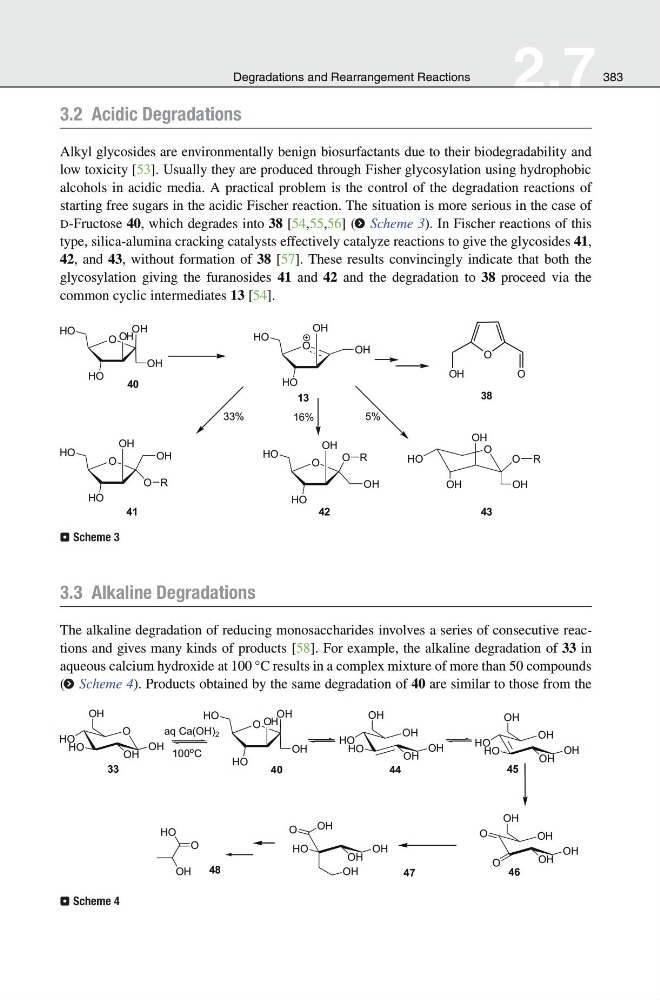
D-Fructose 40, which degrades into 38 [54,55,56] ( > Scheme 3). In Fischer reactions of this
type, silica-alumina cracking catalysts effectively catalyze reactions to give the glycosides 41,
42, and 43, without formation of 38 [57]. These results convincingly indicate that both the
glycosylation giving the furanosides 41 and 42 and the degradation to 38 proceed via the
common cyclic intermediates 13 [54].
⊡ Scheme 3
3.3 Alkaline Degradations
The alkaline degradation of reducing monosaccharides involves a series of consecutive reactions and gives many kinds of products [58]. For example, the alkaline degradation of 33 in
aqueous calcium hydroxide at 100 °C results in a complex mixture of more than 50 compounds
( > Scheme 4). Products obtained by the same degradation of 40 are similar to those from the
⊡ Scheme 4
2.7
383
3.2 Acidic Degradations
Alkyl glycosides are environmentally benign biosurfactants due to their biodegradability and
low toxicity [53]. Usually they are produced through Fisher glycosylation using hydrophobic
alcohols in acidic media. A practical problem is the control of the degradation reactions of
starting free sugars in the acidic Fischer reaction. The situation is more serious in the case of
D-Fructose 40, which degrades into 38 [54,55,56] ( > Scheme 3). In Fischer reactions of this
type, silica-alumina cracking catalysts effectively catalyze reactions to give the glycosides 41,
42, and 43, without formation of 38 [57]. These results convincingly indicate that both the
glycosylation giving the furanosides 41 and 42 and the degradation to 38 proceed via the
common cyclic intermediates 13 [54].
⊡ Scheme 3
3.3 Alkaline Degradations
The alkaline degradation of reducing monosaccharides involves a series of consecutive reactions and gives many kinds of products [58]. For example, the alkaline degradation of 33 in
aqueous calcium hydroxide at 100 °C results in a complex mixture of more than 50 compounds
( > Scheme 4). Products obtained by the same degradation of 40 are similar to those from the
⊡ Scheme 4