

Degradations and Rearrangement Reactions
2.7
389
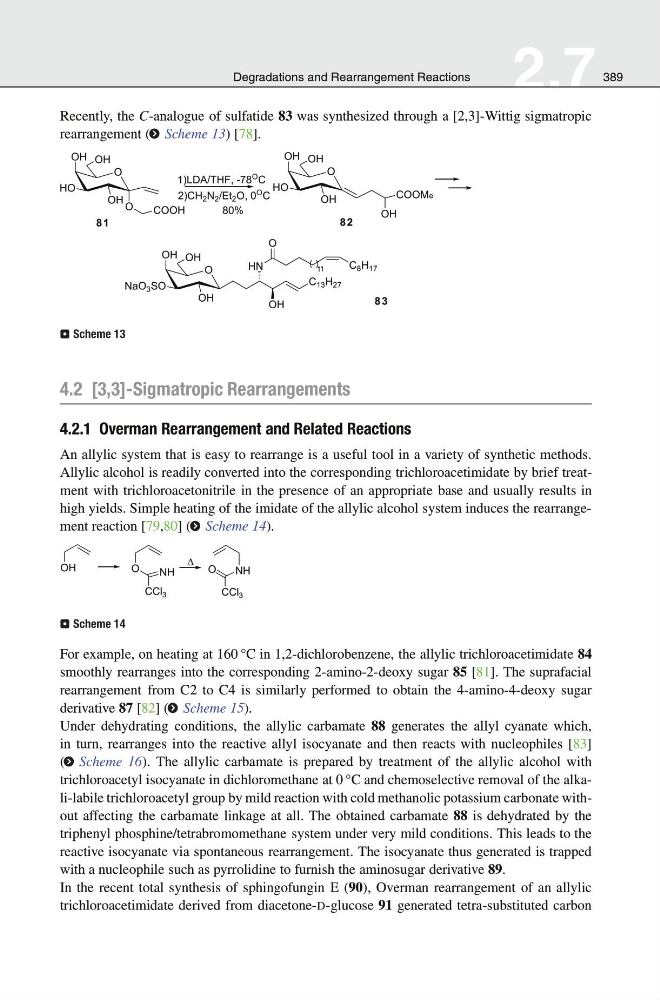
Recently, the C-analogue of sulfatide 83 was synthesized through a [2,3]-Wittig sigmatropic
rearrangement ( > Scheme 13) [78].
⊡ Scheme 13
4.2 [3,3]-Sigmatropic Rearrangements
4.2.1 Overman Rearrangement and Related Reactions
An allylic system that is easy to rearrange is a useful tool in a variety of synthetic methods.
Allylic alcohol is readily converted into the corresponding trichloroacetimidate by brief treatment with trichloroacetonitrile in the presence of an appropriate base and usually results in
high yields. Simple heating of the imidate of the allylic alcohol system induces the rearrangement reaction [79,80] ( > Scheme 14).
⊡ Scheme 14
For example, on heating at 160 °C in 1,2-dichlorobenzene, the allylic trichloroacetimidate 84
smoothly rearranges into the corresponding 2-amino-2-deoxy sugar 85 [81]. The suprafacial
rearrangement from C2 to C4 is similarly performed to obtain the 4-amino-4-deoxy sugar
derivative 87 [82] ( > Scheme 15).
Under dehydrating conditions, the allylic carbamate 88 generates the allyl cyanate which,
in turn, rearranges into the reactive allyl isocyanate and then reacts with nucleophiles [83]
( > Scheme 16). The allylic carbamate is prepared by treatment of the allylic alcohol with
trichloroacetyl isocyanate in dichloromethane at 0 °C and chemoselective removal of the alkali-labile trichloroacetyl group by mild reaction with cold methanolic potassium carbonate without affecting the carbamate linkage at all. The obtained carbamate 88 is dehydrated by the
triphenyl phosphine/tetrabromomethane system under very mild conditions. This leads to the
reactive isocyanate via spontaneous rearrangement. The isocyanate thus generated is trapped
with a nucleophile such as pyrrolidine to furnish the aminosugar derivative 89.
In the recent total synthesis of sphingofungin E (90), Overman rearrangement of an allylic
trichloroacetimidate derived from diacetone-D-glucose 91 generated tetra-substituted carbon
2.7
389
Recently, the C-analogue of sulfatide 83 was synthesized through a [2,3]-Wittig sigmatropic
rearrangement ( > Scheme 13) [78].
⊡ Scheme 13
4.2 [3,3]-Sigmatropic Rearrangements
4.2.1 Overman Rearrangement and Related Reactions
An allylic system that is easy to rearrange is a useful tool in a variety of synthetic methods.
Allylic alcohol is readily converted into the corresponding trichloroacetimidate by brief treatment with trichloroacetonitrile in the presence of an appropriate base and usually results in
high yields. Simple heating of the imidate of the allylic alcohol system induces the rearrangement reaction [79,80] ( > Scheme 14).
⊡ Scheme 14
For example, on heating at 160 °C in 1,2-dichlorobenzene, the allylic trichloroacetimidate 84
smoothly rearranges into the corresponding 2-amino-2-deoxy sugar 85 [81]. The suprafacial
rearrangement from C2 to C4 is similarly performed to obtain the 4-amino-4-deoxy sugar
derivative 87 [82] ( > Scheme 15).
Under dehydrating conditions, the allylic carbamate 88 generates the allyl cyanate which,
in turn, rearranges into the reactive allyl isocyanate and then reacts with nucleophiles [83]
( > Scheme 16). The allylic carbamate is prepared by treatment of the allylic alcohol with
trichloroacetyl isocyanate in dichloromethane at 0 °C and chemoselective removal of the alkali-labile trichloroacetyl group by mild reaction with cold methanolic potassium carbonate without affecting the carbamate linkage at all. The obtained carbamate 88 is dehydrated by the
triphenyl phosphine/tetrabromomethane system under very mild conditions. This leads to the
reactive isocyanate via spontaneous rearrangement. The isocyanate thus generated is trapped
with a nucleophile such as pyrrolidine to furnish the aminosugar derivative 89.
In the recent total synthesis of sphingofungin E (90), Overman rearrangement of an allylic
trichloroacetimidate derived from diacetone-D-glucose 91 generated tetra-substituted carbon