

380
2
General Synthetic Methods
significant proton donation to the leaving group for the influenza virus enzyme, whereas the
S. typhimurium enzyme works through a single chemical transition state derived from the
ground state 2 C 5 conformation with little proton donation to the leaving group [13]. The leaving group 18 O isotope effects are higher at pH 6.67 and 60 °C than at pH 2.69 and 50 °C in the
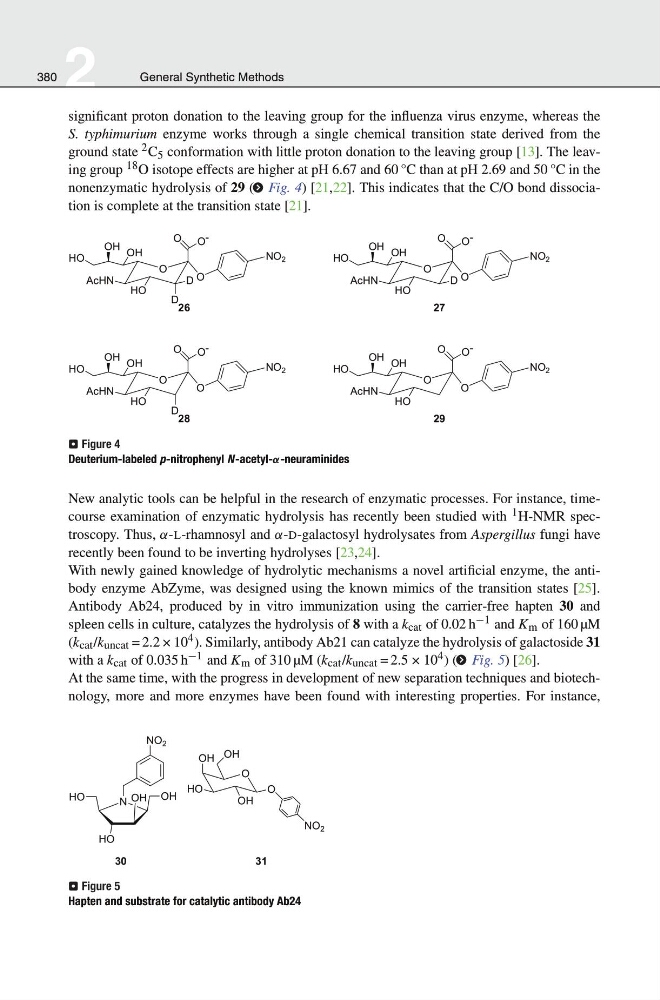
nonenzymatic hydrolysis of 29 ( > Fig. 4) [21,22]. This indicates that the C/O bond dissociation is complete at the transition state [21].
⊡ Figure 4
Deuterium-labeled p-nitrophenyl N -acetyl-α-neuraminides
New analytic tools can be helpful in the research of enzymatic processes. For instance, timecourse examination of enzymatic hydrolysis has recently been studied with 1 H-NMR spectroscopy. Thus, α-L-rhamnosyl and α-D-galactosyl hydrolysates from Aspergillus fungi have
recently been found to be inverting hydrolyses [23,24].
With newly gained knowledge of hydrolytic mechanisms a novel artificial enzyme, the antibody enzyme AbZyme, was designed using the known mimics of the transition states [25].
Antibody Ab24, produced by in vitro immunization using the carrier-free hapten 30 and
spleen cells in culture, catalyzes the hydrolysis of 8 with a k cat of 0.02 h −1 and K m of 160 µM
(k cat /k uncat = 2.2 × 10 4 ). Similarly, antibody Ab21 can catalyze the hydrolysis of galactoside 31
with a k cat of 0.035 h −1 and K m of 310 µM (k cat /k uncat = 2.5 × 10 4 ) ( > Fig. 5) [26].
At the same time, with the progress in development of new separation techniques and biotechnology, more and more enzymes have been found with interesting properties. For instance,
⊡ Figure 5
Hapten and substrate for catalytic antibody Ab24
2
General Synthetic Methods
significant proton donation to the leaving group for the influenza virus enzyme, whereas the
S. typhimurium enzyme works through a single chemical transition state derived from the
ground state 2 C 5 conformation with little proton donation to the leaving group [13]. The leaving group 18 O isotope effects are higher at pH 6.67 and 60 °C than at pH 2.69 and 50 °C in the
nonenzymatic hydrolysis of 29 ( > Fig. 4) [21,22]. This indicates that the C/O bond dissociation is complete at the transition state [21].
⊡ Figure 4
Deuterium-labeled p-nitrophenyl N -acetyl-α-neuraminides
New analytic tools can be helpful in the research of enzymatic processes. For instance, timecourse examination of enzymatic hydrolysis has recently been studied with 1 H-NMR spectroscopy. Thus, α-L-rhamnosyl and α-D-galactosyl hydrolysates from Aspergillus fungi have
recently been found to be inverting hydrolyses [23,24].
With newly gained knowledge of hydrolytic mechanisms a novel artificial enzyme, the antibody enzyme AbZyme, was designed using the known mimics of the transition states [25].
Antibody Ab24, produced by in vitro immunization using the carrier-free hapten 30 and
spleen cells in culture, catalyzes the hydrolysis of 8 with a k cat of 0.02 h −1 and K m of 160 µM
(k cat /k uncat = 2.2 × 10 4 ). Similarly, antibody Ab21 can catalyze the hydrolysis of galactoside 31
with a k cat of 0.035 h −1 and K m of 310 µM (k cat /k uncat = 2.5 × 10 4 ) ( > Fig. 5) [26].
At the same time, with the progress in development of new separation techniques and biotechnology, more and more enzymes have been found with interesting properties. For instance,
⊡ Figure 5
Hapten and substrate for catalytic antibody Ab24