

Degradations and Rearrangement Reactions
2.7
379
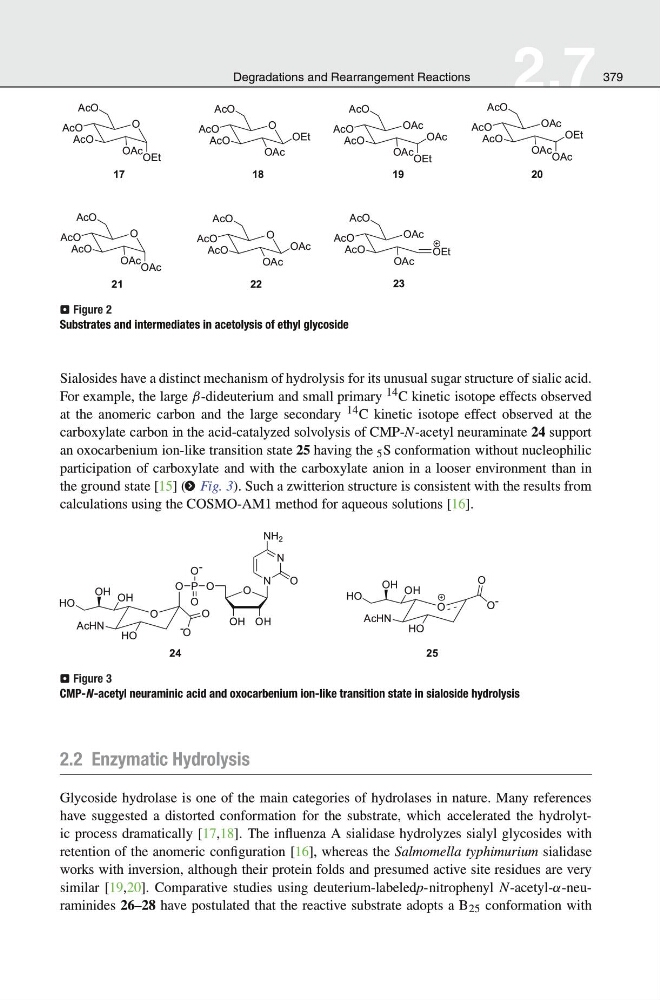
⊡ Figure 2
Substrates and intermediates in acetolysis of ethyl glycoside
Sialosides have a distinct mechanism of hydrolysis for its unusual sugar structure of sialic acid.
For example, the large β-dideuterium and small primary 14 C kinetic isotope effects observed
at the anomeric carbon and the large secondary 14 C kinetic isotope effect observed at the
carboxylate carbon in the acid-catalyzed solvolysis of CMP-N-acetyl neuraminate 24 support
an oxocarbenium ion-like transition state 25 having the 5 S conformation without nucleophilic
participation of carboxylate and with the carboxylate anion in a looser environment than in
the ground state [15] ( > Fig. 3). Such a zwitterion structure is consistent with the results from
calculations using the COSMO-AM1 method for aqueous solutions [16].
⊡ Figure 3
CMP-N -acetyl neuraminic acid and oxocarbenium ion-like transition state in sialoside hydrolysis
2.2 Enzymatic Hydrolysis
Glycoside hydrolase is one of the main categories of hydrolases in nature. Many references
have suggested a distorted conformation for the substrate, which accelerated the hydrolytic process dramatically [17,18]. The influenza A sialidase hydrolyzes sialyl glycosides with
retention of the anomeric configuration [16], whereas the Salmomella typhimurium sialidase
works with inversion, although their protein folds and presumed active site residues are very
similar [19,20]. Comparative studies using deuterium-labeledp-nitrophenyl N-acetyl-α-neuraminides 26–28 have postulated that the reactive substrate adopts a B 25 conformation with
2.7
379
⊡ Figure 2
Substrates and intermediates in acetolysis of ethyl glycoside
Sialosides have a distinct mechanism of hydrolysis for its unusual sugar structure of sialic acid.
For example, the large β-dideuterium and small primary 14 C kinetic isotope effects observed
at the anomeric carbon and the large secondary 14 C kinetic isotope effect observed at the
carboxylate carbon in the acid-catalyzed solvolysis of CMP-N-acetyl neuraminate 24 support
an oxocarbenium ion-like transition state 25 having the 5 S conformation without nucleophilic
participation of carboxylate and with the carboxylate anion in a looser environment than in
the ground state [15] ( > Fig. 3). Such a zwitterion structure is consistent with the results from
calculations using the COSMO-AM1 method for aqueous solutions [16].
⊡ Figure 3
CMP-N -acetyl neuraminic acid and oxocarbenium ion-like transition state in sialoside hydrolysis
2.2 Enzymatic Hydrolysis
Glycoside hydrolase is one of the main categories of hydrolases in nature. Many references
have suggested a distorted conformation for the substrate, which accelerated the hydrolytic process dramatically [17,18]. The influenza A sialidase hydrolyzes sialyl glycosides with
retention of the anomeric configuration [16], whereas the Salmomella typhimurium sialidase
works with inversion, although their protein folds and presumed active site residues are very
similar [19,20]. Comparative studies using deuterium-labeledp-nitrophenyl N-acetyl-α-neuraminides 26–28 have postulated that the reactive substrate adopts a B 25 conformation with