

Degradations and Rearrangement Reactions
2.7
381
the α-1,4 glucan lyase (EC 4.2.2.-) from Gracilariopsis lemeneiformis is a new class of
starch/glycogen degrading enzyme that digests the substrate from the nonreducing end
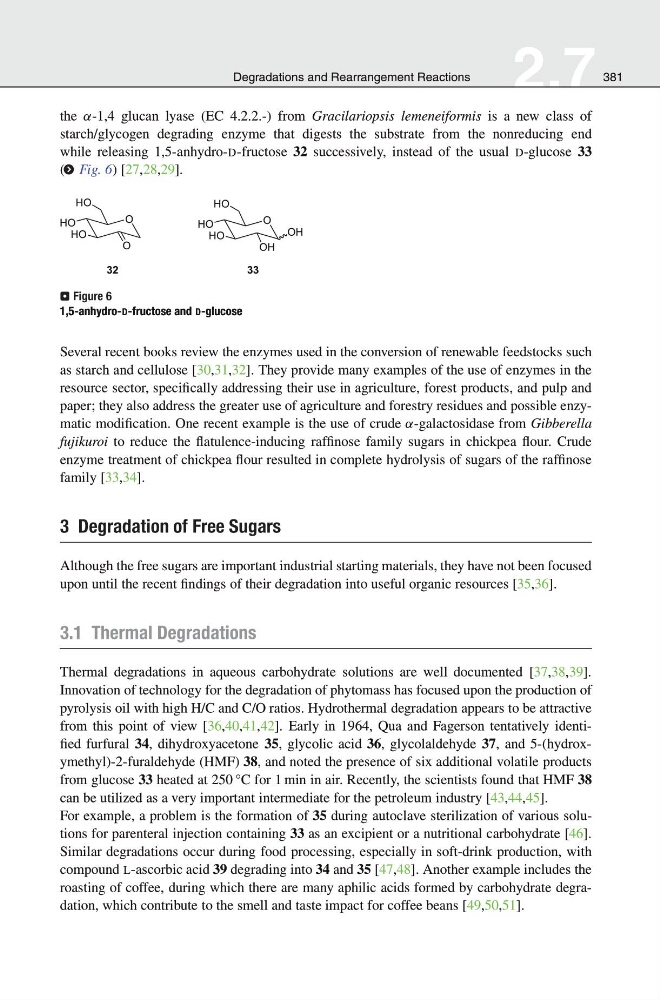
while releasing 1,5-anhydro-D-fructose 32 successively, instead of the usual D-glucose 33
( > Fig. 6) [27,28,29].
⊡ Figure 6
1,5-anhydro-D-fructose and D-glucose
Several recent books review the enzymes used in the conversion of renewable feedstocks such
as starch and cellulose [30,31,32]. They provide many examples of the use of enzymes in the
resource sector, specifically addressing their use in agriculture, forest products, and pulp and
paper; they also address the greater use of agriculture and forestry residues and possible enzymatic modification. One recent example is the use of crude α-galactosidase from Gibberella
fujikuroi to reduce the flatulence-inducing raffinose family sugars in chickpea flour. Crude
enzyme treatment of chickpea flour resulted in complete hydrolysis of sugars of the raffinose
family [33,34].
3 Degradation of Free Sugars
Although the free sugars are important industrial starting materials, they have not been focused
upon until the recent findings of their degradation into useful organic resources [35,36].
3.1 Thermal Degradations
Thermal degradations in aqueous carbohydrate solutions are well documented [37,38,39].
Innovation of technology for the degradation of phytomass has focused upon the production of
pyrolysis oil with high H/C and C/O ratios. Hydrothermal degradation appears to be attractive
from this point of view [36,40,41,42]. Early in 1964, Qua and Fagerson tentatively identified furfural 34, dihydroxyacetone 35, glycolic acid 36, glycolaldehyde 37, and 5-(hydroxymethyl)-2-furaldehyde (HMF) 38, and noted the presence of six additional volatile products
from glucose 33 heated at 250 °C for 1 min in air. Recently, the scientists found that HMF 38
can be utilized as a very important intermediate for the petroleum industry [43,44,45].
For example, a problem is the formation of 35 during autoclave sterilization of various solutions for parenteral injection containing 33 as an excipient or a nutritional carbohydrate [46].
Similar degradations occur during food processing, especially in soft-drink production, with
compound L-ascorbic acid 39 degrading into 34 and 35 [47,48]. Another example includes the
roasting of coffee, during which there are many aphilic acids formed by carbohydrate degradation, which contribute to the smell and taste impact for coffee beans [49,50,51].
2.7
381
the α-1,4 glucan lyase (EC 4.2.2.-) from Gracilariopsis lemeneiformis is a new class of
starch/glycogen degrading enzyme that digests the substrate from the nonreducing end
while releasing 1,5-anhydro-D-fructose 32 successively, instead of the usual D-glucose 33
( > Fig. 6) [27,28,29].
⊡ Figure 6
1,5-anhydro-D-fructose and D-glucose
Several recent books review the enzymes used in the conversion of renewable feedstocks such
as starch and cellulose [30,31,32]. They provide many examples of the use of enzymes in the
resource sector, specifically addressing their use in agriculture, forest products, and pulp and
paper; they also address the greater use of agriculture and forestry residues and possible enzymatic modification. One recent example is the use of crude α-galactosidase from Gibberella
fujikuroi to reduce the flatulence-inducing raffinose family sugars in chickpea flour. Crude
enzyme treatment of chickpea flour resulted in complete hydrolysis of sugars of the raffinose
family [33,34].
3 Degradation of Free Sugars
Although the free sugars are important industrial starting materials, they have not been focused
upon until the recent findings of their degradation into useful organic resources [35,36].
3.1 Thermal Degradations
Thermal degradations in aqueous carbohydrate solutions are well documented [37,38,39].
Innovation of technology for the degradation of phytomass has focused upon the production of
pyrolysis oil with high H/C and C/O ratios. Hydrothermal degradation appears to be attractive
from this point of view [36,40,41,42]. Early in 1964, Qua and Fagerson tentatively identified furfural 34, dihydroxyacetone 35, glycolic acid 36, glycolaldehyde 37, and 5-(hydroxymethyl)-2-furaldehyde (HMF) 38, and noted the presence of six additional volatile products
from glucose 33 heated at 250 °C for 1 min in air. Recently, the scientists found that HMF 38
can be utilized as a very important intermediate for the petroleum industry [43,44,45].
For example, a problem is the formation of 35 during autoclave sterilization of various solutions for parenteral injection containing 33 as an excipient or a nutritional carbohydrate [46].
Similar degradations occur during food processing, especially in soft-drink production, with
compound L-ascorbic acid 39 degrading into 34 and 35 [47,48]. Another example includes the
roasting of coffee, during which there are many aphilic acids formed by carbohydrate degradation, which contribute to the smell and taste impact for coffee beans [49,50,51].