

C=C Bond Formation
2.6
371
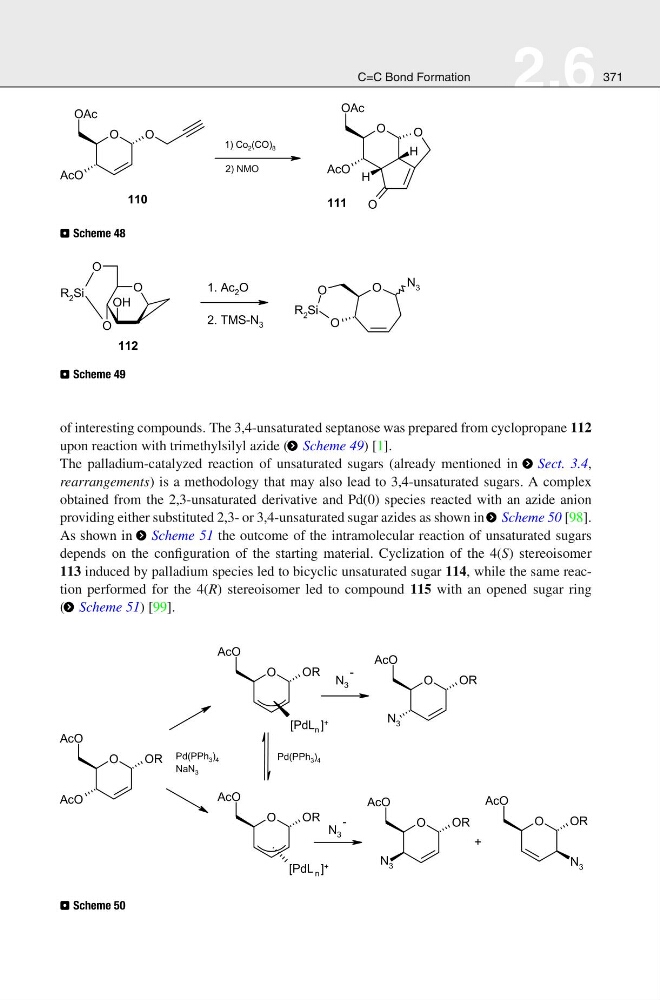
⊡ Scheme 48
⊡ Scheme 49
of interesting compounds. The 3,4-unsaturated septanose was prepared from cyclopropane 112
upon reaction with trimethylsilyl azide ( > Scheme 49) [1].
The palladium-catalyzed reaction of unsaturated sugars (already mentioned in > Sect. 3.4,
rearrangements) is a methodology that may also lead to 3,4-unsaturated sugars. A complex
obtained from the 2,3-unsaturated derivative and Pd(0) species reacted with an azide anion
providing either substituted 2,3- or 3,4-unsaturated sugar azides as shown in > Scheme 50 [98].
As shown in > Scheme 51 the outcome of the intramolecular reaction of unsaturated sugars
depends on the configuration of the starting material. Cyclization of the 4(S) stereoisomer
113 induced by palladium species led to bicyclic unsaturated sugar 114, while the same reaction performed for the 4(R) stereoisomer led to compound 115 with an opened sugar ring
( > Scheme 51) [99].
⊡ Scheme 50
2.6
371
⊡ Scheme 48
⊡ Scheme 49
of interesting compounds. The 3,4-unsaturated septanose was prepared from cyclopropane 112
upon reaction with trimethylsilyl azide ( > Scheme 49) [1].
The palladium-catalyzed reaction of unsaturated sugars (already mentioned in > Sect. 3.4,
rearrangements) is a methodology that may also lead to 3,4-unsaturated sugars. A complex
obtained from the 2,3-unsaturated derivative and Pd(0) species reacted with an azide anion
providing either substituted 2,3- or 3,4-unsaturated sugar azides as shown in > Scheme 50 [98].
As shown in > Scheme 51 the outcome of the intramolecular reaction of unsaturated sugars
depends on the configuration of the starting material. Cyclization of the 4(S) stereoisomer
113 induced by palladium species led to bicyclic unsaturated sugar 114, while the same reaction performed for the 4(R) stereoisomer led to compound 115 with an opened sugar ring
( > Scheme 51) [99].
⊡ Scheme 50