

372
2
General Synthetic Methods
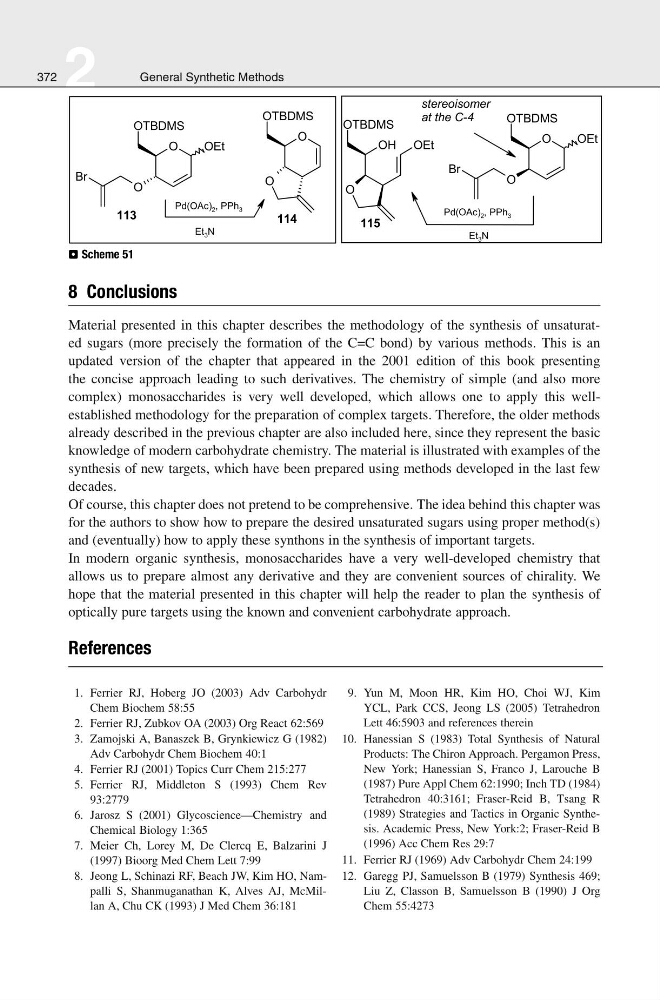
⊡ Scheme 51
8 Conclusions
Material presented in this chapter describes the methodology of the synthesis of unsaturated sugars (more precisely the formation of the C=C bond) by various methods. This is an
updated version of the chapter that appeared in the 2001 edition of this book presenting
the concise approach leading to such derivatives. The chemistry of simple (and also more
complex) monosaccharides is very well developed, which allows one to apply this wellestablished methodology for the preparation of complex targets. Therefore, the older methods
already described in the previous chapter are also included here, since they represent the basic
knowledge of modern carbohydrate chemistry. The material is illustrated with examples of the
synthesis of new targets, which have been prepared using methods developed in the last few
decades.
Of course, this chapter does not pretend to be comprehensive. The idea behind this chapter was
for the authors to show how to prepare the desired unsaturated sugars using proper method(s)
and (eventually) how to apply these synthons in the synthesis of important targets.
In modern organic synthesis, monosaccharides have a very well-developed chemistry that
allows us to prepare almost any derivative and they are convenient sources of chirality. We
hope that the material presented in this chapter will help the reader to plan the synthesis of
optically pure targets using the known and convenient carbohydrate approach.
References
1. Ferrier RJ, Hoberg JO (2003) Adv Carbohydr
Chem Biochem 58:55
2. Ferrier RJ, Zubkov OA (2003) Org React 62:569
3. Zamojski A, Banaszek B, Grynkiewicz G (1982)
Adv Carbohydr Chem Biochem 40:1
4. Ferrier RJ (2001) Topics Curr Chem 215:277
5. Ferrier RJ, Middleton S (1993) Chem Rev
93:2779
6. Jarosz S (2001) Glycoscience—Chemistry and
Chemical Biology 1:365
7. Meier Ch, Lorey M, De Clercq E, Balzarini J
(1997) Bioorg Med Chem Lett 7:99
8. Jeong L, Schinazi RF, Beach JW, Kim HO, Nampalli S, Shanmuganathan K, Alves AJ, McMillan A, Chu CK (1993) J Med Chem 36:181
9. Yun M, Moon HR, Kim HO, Choi WJ, Kim
YCL, Park CCS, Jeong LS (2005) Tetrahedron
Lett 46:5903 and references therein
10. Hanessian S (1983) Total Synthesis of Natural
Products: The Chiron Approach. Pergamon Press,
New York; Hanessian S, Franco J, Larouche B
(1987) Pure Appl Chem 62:1990; Inch TD (1984)
Tetrahedron 40:3161; Fraser-Reid B, Tsang R
(1989) Strategies and Tactics in Organic Synthesis. Academic Press, New York:2; Fraser-Reid B
(1996) Acc Chem Res 29:7
11. Ferrier RJ (1969) Adv Carbohydr Chem 24:199
12. Garegg PJ, Samuelsson B (1979) Synthesis 469;
Liu Z, Classon B, Samuelsson B (1990) J Org
Chem 55:4273
2
General Synthetic Methods
⊡ Scheme 51
8 Conclusions
Material presented in this chapter describes the methodology of the synthesis of unsaturated sugars (more precisely the formation of the C=C bond) by various methods. This is an
updated version of the chapter that appeared in the 2001 edition of this book presenting
the concise approach leading to such derivatives. The chemistry of simple (and also more
complex) monosaccharides is very well developed, which allows one to apply this wellestablished methodology for the preparation of complex targets. Therefore, the older methods
already described in the previous chapter are also included here, since they represent the basic
knowledge of modern carbohydrate chemistry. The material is illustrated with examples of the
synthesis of new targets, which have been prepared using methods developed in the last few
decades.
Of course, this chapter does not pretend to be comprehensive. The idea behind this chapter was
for the authors to show how to prepare the desired unsaturated sugars using proper method(s)
and (eventually) how to apply these synthons in the synthesis of important targets.
In modern organic synthesis, monosaccharides have a very well-developed chemistry that
allows us to prepare almost any derivative and they are convenient sources of chirality. We
hope that the material presented in this chapter will help the reader to plan the synthesis of
optically pure targets using the known and convenient carbohydrate approach.
References
1. Ferrier RJ, Hoberg JO (2003) Adv Carbohydr
Chem Biochem 58:55
2. Ferrier RJ, Zubkov OA (2003) Org React 62:569
3. Zamojski A, Banaszek B, Grynkiewicz G (1982)
Adv Carbohydr Chem Biochem 40:1
4. Ferrier RJ (2001) Topics Curr Chem 215:277
5. Ferrier RJ, Middleton S (1993) Chem Rev
93:2779
6. Jarosz S (2001) Glycoscience—Chemistry and
Chemical Biology 1:365
7. Meier Ch, Lorey M, De Clercq E, Balzarini J
(1997) Bioorg Med Chem Lett 7:99
8. Jeong L, Schinazi RF, Beach JW, Kim HO, Nampalli S, Shanmuganathan K, Alves AJ, McMillan A, Chu CK (1993) J Med Chem 36:181
9. Yun M, Moon HR, Kim HO, Choi WJ, Kim
YCL, Park CCS, Jeong LS (2005) Tetrahedron
Lett 46:5903 and references therein
10. Hanessian S (1983) Total Synthesis of Natural
Products: The Chiron Approach. Pergamon Press,
New York; Hanessian S, Franco J, Larouche B
(1987) Pure Appl Chem 62:1990; Inch TD (1984)
Tetrahedron 40:3161; Fraser-Reid B, Tsang R
(1989) Strategies and Tactics in Organic Synthesis. Academic Press, New York:2; Fraser-Reid B
(1996) Acc Chem Res 29:7
11. Ferrier RJ (1969) Adv Carbohydr Chem 24:199
12. Garegg PJ, Samuelsson B (1979) Synthesis 469;
Liu Z, Classon B, Samuelsson B (1990) J Org
Chem 55:4273