

370
2
General Synthetic Methods
7 Miscellaneous
α,β-Unsaturated γ -lactones occur widely in nature as simple metabolites of a broad class
of natural products. Many of these compounds exhibit interesting biological activity such
as, for example, antifungal, antibacterial, cytotoxic properties, etc. Because of their biological importance a number of methods for preparation of such compounds were described
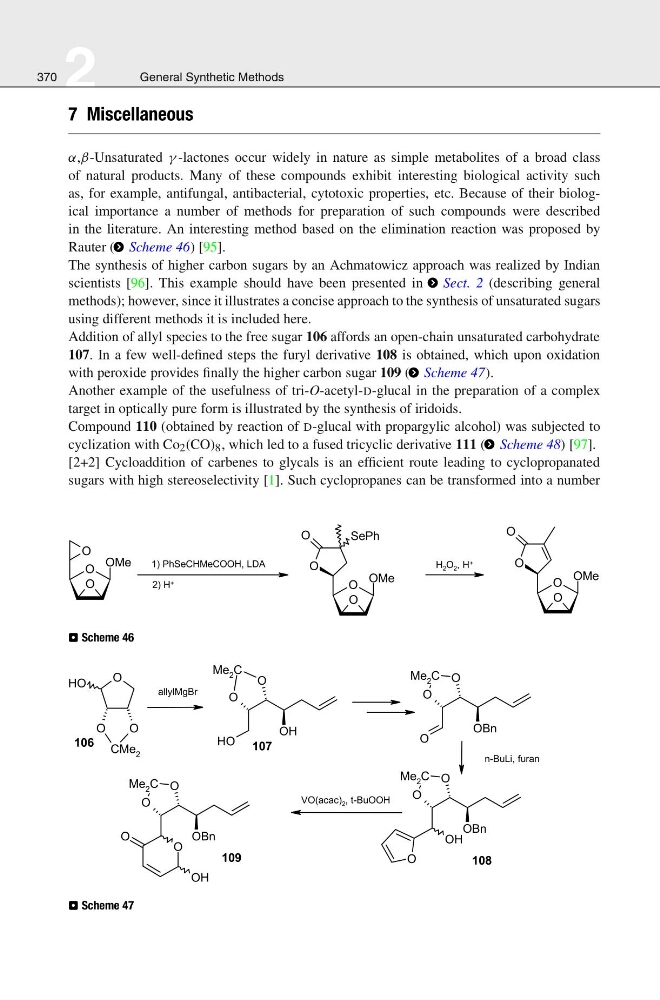
in the literature. An interesting method based on the elimination reaction was proposed by
Rauter ( > Scheme 46) [95].
The synthesis of higher carbon sugars by an Achmatowicz approach was realized by Indian
scientists [96]. This example should have been presented in > Sect. 2 (describing general
methods); however, since it illustrates a concise approach to the synthesis of unsaturated sugars
using different methods it is included here.
Addition of allyl species to the free sugar 106 affords an open-chain unsaturated carbohydrate
107. In a few well-defined steps the furyl derivative 108 is obtained, which upon oxidation
with peroxide provides finally the higher carbon sugar 109 ( > Scheme 47).
Another example of the usefulness of tri-O-acetyl-D-glucal in the preparation of a complex
target in optically pure form is illustrated by the synthesis of iridoids.
Compound 110 (obtained by reaction of D-glucal with propargylic alcohol) was subjected to
cyclization with Co 2 (CO) 8 , which led to a fused tricyclic derivative 111 ( > Scheme 48) [97].
[2+2] Cycloaddition of carbenes to glycals is an efficient route leading to cyclopropanated
sugars with high stereoselectivity [1]. Such cyclopropanes can be transformed into a number
⊡ Scheme 46
⊡ Scheme 47
2
General Synthetic Methods
7 Miscellaneous
α,β-Unsaturated γ -lactones occur widely in nature as simple metabolites of a broad class
of natural products. Many of these compounds exhibit interesting biological activity such
as, for example, antifungal, antibacterial, cytotoxic properties, etc. Because of their biological importance a number of methods for preparation of such compounds were described
in the literature. An interesting method based on the elimination reaction was proposed by
Rauter ( > Scheme 46) [95].
The synthesis of higher carbon sugars by an Achmatowicz approach was realized by Indian
scientists [96]. This example should have been presented in > Sect. 2 (describing general
methods); however, since it illustrates a concise approach to the synthesis of unsaturated sugars
using different methods it is included here.
Addition of allyl species to the free sugar 106 affords an open-chain unsaturated carbohydrate
107. In a few well-defined steps the furyl derivative 108 is obtained, which upon oxidation
with peroxide provides finally the higher carbon sugar 109 ( > Scheme 47).
Another example of the usefulness of tri-O-acetyl-D-glucal in the preparation of a complex
target in optically pure form is illustrated by the synthesis of iridoids.
Compound 110 (obtained by reaction of D-glucal with propargylic alcohol) was subjected to
cyclization with Co 2 (CO) 8 , which led to a fused tricyclic derivative 111 ( > Scheme 48) [97].
[2+2] Cycloaddition of carbenes to glycals is an efficient route leading to cyclopropanated
sugars with high stereoselectivity [1]. Such cyclopropanes can be transformed into a number
⊡ Scheme 46
⊡ Scheme 47