

366
2
General Synthetic Methods
Moreover, only one stereoisomer was formed regardless of the geometry (E- or Z-) of the substrate, to which the S-configuration at the newly created stereogenic center was assigned [80].
It was found that such secondary allyltins decomposed thermally (the primary ones are stable
up to at least 220 °C) into the dienoaldehydes 87 with the Z-geometry across the internal double bond. Therefore, both dienes are available with high stereoselectivity ( > Scheme 37) [77].
6 Application of Unsaturated Sugars as Chirons
Azasugars [81], carbasugars [82], and C-glycosides [83] are important sugar mimics, which
may be prepared by a variety of methods. In this section the selected methods for the preparation of such derivatives (and also other important compounds) from unsaturated sugars will be
presented. Although this is not connected directly with the main subject of this chapter (which
deals with the formation of a double bond in sugars), these important targets are prepared from
unsaturated sugars, which are in turn synthesized by a number of methods described within
this chapter. This would also show the very high synthetic potential of unsaturated sugars.
An interesting methodology to highly oxygenated pyrazolidines and indolizidines from
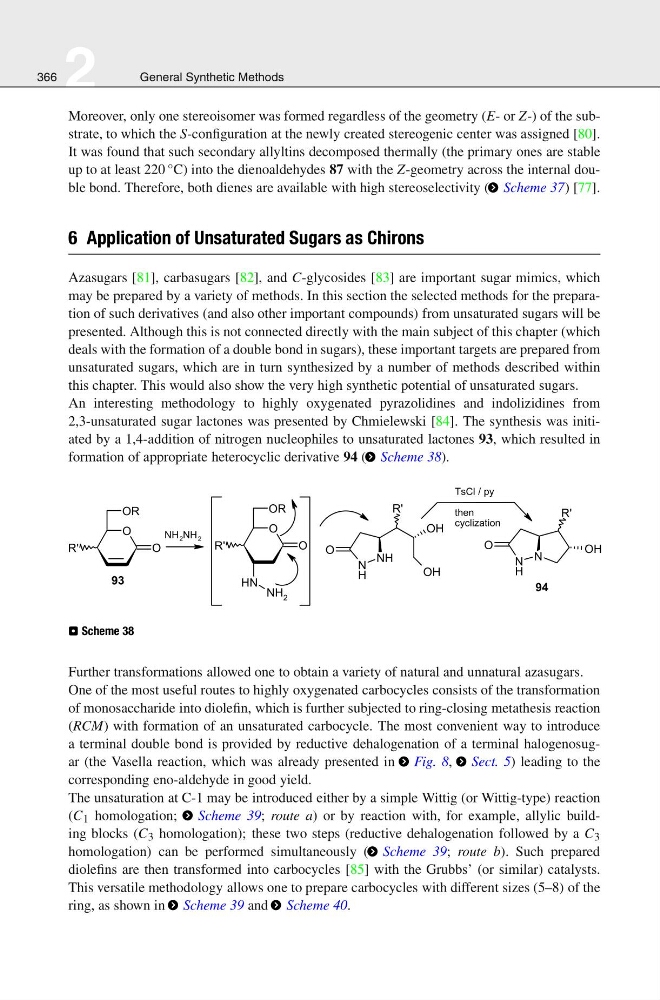
2,3-unsaturated sugar lactones was presented by Chmielewski [84]. The synthesis was initiated by a 1,4-addition of nitrogen nucleophiles to unsaturated lactones 93, which resulted in
formation of appropriate heterocyclic derivative 94 ( > Scheme 38).
⊡ Scheme 38
Further transformations allowed one to obtain a variety of natural and unnatural azasugars.
One of the most useful routes to highly oxygenated carbocycles consists of the transformation
of monosaccharide into diolefin, which is further subjected to ring-closing metathesis reaction
(RCM) with formation of an unsaturated carbocycle. The most convenient way to introduce
a terminal double bond is provided by reductive dehalogenation of a terminal halogenosugar (the Vasella reaction, which was already presented in > Fig. 8, > Sect. 5) leading to the
corresponding eno-aldehyde in good yield.
The unsaturation at C-1 may be introduced either by a simple Wittig (or Wittig-type) reaction
(C 1 homologation; > Scheme 39; route a) or by reaction with, for example, allylic building blocks (C 3 homologation); these two steps (reductive dehalogenation followed by a C 3
homologation) can be performed simultaneously ( > Scheme 39; route b). Such prepared
diolefins are then transformed into carbocycles [85] with the Grubbs’ (or similar) catalysts.
This versatile methodology allows one to prepare carbocycles with different sizes (5–8) of the
ring, as shown in > Scheme 39 and > Scheme 40.
2
General Synthetic Methods
Moreover, only one stereoisomer was formed regardless of the geometry (E- or Z-) of the substrate, to which the S-configuration at the newly created stereogenic center was assigned [80].
It was found that such secondary allyltins decomposed thermally (the primary ones are stable
up to at least 220 °C) into the dienoaldehydes 87 with the Z-geometry across the internal double bond. Therefore, both dienes are available with high stereoselectivity ( > Scheme 37) [77].
6 Application of Unsaturated Sugars as Chirons
Azasugars [81], carbasugars [82], and C-glycosides [83] are important sugar mimics, which
may be prepared by a variety of methods. In this section the selected methods for the preparation of such derivatives (and also other important compounds) from unsaturated sugars will be
presented. Although this is not connected directly with the main subject of this chapter (which
deals with the formation of a double bond in sugars), these important targets are prepared from
unsaturated sugars, which are in turn synthesized by a number of methods described within
this chapter. This would also show the very high synthetic potential of unsaturated sugars.
An interesting methodology to highly oxygenated pyrazolidines and indolizidines from
2,3-unsaturated sugar lactones was presented by Chmielewski [84]. The synthesis was initiated by a 1,4-addition of nitrogen nucleophiles to unsaturated lactones 93, which resulted in
formation of appropriate heterocyclic derivative 94 ( > Scheme 38).
⊡ Scheme 38
Further transformations allowed one to obtain a variety of natural and unnatural azasugars.
One of the most useful routes to highly oxygenated carbocycles consists of the transformation
of monosaccharide into diolefin, which is further subjected to ring-closing metathesis reaction
(RCM) with formation of an unsaturated carbocycle. The most convenient way to introduce
a terminal double bond is provided by reductive dehalogenation of a terminal halogenosugar (the Vasella reaction, which was already presented in > Fig. 8, > Sect. 5) leading to the
corresponding eno-aldehyde in good yield.
The unsaturation at C-1 may be introduced either by a simple Wittig (or Wittig-type) reaction
(C 1 homologation; > Scheme 39; route a) or by reaction with, for example, allylic building blocks (C 3 homologation); these two steps (reductive dehalogenation followed by a C 3
homologation) can be performed simultaneously ( > Scheme 39; route b). Such prepared
diolefins are then transformed into carbocycles [85] with the Grubbs’ (or similar) catalysts.
This versatile methodology allows one to prepare carbocycles with different sizes (5–8) of the
ring, as shown in > Scheme 39 and > Scheme 40.