

C=C Bond Formation
2.6
365
⊡ Scheme 36
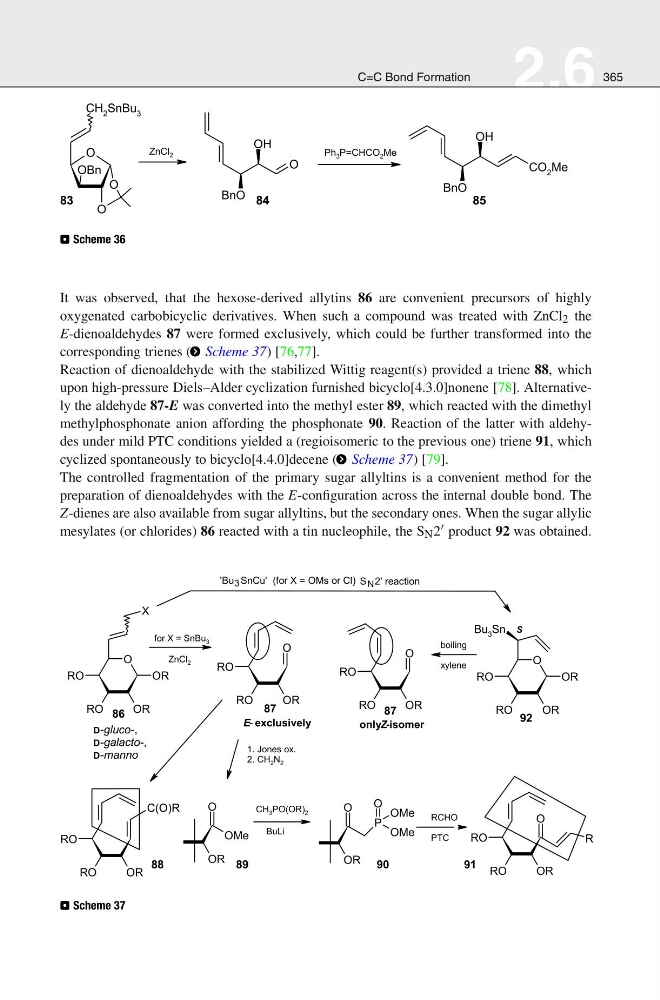
It was observed, that the hexose-derived allytins 86 are convenient precursors of highly
oxygenated carbobicyclic derivatives. When such a compound was treated with ZnCl 2 the
E-dienoaldehydes 87 were formed exclusively, which could be further transformed into the
corresponding trienes ( > Scheme 37) [76,77].
Reaction of dienoaldehyde with the stabilized Wittig reagent(s) provided a triene 88, which
upon high-pressure Diels–Alder cyclization furnished bicyclo[4.3.0]nonene [78]. Alternatively the aldehyde 87-E was converted into the methyl ester 89, which reacted with the dimethyl
methylphosphonate anion affording the phosphonate 90. Reaction of the latter with aldehydes under mild PTC conditions yielded a (regioisomeric to the previous one) triene 91, which
cyclized spontaneously to bicyclo[4.4.0]decene ( > Scheme 37) [79].
The controlled fragmentation of the primary sugar allyltins is a convenient method for the
preparation of dienoaldehydes with the E-configuration across the internal double bond. The
Z-dienes are also available from sugar allyltins, but the secondary ones. When the sugar allylic
mesylates (or chlorides) 86 reacted with a tin nucleophile, the S N 2 product 92 was obtained.
⊡ Scheme 37
2.6
365
⊡ Scheme 36
It was observed, that the hexose-derived allytins 86 are convenient precursors of highly
oxygenated carbobicyclic derivatives. When such a compound was treated with ZnCl 2 the
E-dienoaldehydes 87 were formed exclusively, which could be further transformed into the
corresponding trienes ( > Scheme 37) [76,77].
Reaction of dienoaldehyde with the stabilized Wittig reagent(s) provided a triene 88, which
upon high-pressure Diels–Alder cyclization furnished bicyclo[4.3.0]nonene [78]. Alternatively the aldehyde 87-E was converted into the methyl ester 89, which reacted with the dimethyl
methylphosphonate anion affording the phosphonate 90. Reaction of the latter with aldehydes under mild PTC conditions yielded a (regioisomeric to the previous one) triene 91, which
cyclized spontaneously to bicyclo[4.4.0]decene ( > Scheme 37) [79].
The controlled fragmentation of the primary sugar allyltins is a convenient method for the
preparation of dienoaldehydes with the E-configuration across the internal double bond. The
Z-dienes are also available from sugar allyltins, but the secondary ones. When the sugar allylic
mesylates (or chlorides) 86 reacted with a tin nucleophile, the S N 2 product 92 was obtained.
⊡ Scheme 37