

364
2
General Synthetic Methods
⊡ Scheme 34
⊡ Figure 8
Synthesis of unsaturated open chain sugars by fragmentation reactions
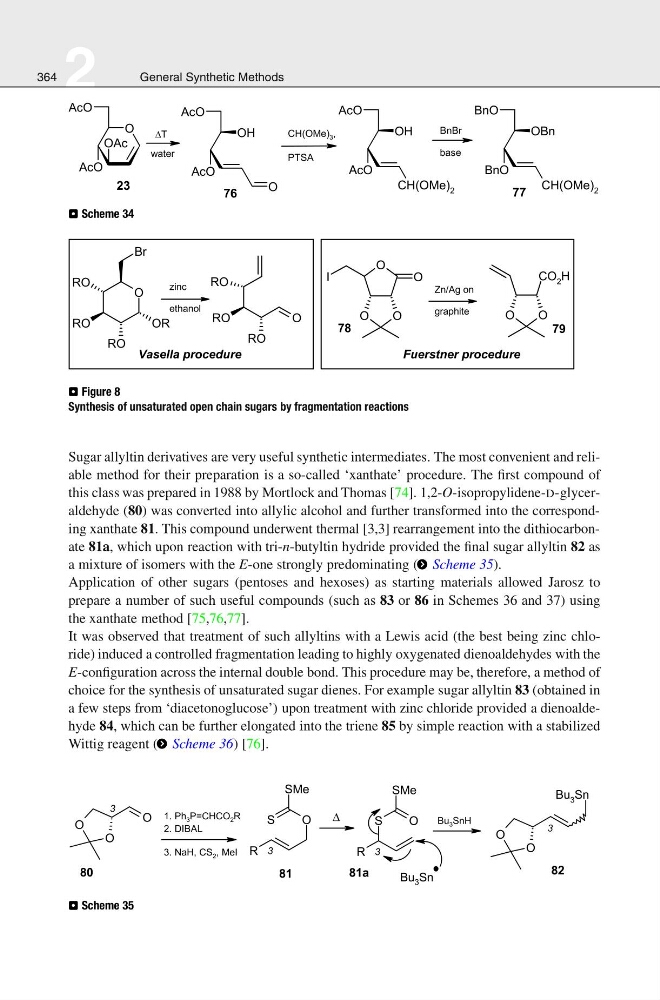
Sugar allyltin derivatives are very useful synthetic intermediates. The most convenient and reliable method for their preparation is a so-called ‘xanthate’ procedure. The first compound of
this class was prepared in 1988 by Mortlock and Thomas [74]. 1,2-O-isopropylidene-D-glyceraldehyde (80) was converted into allylic alcohol and further transformed into the corresponding xanthate 81. This compound underwent thermal [3,3] rearrangement into the dithiocarbonate 81a, which upon reaction with tri-n-butyltin hydride provided the final sugar allyltin 82 as
a mixture of isomers with the E-one strongly predominating ( > Scheme 35).
Application of other sugars (pentoses and hexoses) as starting materials allowed Jarosz to
prepare a number of such useful compounds (such as 83 or 86 in Schemes 36 and 37) using
the xanthate method [75,76,77].
It was observed that treatment of such allyltins with a Lewis acid (the best being zinc chloride) induced a controlled fragmentation leading to highly oxygenated dienoaldehydes with the
E-configuration across the internal double bond. This procedure may be, therefore, a method of
choice for the synthesis of unsaturated sugar dienes. For example sugar allyltin 83 (obtained in
a few steps from ‘diacetonoglucose’) upon treatment with zinc chloride provided a dienoaldehyde 84, which can be further elongated into the triene 85 by simple reaction with a stabilized
Wittig reagent ( > Scheme 36) [76].
⊡ Scheme 35
2
General Synthetic Methods
⊡ Scheme 34
⊡ Figure 8
Synthesis of unsaturated open chain sugars by fragmentation reactions
Sugar allyltin derivatives are very useful synthetic intermediates. The most convenient and reliable method for their preparation is a so-called ‘xanthate’ procedure. The first compound of
this class was prepared in 1988 by Mortlock and Thomas [74]. 1,2-O-isopropylidene-D-glyceraldehyde (80) was converted into allylic alcohol and further transformed into the corresponding xanthate 81. This compound underwent thermal [3,3] rearrangement into the dithiocarbonate 81a, which upon reaction with tri-n-butyltin hydride provided the final sugar allyltin 82 as
a mixture of isomers with the E-one strongly predominating ( > Scheme 35).
Application of other sugars (pentoses and hexoses) as starting materials allowed Jarosz to
prepare a number of such useful compounds (such as 83 or 86 in Schemes 36 and 37) using
the xanthate method [75,76,77].
It was observed that treatment of such allyltins with a Lewis acid (the best being zinc chloride) induced a controlled fragmentation leading to highly oxygenated dienoaldehydes with the
E-configuration across the internal double bond. This procedure may be, therefore, a method of
choice for the synthesis of unsaturated sugar dienes. For example sugar allyltin 83 (obtained in
a few steps from ‘diacetonoglucose’) upon treatment with zinc chloride provided a dienoaldehyde 84, which can be further elongated into the triene 85 by simple reaction with a stabilized
Wittig reagent ( > Scheme 36) [76].
⊡ Scheme 35