

C=C Bond Formation
2.6
359
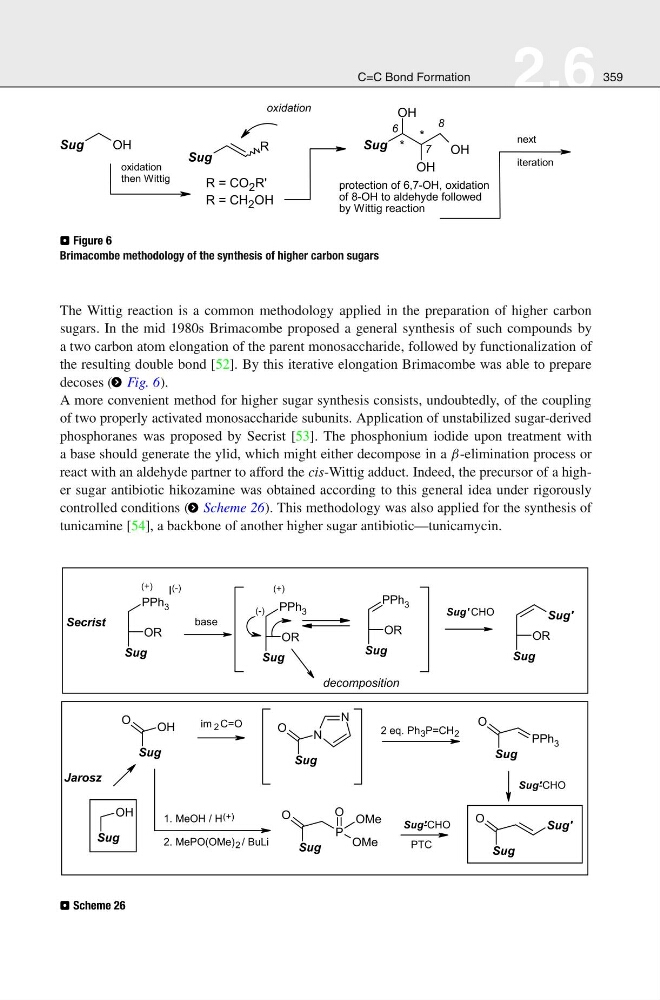
⊡ Figure 6
Brimacombe methodology of the synthesis of higher carbon sugars
The Wittig reaction is a common methodology applied in the preparation of higher carbon
sugars. In the mid 1980s Brimacombe proposed a general synthesis of such compounds by
a two carbon atom elongation of the parent monosaccharide, followed by functionalization of
the resulting double bond [52]. By this iterative elongation Brimacombe was able to prepare
decoses ( > Fig. 6).
A more convenient method for higher sugar synthesis consists, undoubtedly, of the coupling
of two properly activated monosaccharide subunits. Application of unstabilized sugar-derived
phosphoranes was proposed by Secrist [53]. The phosphonium iodide upon treatment with
a base should generate the ylid, which might either decompose in a β-elimination process or
react with an aldehyde partner to afford the cis-Wittig adduct. Indeed, the precursor of a higher sugar antibiotic hikozamine was obtained according to this general idea under rigorously
controlled conditions ( > Scheme 26). This methodology was also applied for the synthesis of
tunicamine [54], a backbone of another higher sugar antibiotic—tunicamycin.
⊡ Scheme 26
2.6
359
⊡ Figure 6
Brimacombe methodology of the synthesis of higher carbon sugars
The Wittig reaction is a common methodology applied in the preparation of higher carbon
sugars. In the mid 1980s Brimacombe proposed a general synthesis of such compounds by
a two carbon atom elongation of the parent monosaccharide, followed by functionalization of
the resulting double bond [52]. By this iterative elongation Brimacombe was able to prepare
decoses ( > Fig. 6).
A more convenient method for higher sugar synthesis consists, undoubtedly, of the coupling
of two properly activated monosaccharide subunits. Application of unstabilized sugar-derived
phosphoranes was proposed by Secrist [53]. The phosphonium iodide upon treatment with
a base should generate the ylid, which might either decompose in a β-elimination process or
react with an aldehyde partner to afford the cis-Wittig adduct. Indeed, the precursor of a higher sugar antibiotic hikozamine was obtained according to this general idea under rigorously
controlled conditions ( > Scheme 26). This methodology was also applied for the synthesis of
tunicamine [54], a backbone of another higher sugar antibiotic—tunicamycin.
⊡ Scheme 26