

360
2
General Synthetic Methods
A general methodology for the preparation of higher carbon sugars was proposed by Jarosz in
the mid 1980s [6,55,56]. Protected monosaccharide with the terminal OH free was oxidized to
an acid, which was further converted either into phosphorane or phosphonate. Upon reaction
with another sugar synthon (aldehyde), α,β-unsaturated higher sugar enones were formed in
good yields ( > Scheme 26). The second approach is more versatile, since the phosphonates
are more reactive and can be prepared in much higher yields than the corresponding phosphoranes [6,55].
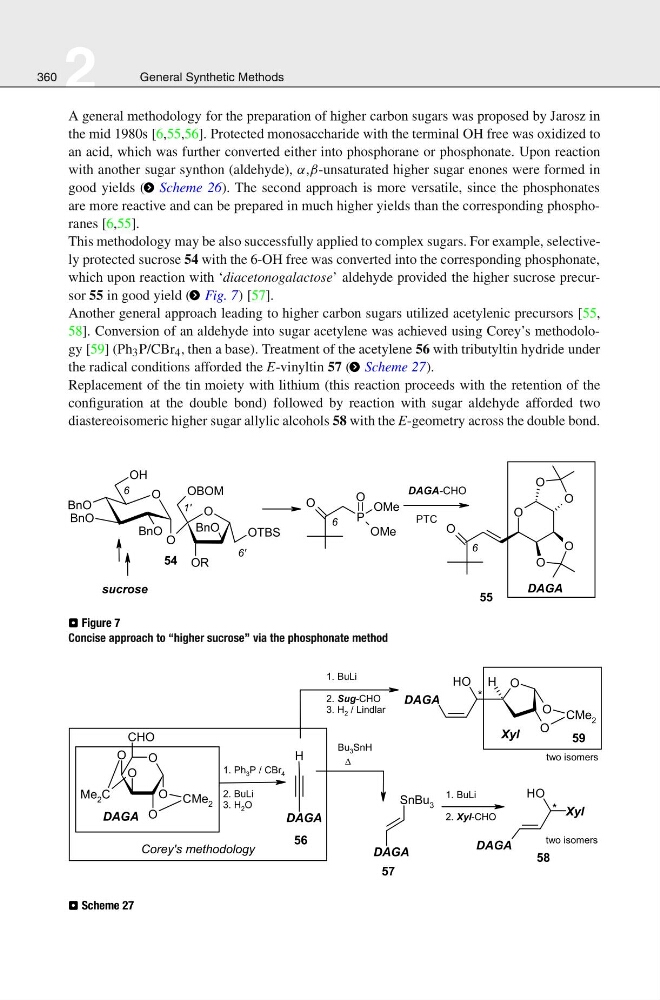
This methodology may be also successfully applied to complex sugars. For example, selectively protected sucrose 54 with the 6-OH free was converted into the corresponding phosphonate,
which upon reaction with ‘diacetonogalactose’ aldehyde provided the higher sucrose precursor 55 in good yield ( > Fig. 7) [57].
Another general approach leading to higher carbon sugars utilized acetylenic precursors [55,
58]. Conversion of an aldehyde into sugar acetylene was achieved using Corey’s methodology [59] (Ph 3 P/CBr 4 , then a base). Treatment of the acetylene 56 with tributyltin hydride under
the radical conditions afforded the E-vinyltin 57 ( > Scheme 27).
Replacement of the tin moiety with lithium (this reaction proceeds with the retention of the
configuration at the double bond) followed by reaction with sugar aldehyde afforded two
diastereoisomeric higher sugar allylic alcohols 58 with the E-geometry across the double bond.
⊡ Figure 7
Concise approach to “higher sucrose” via the phosphonate method
⊡ Scheme 27
2
General Synthetic Methods
A general methodology for the preparation of higher carbon sugars was proposed by Jarosz in
the mid 1980s [6,55,56]. Protected monosaccharide with the terminal OH free was oxidized to
an acid, which was further converted either into phosphorane or phosphonate. Upon reaction
with another sugar synthon (aldehyde), α,β-unsaturated higher sugar enones were formed in
good yields ( > Scheme 26). The second approach is more versatile, since the phosphonates
are more reactive and can be prepared in much higher yields than the corresponding phosphoranes [6,55].
This methodology may be also successfully applied to complex sugars. For example, selectively protected sucrose 54 with the 6-OH free was converted into the corresponding phosphonate,
which upon reaction with ‘diacetonogalactose’ aldehyde provided the higher sucrose precursor 55 in good yield ( > Fig. 7) [57].
Another general approach leading to higher carbon sugars utilized acetylenic precursors [55,
58]. Conversion of an aldehyde into sugar acetylene was achieved using Corey’s methodology [59] (Ph 3 P/CBr 4 , then a base). Treatment of the acetylene 56 with tributyltin hydride under
the radical conditions afforded the E-vinyltin 57 ( > Scheme 27).
Replacement of the tin moiety with lithium (this reaction proceeds with the retention of the
configuration at the double bond) followed by reaction with sugar aldehyde afforded two
diastereoisomeric higher sugar allylic alcohols 58 with the E-geometry across the double bond.
⊡ Figure 7
Concise approach to “higher sucrose” via the phosphonate method
⊡ Scheme 27