

358
2
General Synthetic Methods
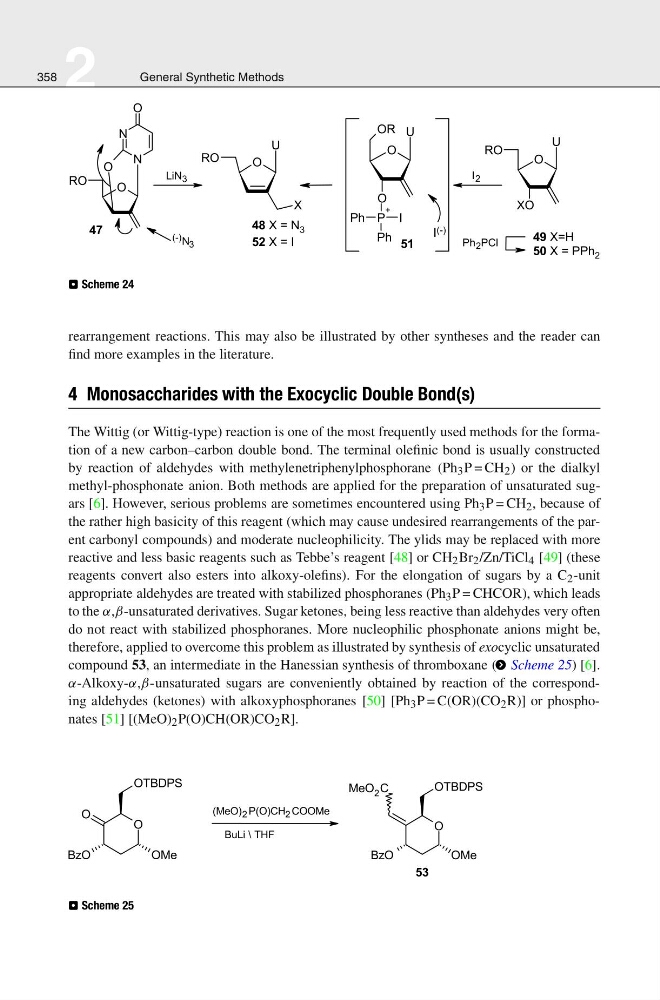
⊡ Scheme 24
rearrangement reactions. This may also be illustrated by other syntheses and the reader can
find more examples in the literature.
4 Monosaccharides with the Exocyclic Double Bond(s)
The Wittig (or Wittig-type) reaction is one of the most frequently used methods for the formation of a new carbon–carbon double bond. The terminal olefinic bond is usually constructed
by reaction of aldehydes with methylenetriphenylphosphorane (Ph 3 P = CH 2 ) or the dialkyl
methyl-phosphonate anion. Both methods are applied for the preparation of unsaturated sugars [6]. However, serious problems are sometimes encountered using Ph 3 P = CH 2 , because of
the rather high basicity of this reagent (which may cause undesired rearrangements of the parent carbonyl compounds) and moderate nucleophilicity. The ylids may be replaced with more
reactive and less basic reagents such as Tebbe’s reagent [48] or CH 2 Br 2 /Zn/TiCl 4 [49] (these
reagents convert also esters into alkoxy-olefins). For the elongation of sugars by a C 2 -unit
appropriate aldehydes are treated with stabilized phosphoranes (Ph 3 P = CHCOR), which leads
to the α,β-unsaturated derivatives. Sugar ketones, being less reactive than aldehydes very often
do not react with stabilized phosphoranes. More nucleophilic phosphonate anions might be,
therefore, applied to overcome this problem as illustrated by synthesis of exocyclic unsaturated
compound 53, an intermediate in the Hanessian synthesis of thromboxane ( > Scheme 25) [6].
α-Alkoxy-α,β-unsaturated sugars are conveniently obtained by reaction of the corresponding aldehydes (ketones) with alkoxyphosphoranes [50] [Ph 3 P = C(OR)(CO 2 R)] or phosphonates [51] [(MeO) 2 P(O)CH(OR)CO 2 R].
⊡ Scheme 25
2
General Synthetic Methods
⊡ Scheme 24
rearrangement reactions. This may also be illustrated by other syntheses and the reader can
find more examples in the literature.
4 Monosaccharides with the Exocyclic Double Bond(s)
The Wittig (or Wittig-type) reaction is one of the most frequently used methods for the formation of a new carbon–carbon double bond. The terminal olefinic bond is usually constructed
by reaction of aldehydes with methylenetriphenylphosphorane (Ph 3 P = CH 2 ) or the dialkyl
methyl-phosphonate anion. Both methods are applied for the preparation of unsaturated sugars [6]. However, serious problems are sometimes encountered using Ph 3 P = CH 2 , because of
the rather high basicity of this reagent (which may cause undesired rearrangements of the parent carbonyl compounds) and moderate nucleophilicity. The ylids may be replaced with more
reactive and less basic reagents such as Tebbe’s reagent [48] or CH 2 Br 2 /Zn/TiCl 4 [49] (these
reagents convert also esters into alkoxy-olefins). For the elongation of sugars by a C 2 -unit
appropriate aldehydes are treated with stabilized phosphoranes (Ph 3 P = CHCOR), which leads
to the α,β-unsaturated derivatives. Sugar ketones, being less reactive than aldehydes very often
do not react with stabilized phosphoranes. More nucleophilic phosphonate anions might be,
therefore, applied to overcome this problem as illustrated by synthesis of exocyclic unsaturated
compound 53, an intermediate in the Hanessian synthesis of thromboxane ( > Scheme 25) [6].
α-Alkoxy-α,β-unsaturated sugars are conveniently obtained by reaction of the corresponding aldehydes (ketones) with alkoxyphosphoranes [50] [Ph 3 P = C(OR)(CO 2 R)] or phosphonates [51] [(MeO) 2 P(O)CH(OR)CO 2 R].
⊡ Scheme 25