

C=C Bond Formation
2.6
355
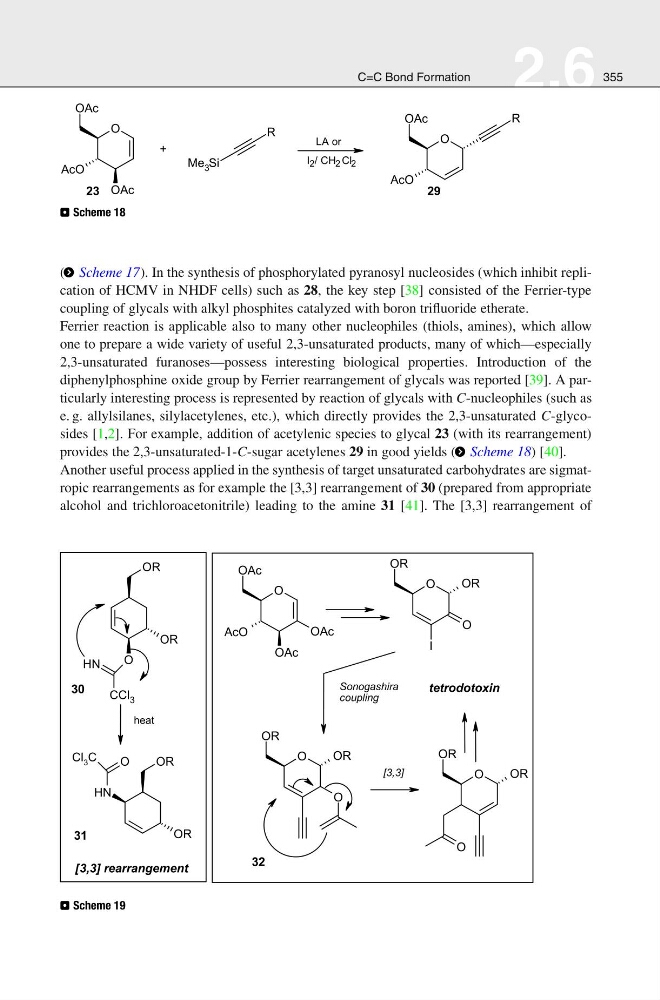
⊡ Scheme 18
( > Scheme 17). In the synthesis of phosphorylated pyranosyl nucleosides (which inhibit replication of HCMV in NHDF cells) such as 28, the key step [38] consisted of the Ferrier-type
coupling of glycals with alkyl phosphites catalyzed with boron trifluoride etherate.
Ferrier reaction is applicable also to many other nucleophiles (thiols, amines), which allow
one to prepare a wide variety of useful 2,3-unsaturated products, many of which—especially
2,3-unsaturated furanoses—possess interesting biological properties. Introduction of the
diphenylphosphine oxide group by Ferrier rearrangement of glycals was reported [39]. A particularly interesting process is represented by reaction of glycals with C-nucleophiles (such as
e. g. allylsilanes, silylacetylenes, etc.), which directly provides the 2,3-unsaturated C-glycosides [1,2]. For example, addition of acetylenic species to glycal 23 (with its rearrangement)
provides the 2,3-unsaturated-1-C-sugar acetylenes 29 in good yields ( > Scheme 18) [40].
Another useful process applied in the synthesis of target unsaturated carbohydrates are sigmatropic rearrangements as for example the [3,3] rearrangement of 30 (prepared from appropriate
alcohol and trichloroacetonitrile) leading to the amine 31 [41]. The [3,3] rearrangement of
⊡ Scheme 19
2.6
355
⊡ Scheme 18
( > Scheme 17). In the synthesis of phosphorylated pyranosyl nucleosides (which inhibit replication of HCMV in NHDF cells) such as 28, the key step [38] consisted of the Ferrier-type
coupling of glycals with alkyl phosphites catalyzed with boron trifluoride etherate.
Ferrier reaction is applicable also to many other nucleophiles (thiols, amines), which allow
one to prepare a wide variety of useful 2,3-unsaturated products, many of which—especially
2,3-unsaturated furanoses—possess interesting biological properties. Introduction of the
diphenylphosphine oxide group by Ferrier rearrangement of glycals was reported [39]. A particularly interesting process is represented by reaction of glycals with C-nucleophiles (such as
e. g. allylsilanes, silylacetylenes, etc.), which directly provides the 2,3-unsaturated C-glycosides [1,2]. For example, addition of acetylenic species to glycal 23 (with its rearrangement)
provides the 2,3-unsaturated-1-C-sugar acetylenes 29 in good yields ( > Scheme 18) [40].
Another useful process applied in the synthesis of target unsaturated carbohydrates are sigmatropic rearrangements as for example the [3,3] rearrangement of 30 (prepared from appropriate
alcohol and trichloroacetonitrile) leading to the amine 31 [41]. The [3,3] rearrangement of
⊡ Scheme 19