

354
2
General Synthetic Methods
3.4 Rearrangement Reactions of Unsaturated Sugars
Rearrangements of unsaturated sugars are not concerned with a direct formation of a C=C
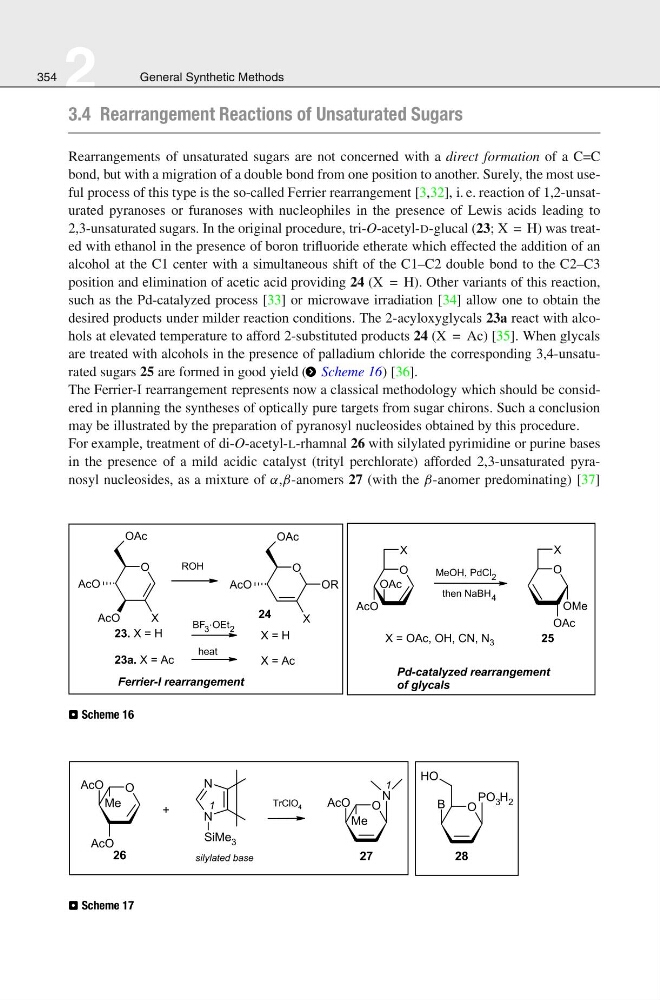
bond, but with a migration of a double bond from one position to another. Surely, the most useful process of this type is the so-called Ferrier rearrangement [3,32], i. e. reaction of 1,2-unsaturated pyranoses or furanoses with nucleophiles in the presence of Lewis acids leading to
2,3-unsaturated sugars. In the original procedure, tri-O-acetyl-D-glucal (23; X = H) was treated with ethanol in the presence of boron trifluoride etherate which effected the addition of an
alcohol at the C1 center with a simultaneous shift of the C1–C2 double bond to the C2–C3
position and elimination of acetic acid providing 24 (X = H). Other variants of this reaction,
such as the Pd-catalyzed process [33] or microwave irradiation [34] allow one to obtain the
desired products under milder reaction conditions. The 2-acyloxyglycals 23a react with alcohols at elevated temperature to afford 2-substituted products 24 (X = Ac) [35]. When glycals
are treated with alcohols in the presence of palladium chloride the corresponding 3,4-unsaturated sugars 25 are formed in good yield ( > Scheme 16) [36].
The Ferrier-I rearrangement represents now a classical methodology which should be considered in planning the syntheses of optically pure targets from sugar chirons. Such a conclusion
may be illustrated by the preparation of pyranosyl nucleosides obtained by this procedure.
For example, treatment of di-O-acetyl-L-rhamnal 26 with silylated pyrimidine or purine bases
in the presence of a mild acidic catalyst (trityl perchlorate) afforded 2,3-unsaturated pyranosyl nucleosides, as a mixture of α,β-anomers 27 (with the β-anomer predominating) [37]
⊡ Scheme 16
⊡ Scheme 17
2
General Synthetic Methods
3.4 Rearrangement Reactions of Unsaturated Sugars
Rearrangements of unsaturated sugars are not concerned with a direct formation of a C=C
bond, but with a migration of a double bond from one position to another. Surely, the most useful process of this type is the so-called Ferrier rearrangement [3,32], i. e. reaction of 1,2-unsaturated pyranoses or furanoses with nucleophiles in the presence of Lewis acids leading to
2,3-unsaturated sugars. In the original procedure, tri-O-acetyl-D-glucal (23; X = H) was treated with ethanol in the presence of boron trifluoride etherate which effected the addition of an
alcohol at the C1 center with a simultaneous shift of the C1–C2 double bond to the C2–C3
position and elimination of acetic acid providing 24 (X = H). Other variants of this reaction,
such as the Pd-catalyzed process [33] or microwave irradiation [34] allow one to obtain the
desired products under milder reaction conditions. The 2-acyloxyglycals 23a react with alcohols at elevated temperature to afford 2-substituted products 24 (X = Ac) [35]. When glycals
are treated with alcohols in the presence of palladium chloride the corresponding 3,4-unsaturated sugars 25 are formed in good yield ( > Scheme 16) [36].
The Ferrier-I rearrangement represents now a classical methodology which should be considered in planning the syntheses of optically pure targets from sugar chirons. Such a conclusion
may be illustrated by the preparation of pyranosyl nucleosides obtained by this procedure.
For example, treatment of di-O-acetyl-L-rhamnal 26 with silylated pyrimidine or purine bases
in the presence of a mild acidic catalyst (trityl perchlorate) afforded 2,3-unsaturated pyranosyl nucleosides, as a mixture of α,β-anomers 27 (with the β-anomer predominating) [37]
⊡ Scheme 16
⊡ Scheme 17